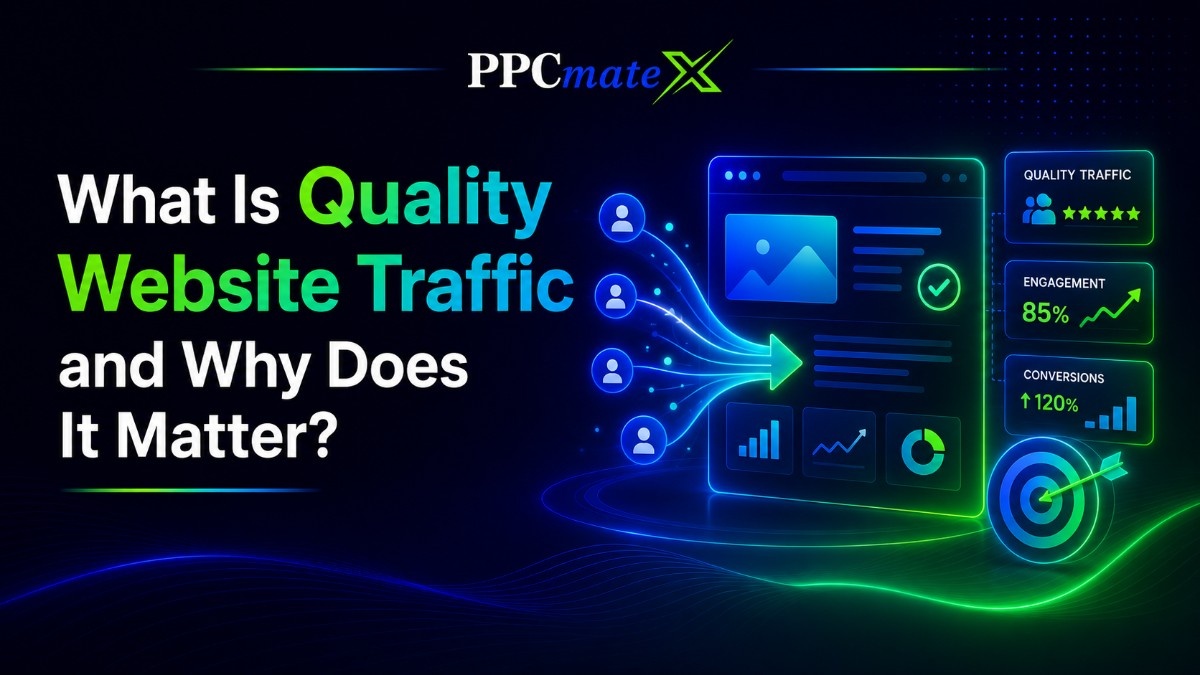
Quality web traffic means visitors who are real, relevant, and likely to take useful action on your website. It is not only about getting more clicks, sessions, or impressions.
For advertisers, quality matters because every visit uses campaign budget. The goal is to reach users who match your offer, understand your message, and have the potential to click, sign up, install, buy, or return later.
Key Takeaways
Quality traffic helps advertisers focus on visitor value instead of visitor volume. A smaller number of relevant users can often perform better than a large number of random visitors.
Key points to remember:
- Quality web traffic comes from real users, not bots or fake clicks.
- Good traffic matches the campaign goal, audience, geo, device, and offer.
- Traffic quality is measured by engagement, conversions, CPA, ROAS, and source performance.
- Programmatic advertising helps improve quality through targeting, bidding, tracking, and optimization.
- PPCmate helps advertisers buy and optimize traffic across multiple ad formats from one platform.
What Does Quality Web Traffic Mean?
Quality web traffic is traffic from users who fit your campaign goal. These users are more likely to stay on the page, click deeper, complete a form, install an app, buy a product, or return later.
Advertisers should look at quality before volume. When buying quality traffic sources, the key question is not “How many visitors did we get?” but “Did the right visitors take useful actions?”
Quality traffic usually includes:
- Real human users
- Strong audience relevance
- Healthy page engagement
- Low suspicious activity
- Good source-level performance
- Clear conversion potential
- Landing page behavior that matches campaign intent
Why Quality Web Traffic Matters
Low-quality traffic can make a campaign look active while wasting budget. It may bring clicks or page visits, but those visits do not help the advertiser reach the real goal.
Quality traffic gives advertisers cleaner data. When users are relevant, campaign reports become easier to trust, and decisions about bids, budgets, creatives, and sources become more accurate.
Quality Web Traffic vs Low-Quality Web Traffic
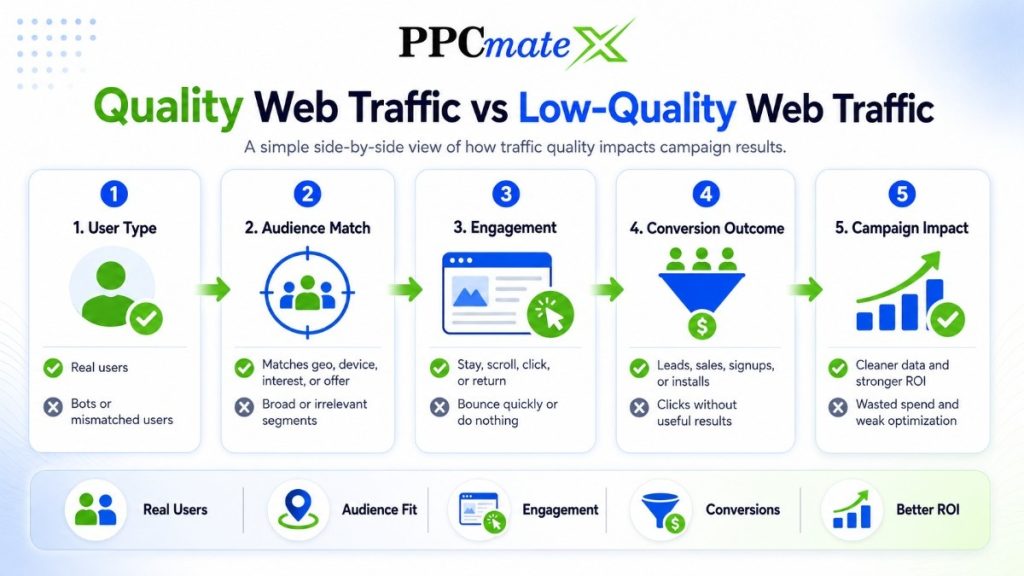
Traffic quality is easier to understand when compared side by side. Good traffic supports the campaign goal, while poor traffic creates weak signals and wasted spend.
| Factor | Quality Web Traffic | Low-Quality Web Traffic |
| User type | Real users with possible interest | Bots, fake users, or mismatched users |
| Audience fit | Matches geo, device, interest, or offer | Comes from broad or irrelevant segments |
| Engagement | Users stay, scroll, click, or return | Users leave quickly or do nothing |
| Conversion value | Leads to signups, sales, installs, or leads | Creates clicks without useful results |
| Source quality | Strong sites, apps, or supply partners | Weak sources with poor or suspicious results |
| Data value | Helps optimize the campaign | Pollutes reporting and bidding decisions |
The best traffic is not always the cheapest traffic. A higher CPC or CPM can still be better if it brings users who convert at a lower CPA.
Key Signs of Quality Web Traffic
Quality traffic leaves useful signals after the click. Advertisers should review both website behavior and campaign data before judging performance.
Strong signs include:
- Users spend enough time on the landing page.
- Bounce rate is not unusually high for the offer.
- Visitors click deeper when the funnel requires it.
- Clicks turn into leads, sales, installs, or signups.
- Certain traffic sources produce steady conversions.
- Traffic matches selected geo, device, OS, and language.
- CPA and ROAS are close to the campaign target.
- There are no strange spikes from one source, device, or time block.
A click alone does not prove quality. A better test is whether that click moves the user closer to the campaign goal.
What Metrics Should Advertisers Track?
Traffic quality should be measured with engagement, cost, and conversion data. This gives a fuller view than CTR alone.
| Metric | What It Shows | Why It Matters |
| Impressions | How often ads were shown | Helps measure reach |
| Clicks | How many users clicked | Shows early interest |
| CTR | Click rate from impressions | Helps judge creative strength |
| Bounce rate | Users who leave quickly | Shows landing page or audience fit |
| Conversion rate | Clicks that become actions | Shows traffic quality |
| CPA | Cost per action | Helps judge profitability |
| ROAS | Revenue compared to spend | Important for sales campaigns |
| Source performance | Results by source, site, or app | Helps find winners and losers |
| Device performance | Results by mobile, desktop, or tablet | Helps separate buying strategy |
| Time performance | Results by hour or day | Helps improve dayparting |
Good tracking makes traffic quality easier to improve. Without tracking, advertisers may scale clicks that never become real results.
How Programmatic Advertising Helps Improve Traffic Quality
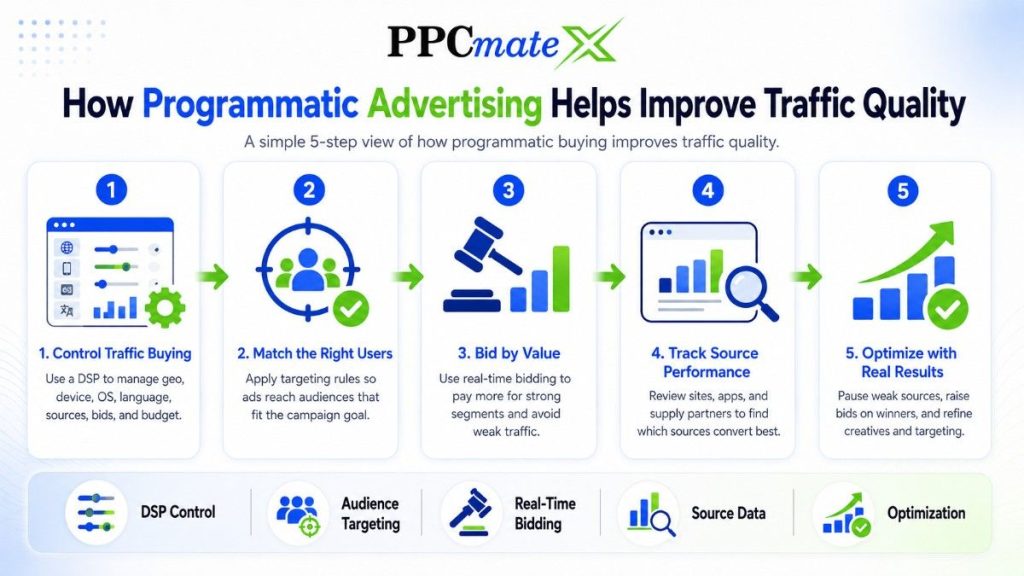
Programmatic advertising helps advertisers buy website traffic with more control. Instead of buying broad traffic blindly, advertisers can use targeting, bidding, source data, and campaign rules to improve traffic quality.
Step 1: Use a DSP to Control Traffic Buying
A DSP helps advertisers manage where ads appear, who sees them, and how much they pay for each impression or click. A strong programmatic DSP setup gives advertisers more control over traffic quality from the start.
This helps advertisers manage:
- Target geos
- Device types
- Operating systems
- Browsers
- Languages
- Sources and supply partners
- Budgets and bids
Step 2: Match Ads With the Right Users
Programmatic advertising helps connect ads with users who fit the campaign goal. This improves the chance that visitors will care about the offer after they land on the website.
With a clear DSP workflow, advertisers can set targeting rules before launch and use performance data after launch. This makes traffic buying more focused and less random.
Step 3: Use Real-Time Bidding to Control Value
Real-time bidding helps advertisers compete for ad placements based on campaign value. Instead of paying the same way for every impression, advertisers can adjust bids based on audience, source, and performance signals.
With real-time bidding, advertisers can avoid overpaying for weak segments and bid more carefully on sources that are more likely to bring quality visitors.
Step 4: Track Source-Level Performance
Not every source will perform the same way. One site, app, or supply partner may bring cheap clicks with no conversions, while another may cost more but produce better leads or sales.
Source-level data helps advertisers find patterns. If a source spends money without results, it can be paused. If a source brings stable conversions, it can be tested with higher bids or more budget.
Step 5: Optimize Based on Real Results
Programmatic campaigns improve when advertisers adjust them based on data. Strong campaign optimization controls help advertisers review performance and make better traffic decisions.
Optimization can include:
- Pausing weak sources
- Raising bids on strong sources
- Testing new creatives
- Separating mobile and desktop campaigns
- Adjusting geos or devices
- Using whitelists and blacklists
- Controlling frequency
- Improving landing pages
Traffic Quality by Ad Format
Different ad formats attract different user behavior. PPCmate advertisers can test formats based on campaign goal, funnel stage, and the type of action they want from visitors.
| PPCmate Ad Format | Traffic Quality Strength | Best For |
| Display ads | Visual reach and retargeting | Brand visibility, product offers, remarketing |
| Push notification ads | Direct response clicks | Offers, alerts, app installs, lead generation |
| Native ads | Content-style engagement | Education, discovery, advertorial funnels |
| Video ads | Stronger explanation | Product demos, app previews, awareness |
| Pop-under ads | High-volume visits | Landing page testing and broad traffic campaigns |
Display campaigns work well when advertisers need visual reach and retargeting. A strong display traffic plan can help keep a brand visible while still measuring clicks, conversions, and source quality.
Push ads can work well when the message is short and action-focused. With push traffic campaigns, advertisers should test clear titles, simple messages, and landing pages that match the ad promise.
Native ads often perform better when users need more context before they act. They are useful for offers that need education, comparison, or explanation before the conversion.
Pop-under traffic can help advertisers test landing pages at scale. It should be measured carefully because high volume does not always mean high intent.
How to Improve Web Traffic Quality
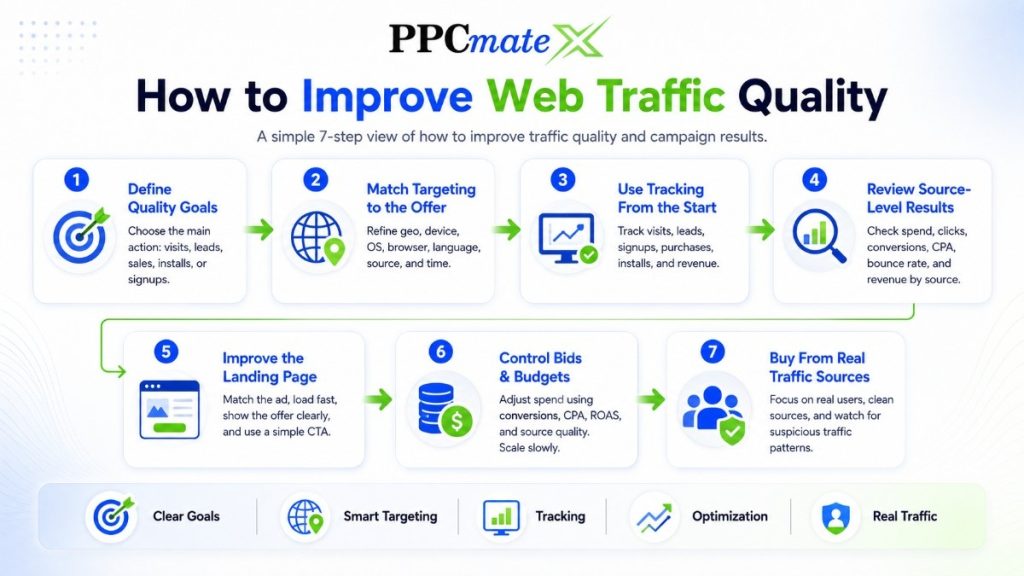
Improving web traffic quality starts with clear goals and simple controls. Advertisers should define what a good visitor looks like before they try to scale traffic.
Step 1: Define What Quality Means for the Campaign
Quality means different things for different campaigns. For an e-commerce campaign, quality may mean purchases. For a lead generation campaign, it may mean completed forms. For an app campaign, it may mean installs.
Choose one main goal first:
- Website visits
- Leads
- Sales
- App installs
- Signups
- Retargeting actions
- Offer testing
A clear goal makes it easier to judge traffic. It also helps advertisers decide which metrics matter most.
Step 2: Match Targeting to the Offer
Targeting should match the users most likely to care about the offer. Broad targeting can bring more volume, but it may also bring irrelevant visitors.
Advertisers can improve quality by adjusting:
- Country or region
- Device type
- Operating system
- Browser
- Language
- Source or site
- App source
- Connection type
- Time of day
Do not narrow too early. Let the campaign collect enough data before making major changes.
Step 3: Use Tracking From the Start
Tracking shows what happens after the click. It helps advertisers understand whether visitors are only landing on the page or actually taking useful actions.
Track actions such as:
- Page visits
- Leads
- Signups
- Purchases
- App installs
- Revenue
- Returning users
Without conversion tracking, traffic quality is mostly guesswork. With tracking, advertisers can improve based on real campaign value.
Step 4: Review Source-Level Results
Source-level reporting helps advertisers see which traffic sources are worth keeping. A source with many clicks but no conversions may hurt campaign performance.
Advertisers should review:
- Spend by source
- Clicks by source
- Conversions by source
- CPA by source
- Bounce rate by source
- Revenue by source
This helps protect budget from weak traffic and gives stronger sources more room to grow.
Step 5: Improve the Landing Page
Traffic quality also depends on the landing page. If the ad and landing page do not match, even relevant users may leave quickly.
A good landing page should:
- Match the ad message
- Load fast
- Show the offer clearly
- Use a simple call to action
- Work well on mobile
- Avoid too many choices
Good traffic can still fail on a weak landing page. Always review landing page performance before blaming the traffic source.
Step 6: Control Bids and Budgets
Bid control helps advertisers avoid overspending on weak traffic. A clear bid and budget strategy should be based on conversions, CPA, ROAS, and source quality.
Increase spend slowly when a segment performs well. Sudden scaling can change the traffic mix and reduce quality.
Step 7: Buy From Real Traffic Sources
Advertisers should focus on real users, clean sources, and measurable results. Buying real website visitors helps campaigns start with a stronger traffic foundation.
Traffic should be reviewed for suspicious patterns. Watch for sudden click spikes, very short sessions, repeated clicks without actions, or sources that spend budget with no useful results.
Common Mistakes That Hurt Traffic Quality
Many advertisers lose budget because they focus on traffic volume first. More visitors only help when those visitors support the campaign goal.
Avoid these mistakes:
- Buying traffic without clear conversion goals
- Judging quality by clicks only
- Ignoring source-level reports
- Using the same bid for every source
- Sending all traffic to one landing page
- Not separating mobile and desktop traffic
- Scaling too quickly
- Running campaigns without fraud protection
- Not using whitelists or blacklists
Small changes can improve traffic quality over time. The best campaigns are tested, measured, and adjusted in steady steps.
How PPCmate Helps Advertisers Buy Quality Web Traffic
PPCmate helps advertisers buy and optimize website traffic through a programmatic DSP with multiple ad formats, pricing models, targeting controls, and performance tools. This gives advertisers more control over where traffic comes from and how campaigns are improved.
Advertisers can use PPCmate to test display, push, native, video, and pop-under traffic while managing bids, budgets, targeting, tracking, and source-level optimization from one place.
PPCmate helps advertisers:
- Target users by geo, device, OS, language, and source
- Buy traffic through CPC and CPM models
- Test different ad formats
- Review campaign performance
- Track conversions and source quality
- Use fraud protection and brand safety controls
- Optimize based on CTR, CPA, and campaign data
- Scale stronger segments with more control
For media buyers, affiliates, agencies, and e-commerce teams, this makes traffic buying more practical. The goal is not just to get more visitors, but to get traffic that converts into useful campaign results.
Ready to Buy Real Website Visitors With More Control?
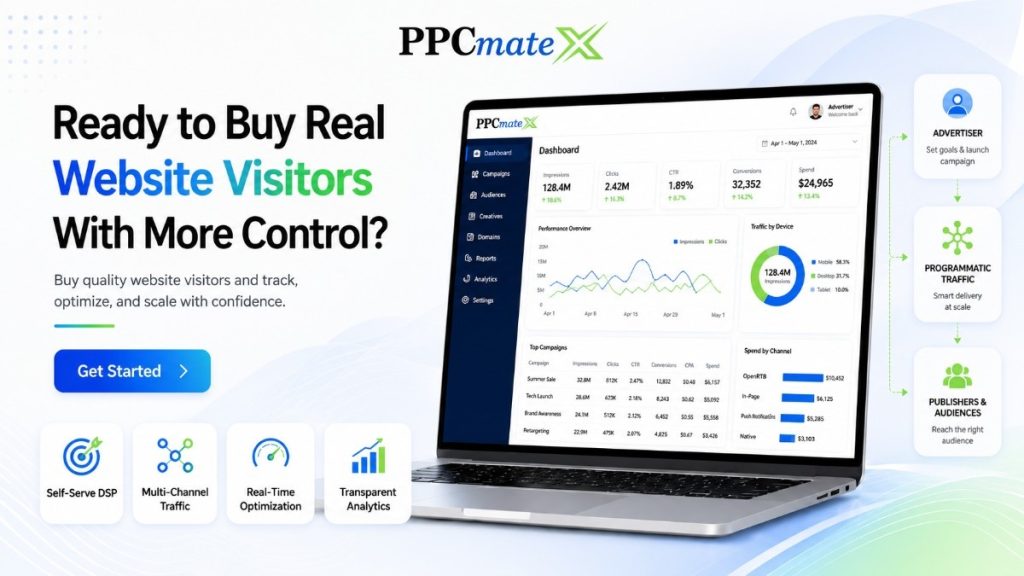
PPCmate gives advertisers a flexible platform for buying real, targeted website traffic through programmatic ads, display ads, push notifications, and other high-performing ad formats. Whether you want to drive more visitors to a landing page, promote an offer, or scale a performance campaign, PPCmate helps you launch, track, and optimize traffic campaigns from one place.
FAQs
1. What is quality web traffic?
Quality web traffic is traffic from real users who match your target audience and have the potential to engage, convert, or support your campaign goal.
2. Is more website traffic always better?
No. More traffic only helps when the visitors are relevant and useful. A smaller group of qualified visitors can perform better than a large number of random clicks.
3. How do advertisers know if traffic is high quality?
Advertisers can check engagement, bounce rate, conversion rate, CPA, ROAS, source performance, device data, and suspicious traffic patterns.
4. What causes low-quality traffic?
Low-quality traffic can come from bots, irrelevant audiences, weak sources, poor targeting, misleading creatives, or landing pages that do not match the ad.
5. Can programmatic ads improve traffic quality?
Yes. Programmatic ads can improve quality by using targeting, bidding, source controls, tracking, and optimization to reach better audience segments.
6. Which ad format brings the best traffic quality?
There is no single best format for every campaign. Display, push, native, video, and pop-under ads can all work when the format matches the goal, audience, and landing page.
7. How can PPCmate help advertisers buy quality traffic?
PPCmate gives advertisers tools for targeting, tracking, format testing, source-level optimization, fraud protection, and performance control. This helps advertisers focus on real users and measurable campaign results instead of only buying more visits.