You find a map listing with a local company name, a street address and a phone number. You call, and the person on the line takes your details and hands the job to a company you have never heard of. That listing is a lead-gen front, one of the patterns behind Google Maps spam.
Google Maps spam means listings that mislead people about who a business is or where it works. This guide covers what a front is, the signals that give it away, how a directory weighs them, and what it means if you buy local leads or calls.
What a Lead-Gen Front Actually Is
A lead generation website is an ordinary business: it collects requests from people who need a service and passes them to companies that pay for those leads or calls. Rank and rent is one form of lead generation: a marketer ranks a site for local searches, then rents it to a local company or sells it the calls.
None of this makes a front by default. A front starts when the site or map listing tells you it is the local company: a brand with no business behind it, an address where nobody works, a founding year no record supports.
Google draws the line in its Business eligibility and ownership guidelines. To qualify, a business must meet customers in person during its stated hours, and the page lists “Lead generation agents or companies” among the examples that aren’t eligible for a Business Profile. The same list includes any business whose address is a remote mailbox or P.O. box.
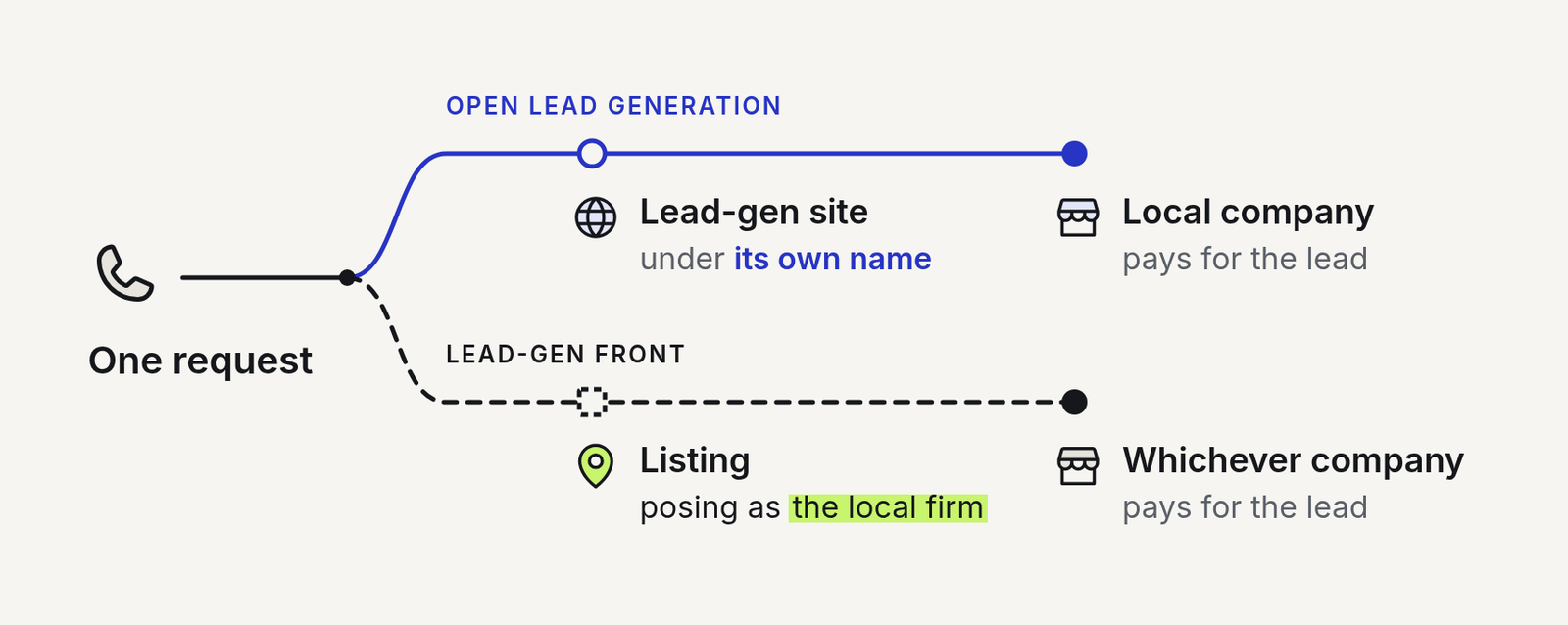
One request, two setups: a lead-gen brand that names itself, and a front.
Real Local Business vs Lead-Gen Front: Side by Side
Each row tells you where to look, not what to conclude.
| Signal | Real local business | Lead-gen front | Where to check |
|---|---|---|---|
| Address | Office, shop or yard it works from; hidden if it travels to customers | Mailbox, virtual office or someone else’s address | Street View, a search for the address, “PMB” in it |
| Name in records | Registered where the law requires it; licensed where the trade requires it | No registration or license, or another company’s | State business registry and license lookup |
| Phone | One number, one business | One number behind several brands or towns | Search the number; call and ask for the legal name |
| Website claims | Founding year, license and address match records | History or license number the records don’t support | The site against the records, line by line |
| Service area | Served from a base it can name | Wide area, no base anywhere | Ask for the base; check it in the registration |
How a Directory Weighs the Signals
To see how one directory spells out this kind of weighing, look at usd.org, which publishes its ranking method for local businesses. Apart from the factors it scores, its methodology has a section on detecting fake data.
That section names signs it watches for, such as “lead generation fronts posing as local companies” and addresses that are mailbox services. It says “no single sign proves anything” and that “the exact thresholds stay private so they cannot be gamed.”
If you judge sources with a traffic quality score, the logic is familiar. A “#”, a shared phone line or a hidden address each has an innocent explanation, so what you look for is several pointing the same way.
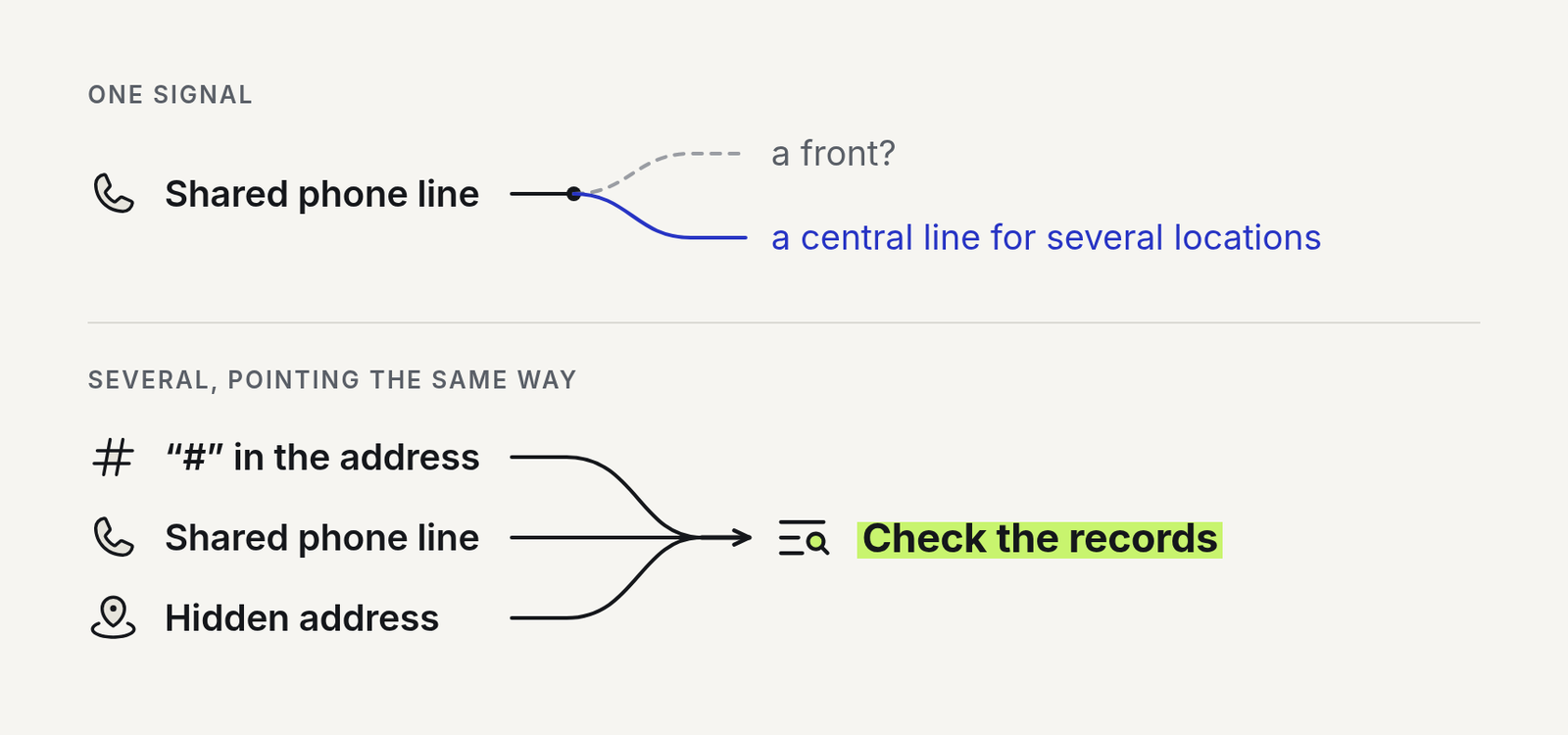
One signal can be read two ways; several pointing the same way are a reason to check the records.
The Signals, One by One
A Mailbox or Virtual Office Address
A street address can be rented. Under the U.S. Postal Service’s Domestic Mail Manual, a Commercial Mail Receiving Agency (CMRA) is a business that accepts mail for others as a business service, and office business centers count as CMRAs for postal purposes.
The rules require a CMRA to mark its customers’ addresses with “PMB” (private mailbox) or the alternative “#” sign plus a box number. So “PMB” in an address points straight at a private mailbox, while “#” alone doesn’t: the manual also names “suite” and “#” as secondary parts of a building’s own address.
A real company may rent a mailbox just for mail. What you need to know is whether anyone from it works there, so look at what stands at the address.
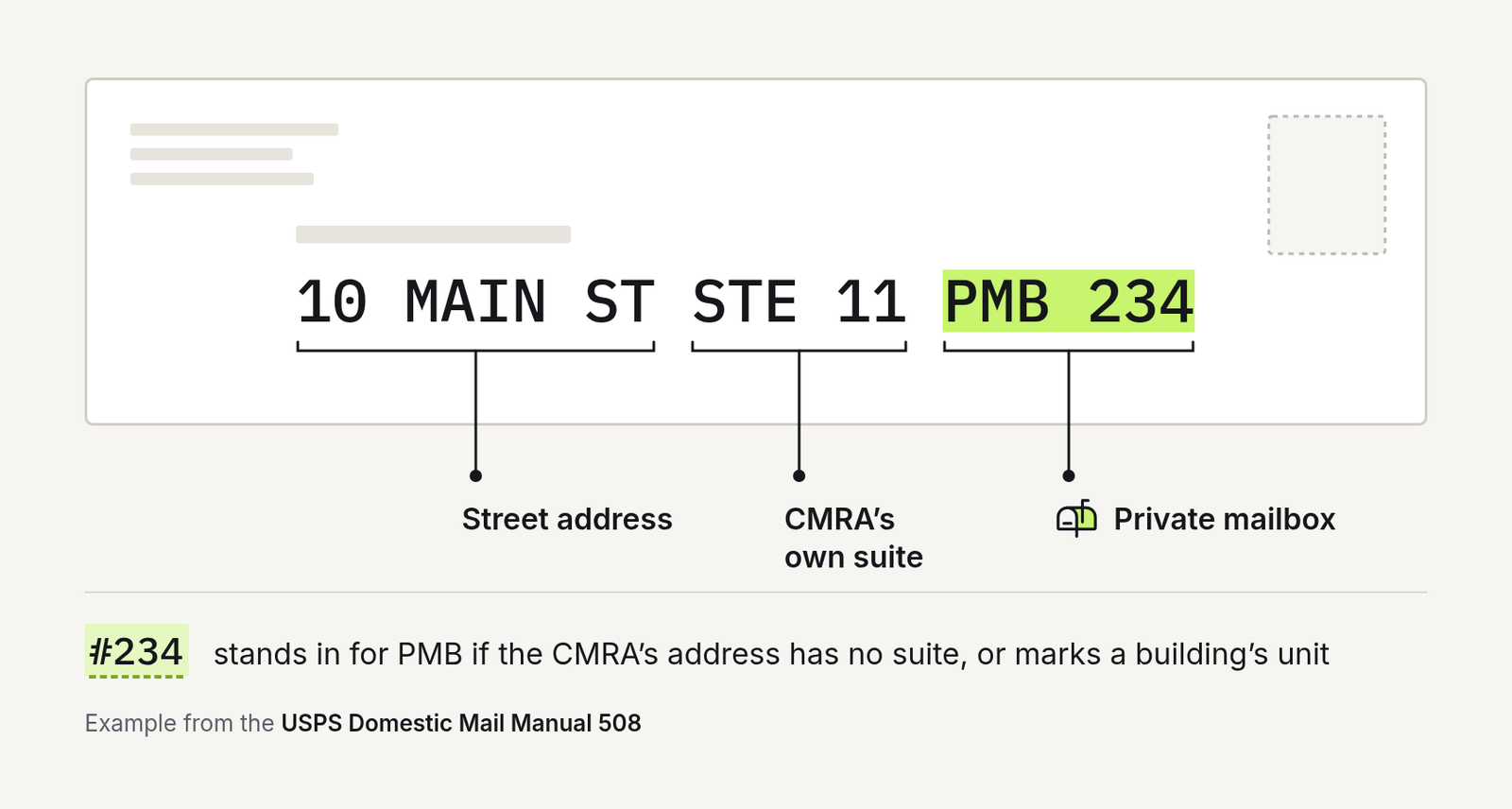
One address line from the postal manual, part by part.
No License or State Registration Under That Name
Look up the exact name on the listing with the state’s business registry and, if the trade needs a license, the matching license lookup. With a front, you may find nothing, or a company in another state or line of work.
A mismatch isn’t proof on its own. Some companies trade under a name other than their registered one, and an owner working under their own legal name may not have to register at all, so ask for the legal name and search it too.
One Phone Number, Many Brands
Google’s eligibility page says a profile’s phone number and website should be “the single, authoritative phone number and website for the business.” A front may run one number behind several brands or towns.
Search the number and count the business names you get back, then call and ask for the legal name. A shared line can be innocent too, such as a central number for a company with several locations.
Website Claims the Records Don’t Back
A front has to look established, so its website makes claims: decades in business, a license number, a local address. You can check each one.
Compare the founding year with the first state record and the license number with the license lookup: is it active, and is it this company’s? A gap isn’t proof, but it gives you a reason to look harder.
A Service Area With No Base
Google’s guidelines for representing your business tell companies that travel to customers to hide their street address, so a profile with no address can be legitimate. The same guidelines still tie that profile to a central office or location.
A front can claim a wide area with no base in it. Ask where the company is based, then check that place against its registration and website.
What This Means If You Buy Local Leads or Calls
Buying local leads and calls is a normal channel. Your risk sits in a source whose calls come from listings posing as a local company rather than from its own brand.

Vet a call source the way you would vet any traffic source.
Google lists lead generation companies as ineligible for a Business Profile, and its eligibility page warns that failure to follow these policies may result in a suspension. When a profile goes down, the calls you were buying from it stop too.
Before you scale a call source, ask where its calls come from (branded sites, ads or map listings) and under whose name. Then check the business that answers against the records, as you would a listing.
Common Mistakes to Avoid
- Calling every “#” a mailbox. A “#” can mark a private mailbox, but the same sign also appears in ordinary building addresses.
- Reading a hidden address as a red flag. Companies that travel to customers are told to hide it, so look for the base instead.
- Judging a listing on one signal. Each has an innocent explanation; several pointing the same way tell you far more.
- Blaming the lead-gen model. Lead generation and rank and rent are business models; the problem is a listing posing as the local company.
- Trusting the website over the records. Founding years, license numbers and addresses on a site stay claims until you find a state record that backs them.
FAQs
What is a CMRA address?
CMRA stands for Commercial Mail Receiving Agency: under U.S. Postal Service rules, a business that accepts mail for others as a business service. Its customers’ mail carries “PMB” or “#” with a box number, and office business centers count as CMRAs too.
Can you use a virtual office as a business address?
For mail, yes: a provider that receives your mail is a CMRA. For a Business Profile, Google’s guidelines for representing your business rule out a rented mailing address the business doesn’t work from. A co-working office qualifies only with clear signage, customers received during business hours and the company’s own staff.
Is lead generation the same as a fake local business?
No. Lead generation openly connects people who need a service with companies that provide it. It becomes a front when a listing or site claims to be the local company itself. Google doesn’t allow lead generation companies a Business Profile.
Is a rank-and-rent site a fake business?
Not by itself. Rank and rent means building a site that ranks for local searches, then renting it to a local business or selling its calls. It becomes a front when it invents a local firm: a made-up name, address or history.
Does one red flag prove a listing is fake?
No. A “#” can belong to a suite in an office building, a hidden address to a company that travels to customers, and a shared number to a business with several locations. Look for signals that point the same way, then check the records.
Why would a directory keep its detection rules private?
A published threshold becomes a target that fronts can be tuned to stay just under. An open methodology can still name what it checks and explain the principle.
___
Source: Usd.org