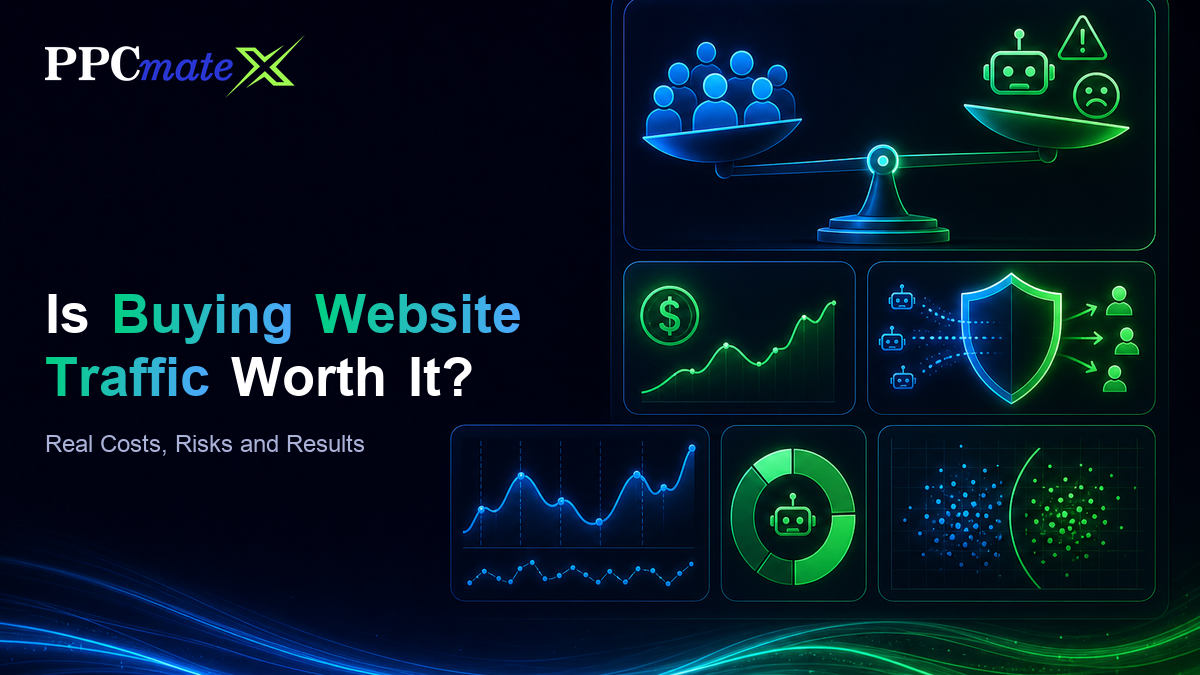
Buying website traffic is worth it when you buy real ad placements, track conversions and treat it as a test you can measure. It is not worth it when you buy cheap “visitor packages” that promise thousands of hits for a few dollars, because that traffic is usually bots. Paid traffic works; fake traffic does not.
What You Are Actually Buying
The question “is buying website traffic worth it” mixes two very different products. Paid advertising means you bid on ad space and real people choose to click your ad. Traffic packages mean someone sends a fixed number of “visitors” to your URL, with no targeting and no proof of where they come from. Almost every bad experience with bought traffic comes from the second kind.
So the more useful question is: does buying traffic work for my offer, at a price I can afford, from a source I can verify? That depends on costs, risks and how you measure results.
Real Costs Of Buying Website Traffic
Media Cost
You pay either per thousand impressions (CPM) or per click (CPC). Search and social clicks are usually the most expensive because demand from advertisers is high. Pop-under, push and native traffic is far cheaper per visit, which makes it attractive for testing and high-volume offers. On PPCmate, CPM starts from $0.10 and CPC from $0.001, with no subscription.
Testing Cost
Part of any budget goes to learning: finding the right country, device, bid and placements. Expect early campaigns to lose money or break even while you collect data. That is normal and should be planned for.
Hidden Costs
- Landing page work: paid traffic exposes slow or confusing pages instantly.
- Tracking setup: pixels or postbacks are essential to judge performance.
- Your time: reviewing reports, blocking placements and updating creatives.
- Bad traffic: if your source does not filter bots, you pay for visits that can never convert.
The Risks
Bot And Fraudulent Traffic
Invalid traffic is a known problem across digital advertising. Bots can load pages, click ads and even fill forms. The risk is highest with unknown sellers and lowest with platforms that filter traffic before it is bought. PPCmate filters every request for bots before bidding, and refused traffic is not billed; the details are on the traffic quality page.
Polluted Analytics
Fake visits skew bounce rate, session duration and conversion rate, and they can poison retargeting audiences and automated bidding. Cleaning that up later costs more than the traffic did.
SEO Myths
Buying traffic does not directly improve your Google rankings. Search engines do not reward you for raw visit counts, and bot traffic can make your site data harder to read. Paid traffic is a separate channel from SEO, not a shortcut to it.
Policy And Account Risk
Major ad platforms have strict policies and may review or suspend new accounts. Running those channels through a platform that uses its own house accounts, as PPCmate does for Google, Microsoft, Meta, TikTok, Reddit, LinkedIn, YouTube and ChatGPT, removes the need for you to set up and maintain your own ad accounts, though ads still have to follow each channel’s rules.
When Buying Traffic Works
- You have a clear conversion: a sale, lead, install or sign-up that you can track.
- Your unit economics allow it: you know roughly what a customer is worth and what you can pay to acquire one.
- The offer matches the format: simple, instantly understandable offers suit pop-under and push; considered purchases suit search, native and social.
- Your landing page is ready: fast, mobile-friendly and focused on one action.
- You can optimise: the platform shows placements and lets you block, bid and cap.
When It Does Not Work
- You only want higher visitor numbers for a screenshot or to impress buyers.
- You hope traffic alone will boost SEO or AdSense earnings; buying traffic to inflate ad revenue can also break publisher policies.
- You have no tracking, so you cannot tell good sources from bad.
- Your budget is too small to gather meaningful data and you will judge results after a few dozen visits.
How To Measure Results Honestly
- Set one primary metric such as cost per acquisition (CPA) or return on ad spend (ROAS).
- Track by source and placement, not just by campaign.
- Compare against a baseline such as your organic or email conversion rate.
- Give tests enough volume before declaring winners or losers.
- Look beyond the first click: repeat purchases and lifetime value can make a breakeven campaign profitable.
A Low-Risk Way To Find Out For Yourself
The cheapest way to answer “does buying traffic work for me” is a controlled test:
- Pick one format and one country.
- Set a small daily budget and a realistic bid.
- Install conversion tracking first.
- Run until you have enough data, then block weak placements and raise bids on strong ones.
- Scale only what is profitable.
PPCmate is set up for this kind of test: a $25 minimum deposit, one prepaid balance across pop-under, push, native, display, video and HTML5 traffic plus major ad channels, and a 7-day money-back guarantee. See traffic pricing and minimum deposit for details, and browse illustrative paid traffic case studies for setup ideas. Agencies can also ask about a white-label DSP through the contact page.
Paid Traffic By Business Type
E-Commerce Stores
Online shops can make paid traffic work when they know their margins and average order value. Search and social ads suit product-led buying, while push and native can work for promotions and seasonal deals. Retargeting visitors who did not buy is often one of the most efficient uses of a budget.
Lead Generation And Services
For leads, the key number is cost per qualified lead, not cost per form fill. Bot traffic is especially harmful here because fake form submissions waste sales time. Filtered traffic, form validation and careful source review are essential.
Apps And Games
Mobile apps often use video, pop-under, push and social formats to drive installs. Track post-install events, such as registrations or first purchases, so you are not just buying installs that never open the app.
Affiliates And Media Buyers
Affiliate marketers are often the heaviest users of pop-under, push and native traffic because those formats are cheap and scalable. Success comes from fast testing, strict placement blocking and accurate postback tracking.
Content Sites And Blogs
For publishers, buying traffic is usually only worth it if those visitors subscribe, buy or come back. Buying cheap visits purely to show more ads is risky and can breach ad network rules.
Quick Checklist Before You Spend
- Conversion tracking is installed and tested.
- You know your target CPA or ROAS.
- Your landing page loads fast on mobile.
- The platform shows placements and filters bots before billing.
- You have a daily budget cap and a stop-loss rule.
- You understand the refund terms.
Frequently Overlooked Factors
Three factors often decide whether bought traffic pays off, yet they get little attention. The first is offer-to-audience fit: the same landing page can fail on one format and succeed on another, so a poor first test does not mean paid traffic cannot work for you. The second is bid level: bidding too low usually means winning only leftover inventory, which tends to convert worse. The third is patience with data: daily results swing, so judge sources on several days of performance rather than a single morning.
It also helps to separate learning budget from scaling budget. Treat the first deposit as the price of finding out which format, country and placements work. Once you have a profitable combination, scaling budget goes only into what is proven, and you keep a small share running on new tests so you always have the next winner ready.
Finally, remember that buying traffic is a repeatable process, not a one-time purchase. The advertisers who get the best results review reports often, refresh creatives before they fatigue, and keep blocking weak placements as new ones appear.
The Verdict
Is buying website traffic worth it? Yes, if you buy real ads from a transparent, filtered source, track conversions and let numbers guide your spend. No, if you buy anonymous visitor packages or expect traffic to fix SEO or a weak offer. The difference between those two outcomes is almost entirely about traffic quality and measurement.
If you want to run a measured test with bot filtering before bidding, you can try PPCmate with a small deposit and see the results for yourself.
Frequently Asked Questions
Is buying website traffic worth it?
Yes, when it is real paid advertising with conversion tracking. No, when it is a cheap visitor package, which is usually bot traffic.
Does buying traffic work for SEO?
No. Bought visits do not directly improve Google rankings. Treat paid traffic as its own channel.
Can bought traffic get my site penalised?
Paid ads are normal. Bot traffic can distort your analytics and, if used to inflate ad revenue, can violate publisher network policies.
How much should I budget to test paid traffic?
Enough to reach meaningful data for one format and one country. PPCmate's minimum deposit is $25 with no subscription.
What is the cheapest traffic that still converts?
Pop-under and push are among the cheapest per visit and can convert for simple, clear offers with fast landing pages.
How do I avoid paying for bots?
Use a platform that filters traffic before bidding. PPCmate filters every request for bots before bidding and does not bill refused traffic.
Is there a refund if traffic does not perform?
Policies vary by seller. PPCmate offers a 7-day money-back guarantee.