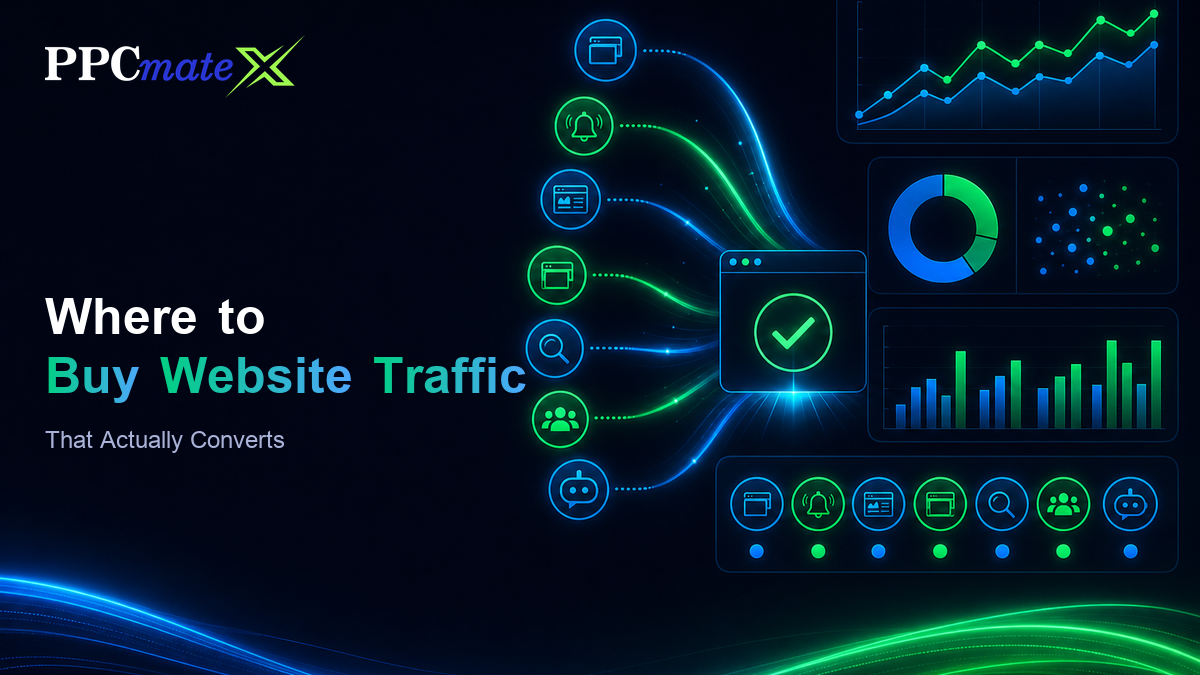
The best place to buy website traffic is a self-serve ad platform where you pick the format, set your own bid, see placement-level data and pay only for filtered, real visits. Avoid anonymous “10,000 visitors for $9” packages: they are usually bots or forced redirects that never convert. A transparent programmatic platform or a major ad network, tested with a small budget, is where traffic that actually converts comes from.
What “Buying Website Traffic” Really Means
When people ask where to buy website traffic, they are usually asking one of two different things. The first is paid advertising: you bid for ad placements on websites, apps, search results or social feeds, and people who click land on your page. The second is a “traffic package”: a seller promises a fixed number of visitors for a flat fee, with no information about where those visitors come from.
Only the first option is a real marketing channel. Paid ads give you targeting, reporting and control. Traffic packages give you a number on an analytics chart and very little else. If your goal is sales, leads, sign-ups or installs, you want visitors who chose to click on an offer that matched their interest, and that only happens through genuine ad inventory.
The Main Places To Buy Website Traffic
1. Search And Social Ad Platforms
Google, Microsoft (Bing), Meta, TikTok, Reddit, LinkedIn and YouTube sell high-intent and high-reach traffic. Search ads catch people actively looking for a solution, which makes them some of the best-converting traffic available. The trade-offs are cost, strict ad policies, account setup, and frequent account reviews or suspensions, especially for new advertisers.
2. Ad Networks And DSPs
Ad networks and demand-side platforms (DSPs) let you buy pop-under, push, native, display, video and HTML5 placements across thousands of publisher sites. This is often the best place to buy website traffic at scale on a modest budget, because CPMs and CPCs are far lower than on search, and you can target by country, device, operating system, browser and more. Quality varies a lot between platforms, so filtering and transparency matter.
3. Sponsorships And Newsletters
Buying a placement in a niche newsletter, podcast or blog can send very targeted visitors. It is harder to scale and to measure, but it works well for B2B and specialist products.
4. Influencers And Creators
Creators can send engaged traffic when their audience matches your product. Results swing widely, so treat each deal as a test with a tracked link.
5. Traffic Packages And “Visitor Sellers”
These are the listings that promise targeted visitors for a flat price. In practice, the traffic is commonly generated by bots, click farms, expired-domain redirects or auto-refreshing pages. It can inflate pageviews, but it rarely produces conversions and can pollute your analytics and retargeting audiences. We do not recommend this route.
How To Choose The Best Place To Buy Website Traffic
Use these criteria before you spend anything:
- Transparency: Can you see which sites, apps or placements your ads ran on? If not, you cannot cut what does not work.
- Bot filtering: Does the platform filter invalid traffic before it bills you, or only after you complain?
- Control over price: Can you set your own CPM or CPC bid, daily budgets and caps?
- Targeting: Country, device, OS, browser, connection type, time of day and placement-level blocking are the basics.
- Conversion tracking: You need postbacks or a pixel so you can judge traffic by results, not by clicks.
- Low minimum deposit: A small minimum lets you test before committing.
- Refund terms: A clear money-back policy is a sign the seller trusts its own traffic.
Which Ad Format Converts For What
There is no single best format. Match the format to the offer:
- Search ads: best for high-intent products and services people already search for.
- Pop-under traffic: very cheap, high-volume full-page visits; works for simple offers, sweepstakes, utilities, gaming and broad consumer products. Your landing page must load fast and make the offer obvious.
- Push notifications: short, attention-grabbing messages to opted-in subscribers; good for e-commerce deals, news, apps and finance lead generation.
- Native ads: ads that blend with editorial content; good for content-led offers, advertorials and higher-consideration purchases.
- Display and HTML5 banners: brand awareness and retargeting, with rich creative options.
- Video: storytelling, product demos and app installs.
- Social ads: interest and audience targeting at scale on Meta, TikTok, Reddit and LinkedIn.
Where PPCmate Fits
PPCmate is a self-serve AI ad platform built to be a practical answer to where to buy website traffic. From one dashboard and one prepaid balance you can buy pop-under, push, native, display, video and HTML5 traffic, and also run Google, Microsoft, Meta, TikTok, Reddit, LinkedIn, YouTube and ChatGPT ads on PPCmate’s own house accounts. You do not need your own ad accounts on those platforms.
A few details matter for conversion-focused buyers:
- Every request is filtered for bots before bidding, and refused traffic is not billed. You can read how this works on the traffic quality and bot filtering page.
- Prices start at CPM from $0.10 and CPC from $0.001, with no subscription. See the full PPCmate pricing for buying traffic.
- The minimum deposit is $25, and there is a 7-day money-back guarantee.
- Agencies can use a white-label DSP to resell traffic under their own brand; ask via the PPCmate contact page.
For examples of how different formats and verticals are typically set up, browse the illustrative advertising case studies.
A Step-By-Step Test Plan
- Define one conversion. A sale, lead, sign-up or install. Set up tracking before you buy a single visit.
- Pick one or two formats that fit your offer, rather than spreading a small budget across everything.
- Start narrow. One country, one device type, one landing page.
- Bid realistically. Too low and you only win leftover inventory; start near the suggested range and adjust.
- Collect enough data. Wait for a meaningful number of clicks or conversions before judging; a handful of visits proves nothing.
- Cut by placement. Block sources that send clicks without conversions, and raise bids on the ones that convert.
- Improve the landing page. Speed, a clear headline and one call to action often matter more than the traffic source.
- Scale slowly. Increase budgets in steps so performance does not collapse when you reach lower-quality inventory.
Red Flags When Buying Traffic
- Guaranteed visitor counts at a fixed low price with no source list.
- Promises of “real human” traffic with no explanation of filtering.
- Very low bounce rates or identical session durations, which often signal scripted visits.
- Traffic that arrives in sudden spikes at odd hours from one country you did not target.
- No refund policy and no way to see placements.
Paid Traffic Vs Organic Traffic
Buying traffic and earning organic traffic are not rivals. SEO and content take months to build but keep paying off; paid traffic is instant but stops the moment you stop paying. Many businesses use paid campaigns to validate an offer, learn which messages and audiences convert, and then feed those insights back into their content and SEO. If an ad headline converts well, it is often a good title or meta description too.
Common Mistakes Even With Good Traffic Sources
- Sending traffic to the homepage instead of a page built for the offer and the ad.
- Changing too many things at once, so you cannot tell what improved results.
- Ignoring device split: mobile and desktop often perform very differently and deserve separate bids.
- Running one creative forever: ad fatigue is real, especially on push and native, so rotate creatives regularly.
- Judging by CTR alone: a high click-through rate with no conversions is a warning, not a win.
- Not setting frequency caps, which can waste budget showing the same user the same ad repeatedly.
How To Read Your First Campaign Report
After your first few days, sort placements by conversions rather than clicks. Sources with spend and zero conversions are candidates for blocking once they have had a fair chance. Sources with conversions at or below your target cost deserve higher bids. Also check the time of day, device and browser split: small changes there can lift results without touching the creative or the offer.
Final Thoughts
The answer to where to buy website traffic that actually converts is simple: buy from a transparent ad platform, filter aggressively, track conversions, and let the data decide. Start small, keep what works and cut the rest.
If you want to test several formats and major ad channels from one balance, you can start a campaign on PPCmate with a $25 deposit and a 7-day money-back guarantee.
Frequently Asked Questions
Where is the best place to buy website traffic?
A transparent self-serve ad platform or a major ad network, where you set bids, see placements and track conversions. Avoid flat-price visitor packages, which are often bot traffic.
Is it safe to buy website traffic?
Buying ads is safe and normal. Buying anonymous traffic packages is risky because they often contain bots that can distort analytics and waste money.
How much does it cost to buy website traffic?
It depends on format and targeting. Search ads cost far more per click than pop-under or push traffic. On PPCmate, CPM starts from $0.10 and CPC from $0.001.
Which traffic type converts best?
Search traffic usually has the highest intent, but pop-under, push and native can convert well and cheaply when the offer and landing page match the audience.
How much should I spend on a first test?
Enough to reach a meaningful number of clicks or conversions for one country and one format. PPCmate's minimum deposit is $25.
Do I need my own Google or Meta ad account?
Not on PPCmate. Campaigns on Google, Microsoft, Meta, TikTok, Reddit, LinkedIn, YouTube and ChatGPT run on PPCmate's own house accounts.
How do I know if traffic is fake?
Watch for spikes, identical session times, no conversions and traffic from untargeted regions. Use platforms that filter bots before bidding.