How to Calculate Break-Even CPA and ROI for Paid Traffic Campaigns
Most paid traffic campaigns are not lost on bad creatives or bad sources. They are lost because nobody worked out, before launch, how much a conversion is allowed to cost. Without that number you cannot tell whether a source is profitable, how high to bid, or when a test has failed.
This guide shows how to calculate your break-even CPA, turn it into a maximum CPC or CPM bid, measure ROI and ROAS correctly, and use all of it to decide which sources to cut, optimise or scale. Every formula works for affiliate offers, lead generation and e-commerce.
What Is Break-Even CPA?
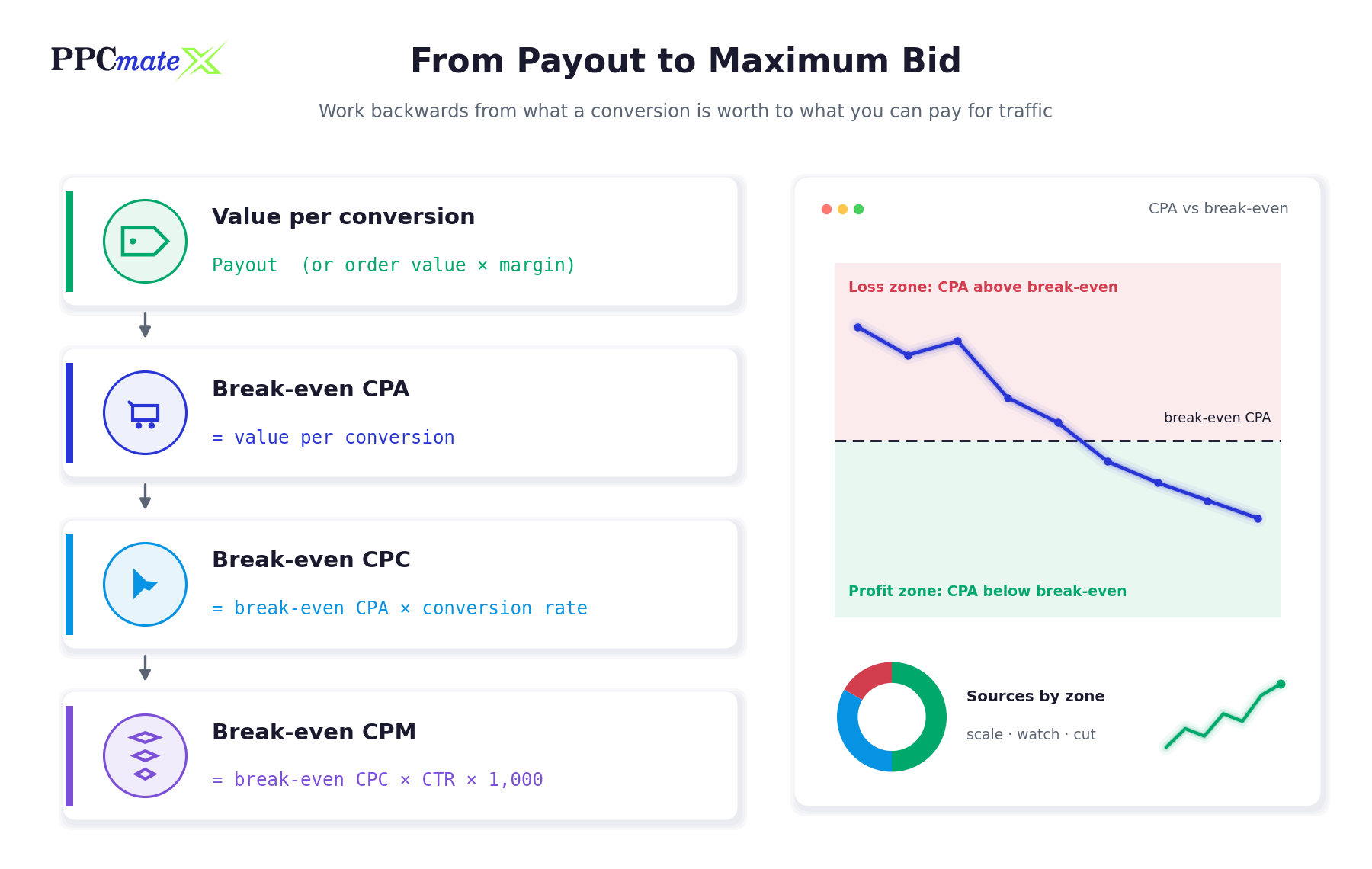
Break-even CPA is the highest cost per acquisition you can pay for a conversion without losing money. At that CPA, ad spend exactly equals the value the conversion brings in, so profit is zero. Any CPA below it is profit; any CPA above it is a loss.
CPA (cost per acquisition) itself is simple: total ad spend divided by the number of conversions. The hard part is knowing what a conversion is actually worth to you, because that is what sets the break-even line.
How to Calculate Break-Even CPA
The general rule is break-even CPA = value per conversion. How you work out that value depends on your business model.
Affiliate and CPA offers
If you are paid a fixed payout per conversion, your break-even CPA is that payout. For revenue-share offers, use the average commission you actually receive per conversion from your affiliate network stats, not the best case.
E-commerce
Revenue is not profit. Use break-even CPA = average order value × gross margin, where gross margin is what is left after product cost, shipping and payment fees. If you sell at a thin margin, your break-even CPA is far lower than your order value suggests.
Lead generation
Use break-even CPA per lead = lead-to-customer rate × profit per customer. If only some leads become customers, each lead is worth only that share of a customer’s profit.
Adjust for refunds, chargebacks and costs
Subtract anything that reduces what you keep: refunds, chargebacks, rejected or scrubbed leads, tracker fees and payment processing. A clean break-even CPA uses the value you keep, not the value shown on the first conversion report.
From Break-Even CPA to Maximum Bid
Most traffic is bought per click (CPC) or per thousand impressions (CPM), not per conversion. To set a bid, work backwards from your break-even CPA using your conversion rate and click-through rate:
- Find your value per conversion using the method for your business model above.
- Set break-even CPA equal to that value.
- Calculate break-even CPC: break-even CPA × conversion rate (conversions ÷ clicks).
- Calculate break-even CPM: break-even CPC × CTR × 1,000 (CTR as clicks ÷ impressions).
- Set a target CPA below break-even to leave room for profit: target CPA = break-even CPA × (1 − desired profit margin).
- Repeat steps 3 and 4 with the target CPA to get the bids you actually start with.
- Recalculate whenever the payout, conversion rate or CTR changes, because each one moves your maximum bid.
A worked example (made-up numbers)
The figures below are invented purely to show the arithmetic. They are not benchmarks for any format or vertical.
- Offer payout: $50, so break-even CPA is $50.
- Conversion rate from your test: 2% of clicks. Break-even CPC = $50 × 0.02 = $1.00.
- CTR on a CPM source: 0.5%. Break-even CPM = $1.00 × 0.005 × 1,000 = $5.00.
- You want a 30% margin, so target CPA = $50 × 0.70 = $35, target CPC = $0.70 and target CPM = $3.50.
If you bid above $5.00 CPM on that source, you lose money even when everything else goes right. Your conversion rate and CTR will differ by source, so do this per source, not just per campaign. For more on how the pricing model changes the maths, see our guide to CPM vs CPC buying.
How to Calculate ROI and ROAS for Paid Traffic
ROI (return on investment) = (revenue − ad cost) ÷ ad cost × 100%. It tells you how much profit each unit of spend returned. Break-even ROI is 0%.
ROAS (return on ad spend) = revenue ÷ ad cost. It tells you how much revenue each unit of spend brought in. Break-even ROAS is 1 only when revenue equals profit, as with a fixed affiliate payout.
For e-commerce, where revenue is not profit, break-even ROAS = 1 ÷ gross margin. A store with a lower margin needs a higher ROAS just to break even. Continuing the made-up example: $1,000 spend producing 25 conversions at $50 is $1,250 revenue, a CPA of $40, an ROI of 25% and a ROAS of 1.25.
| Metric | Formula | What it tells you | Break-even point |
| CPA | Ad spend ÷ conversions | What each conversion cost you | Equal to value per conversion |
| Break-even CPA | Value per conversion (after refunds and costs) | The most you can pay per conversion | It is the break-even line |
| Break-even CPC | Break-even CPA × conversion rate | The most you can pay per click | Bid above it and you lose money |
| Break-even CPM | Break-even CPC × CTR × 1,000 | The most you can pay per thousand impressions | Bid above it and you lose money |
| ROI | (Revenue − cost) ÷ cost × 100% | Profit returned on spend | 0% |
| ROAS | Revenue ÷ cost | Revenue returned on spend | 1 ÷ gross margin (1 if revenue is profit) |
Using Break-Even CPA to Decide What to Cut and Scale
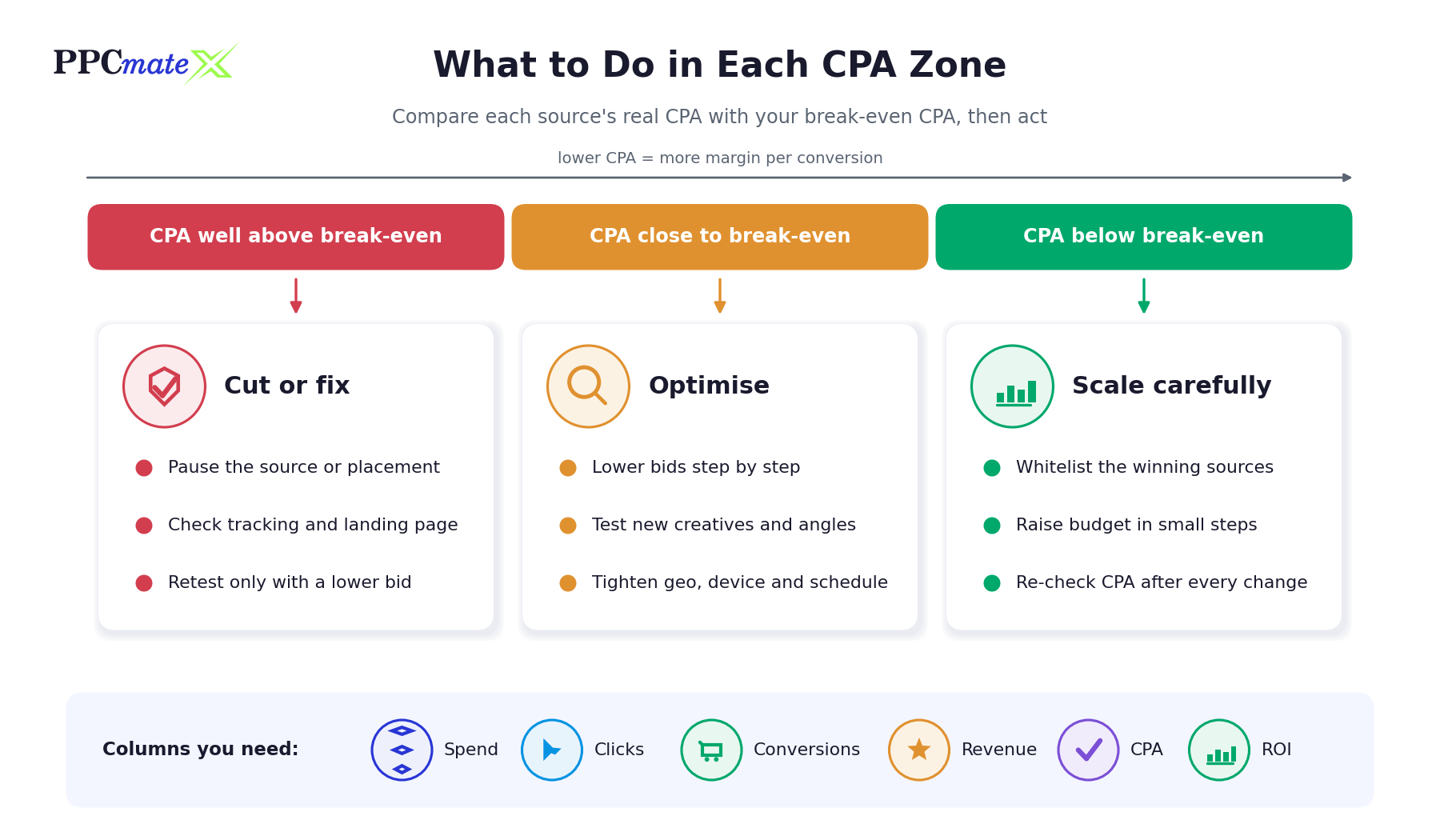
Break-even CPA becomes useful when you compare it with the real CPA of every source, placement and creative. This needs reliable conversion data, so set up postback tracking with Voluum, RedTrack or Binom before you start judging results. Then group sources into three zones:
- CPA well above break-even: pause the source or check whether tracking, the landing page or the offer is the real problem. Retest only with a lower bid.
- CPA close to break-even: optimise. Lower bids gradually, test new creatives and tighten geo, device and schedule targeting.
- CPA below break-even: add the source to a whitelist, raise budget in small steps and re-check CPA after each change, because CPA often rises as you buy more volume.
A source with only one or two conversions has not proved anything yet. Before you cut or scale, give it enough spend to have a fair chance: a common rule of thumb is to allow at least one to two times your break-even CPA in spend before judging a source with no conversions. Our guide on how to read a source-level report covers this decision in more detail, and if you run several offers side by side, see testing multiple offers.
Common Mistakes to Avoid
- Using revenue instead of profit. For e-commerce, break-even CPA is order value × margin, not order value.
- Using the headline payout. Scrubbed leads, rejected conversions and refunds lower what you actually keep.
- Setting bids at break-even. Bidding exactly at break-even leaves no room for profit or for normal day-to-day swings.
- Averaging across all sources. A campaign that looks fine on average can hide sources that lose money on every conversion.
- Judging too early. Small numbers of conversions swing CPA widely. Wait for enough data before you cut or scale.
- Forgetting tracker and tool costs. Small fixed costs still move your real break-even point.
- Never recalculating. When a payout, conversion rate or CTR changes, your maximum bid changes too.
Track CPA and ROI by Source on PPCmate
Break-even maths only works if you can see conversions per source. On PPCmate you can buy display, native, video, push and pop-under traffic with CPC or CPM bids, and connect your tracker through 3rd-party tracking so conversions are attributed back to the sources that drove them.
Running affiliate offers? See how PPCmate helps media buyers grow profitable campaigns: maximize your affiliate earnings with PPCmate.
FAQs
What is break-even CPA?
Break-even CPA is the highest cost per acquisition you can pay without losing money. It equals the value you keep from one conversion, such as an affiliate payout or an order’s gross profit.
How do you calculate break-even CPA for e-commerce?
Multiply your average order value by your gross margin after product, shipping and payment costs. That is the most you can spend to win one order at zero profit.
How do I turn break-even CPA into a maximum CPC bid?
Multiply break-even CPA by your conversion rate (conversions ÷ clicks). The result is the highest CPC you can pay and still break even.
How do I calculate a maximum CPM bid?
Multiply your break-even CPC by your CTR and by 1,000. If you buy on CPM, bidding above that figure loses money even when conversion rate holds.
What is the difference between ROI and ROAS?
ROI measures profit relative to cost: (revenue − cost) ÷ cost. ROAS measures revenue relative to cost: revenue ÷ cost. ROI accounts for cost directly; ROAS does not.
What is a good ROI for paid traffic?
Any ROI above 0% is profitable, but what counts as good depends on your margins, cash flow and risk. Set a target CPA below break-even that gives the margin your business needs.
What is break-even ROAS?
Break-even ROAS is 1 ÷ gross margin. When revenue is pure profit, as with a fixed affiliate payout, break-even ROAS is 1.
Should I calculate break-even CPA per campaign or per source?
Value per conversion is usually set per offer, but compare it with CPA per source, placement and creative. Campaign averages hide sources that lose money.