Whitelist vs Blacklist Targeting: Building a Source List That Performs
Every campaign draws traffic from a mix of subIDs, domains, and app bundles — some consistently strong, some clearly wasteful, and a lot that fall somewhere in between. Deciding which of those sources get more budget, which get cut off entirely, and which stay under observation is what source-list targeting is for, and getting the whitelist/blacklist balance wrong either starves a campaign of good inventory or keeps paying for traffic that was never going to convert.
This guide covers what whitelists and blacklists actually do, how they differ in practice, how to build a source list that improves over time instead of just growing longer, and the mistakes that quietly cap performance.
What Whitelist and Blacklist Targeting Mean
A whitelist is a list of approved sources — specific subIDs, domains, app bundles, or placement IDs — that a campaign is allowed to buy from, sometimes exclusively. A blacklist is the opposite: a list of sources explicitly blocked from receiving bids, regardless of how the rest of the campaign is targeted. Both operate on the same unit (the individual traffic source), but they enforce opposite defaults.
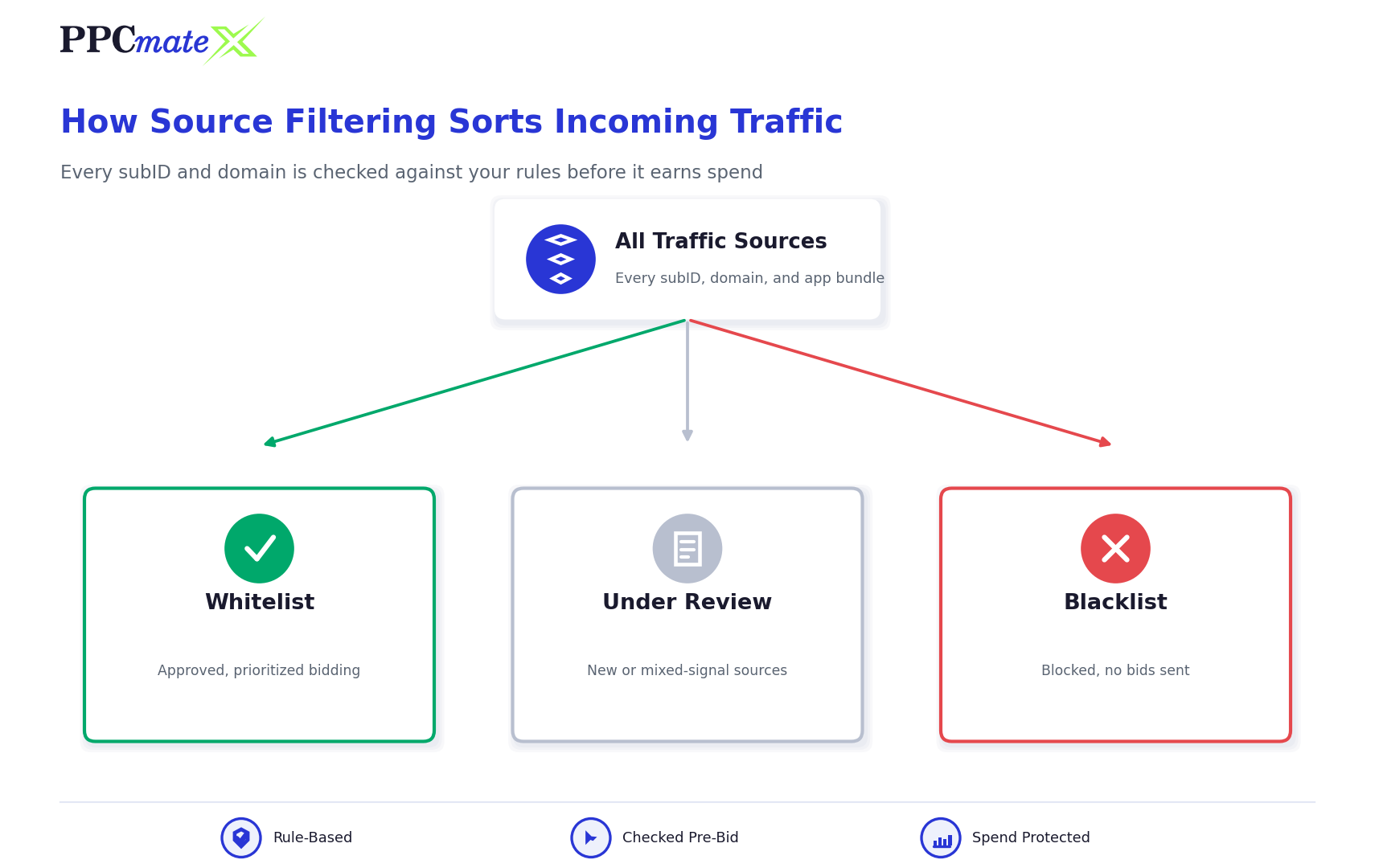
A whitelist-only campaign starts closed and only opens up to sources you’ve explicitly approved — safer, but limited in scale until the list grows. A blacklist-based campaign starts open to your full targeting and only closes off the specific sources you’ve ruled out — more volume, but with more exposure to untested inventory. Most mature campaigns end up running both at once: a blacklist to permanently cut known-bad sources, and a whitelist or bid-priority boost for the proven top performers, with everything else left to run at standard bids while it’s evaluated.
Whitelist vs Blacklist: Side by Side
| Aspect | Whitelist | Blacklist |
| Default state | Closed — only listed sources get bids | Open — everything except listed sources gets bids |
| Reach | Limited to proven inventory | Broad, includes untested sources |
| Risk profile | Low risk of waste, higher risk of under-scaling | Higher short-term waste risk, better long-term scale |
| Best suited for | Small budgets, proven verticals, retargeting-style campaigns | Prospecting, scaling campaigns, broad-reach formats |
| Maintenance | Needs regular additions or it stagnates | Needs regular review or it grows indefinitely |
How to Build a Source List That Actually Improves Performance
- Start broad, not closed — unless you already have a proven whitelist from a prior campaign, begin with open targeting so you get enough source-level data to make real decisions instead of guessing.
- Let sources accumulate enough volume before judging them — a subID with a handful of impressions and no conversions isn’t necessarily bad, it just hasn’t run long enough to be measured fairly.
- Pull a source-level performance breakdown regularly — sort by your actual campaign goal (conversion rate, cost per converted click, post-click engagement), not raw click volume alone.
- Move clear winners to a whitelist or bid-priority tier — sources that consistently outperform the campaign average earn increased budget share or a bid boost.
- Blacklist sources with a clear, repeated pattern of waste — near-zero engagement past the point where volume should have shown something, or signals consistent with invalid traffic.
- Leave the middle tier alone on purpose — sources that are neither clear winners nor clear waste should keep running at standard bids while more data comes in, rather than being forced into a premature decision.
Signals Worth Checking Before You Blacklist a Source
- Engagement metrics that stay flat regardless of creative, format, or bid changes
- A pattern consistent with invalid traffic rather than simple underperformance
- Viewability far below the rest of the campaign, suggesting impressions were rarely seen at all — see what viewability actually measures
- A mismatch between the source’s stated category and the traffic it’s actually sending
- Volume concentrated in a narrow time window or device type that doesn’t match your audience
Where Source Lists Fit Alongside Other Controls
Source-list targeting works best as one layer in a broader optimization stack, not a substitute for it. A frequency cap controls how often the same user sees your ad regardless of source; source filtering controls which sources get to show it at all. Bidding strategy determines how much you pay per source once it’s approved to bid — a topic covered in more format-specific depth in guides like the native ads bidding strategy and pop-under bidding strategy posts. None of these replace each other; a well-run campaign layers all three.
Common Mistakes to Avoid
- Blacklisting too early — cutting a source before it has enough volume to judge fairly, based on a handful of unlucky impressions
- Building a whitelist and never revisiting it — a static whitelist eventually excludes new sources that would have outperformed the original list
- Treating every underperforming source as fraud — most low performers are just a poor audience fit, not invalid traffic; conflating the two leads to wrong fixes
- Applying one source list across every campaign — a source that’s strong for one vertical or format can be weak for another; lists should be scoped per campaign, not global by default
- Ignoring the middle tier indefinitely — sources under review still need a decision eventually, or budget quietly leaks into unresolved inventory
Manage Source Lists Directly Inside PPCmate
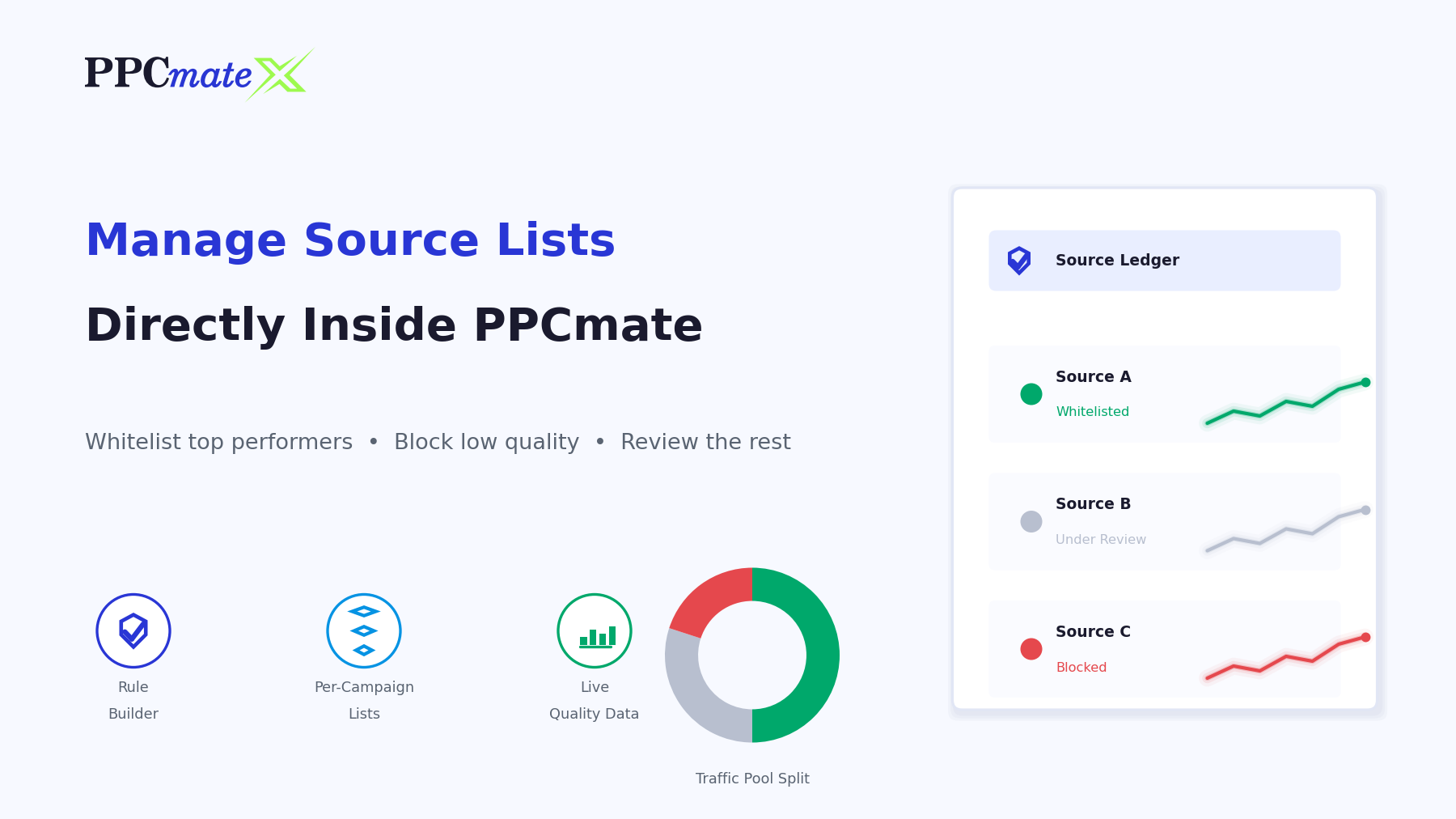
PPCmate’s campaign automation tools let advertisers build and maintain whitelist and blacklist rules per campaign, track source-level performance without exporting to a spreadsheet, and adjust lists as new data comes in rather than setting them once and forgetting them.
FAQs
What’s the difference between a whitelist and a blacklist in programmatic advertising?
A whitelist only allows bidding on sources you’ve explicitly approved, while a blacklist allows bidding on everything except the sources you’ve explicitly blocked. They enforce opposite default states over the same underlying targeting unit — the individual subID, domain, or app bundle.
Should I use a whitelist or a blacklist for a new campaign?
Most new campaigns should start with open, blacklist-based targeting so enough source-level data accumulates to make informed decisions. Whitelists work better once a campaign has run long enough to identify a proven set of top-performing sources.
How much traffic volume does a source need before I judge it?
There’s no universal number, but a source needs enough impressions and clicks that its results reflect a real pattern rather than random variance. Judging a source on a handful of impressions typically leads to blacklisting inventory that simply hasn’t had a fair chance yet.
Can I use a whitelist and a blacklist at the same time?
Yes, and most mature campaigns do. A blacklist permanently removes known-bad sources while a whitelist or bid-priority tier boosts proven top performers, with the remaining sources running at standard bids while they’re evaluated.
Does blacklisting a source mean it’s fraudulent?
No. Most blacklisted sources are simply a poor fit for the campaign’s audience or goal, not evidence of invalid traffic. Fraud-specific signals — like patterns consistent with IVT — are a separate, narrower reason to block a source.
Should source lists be shared across campaigns?
Generally no. A source that performs well for one vertical, format, or audience can perform poorly for another, so source lists are usually more effective when scoped to the individual campaign rather than applied globally by default.
How often should a source list be reviewed?
On a regular cadence tied to how fast the campaign accumulates data — weekly for high-volume campaigns, less often for smaller ones. A source list that’s never revisited eventually excludes new sources that would have outperformed the original list.
What should happen to sources that are neither clear winners nor clear losers?
They should keep running at standard bids while more performance data comes in, rather than being forced onto a whitelist or blacklist prematurely. This middle tier still needs an eventual decision, just not an immediate one.