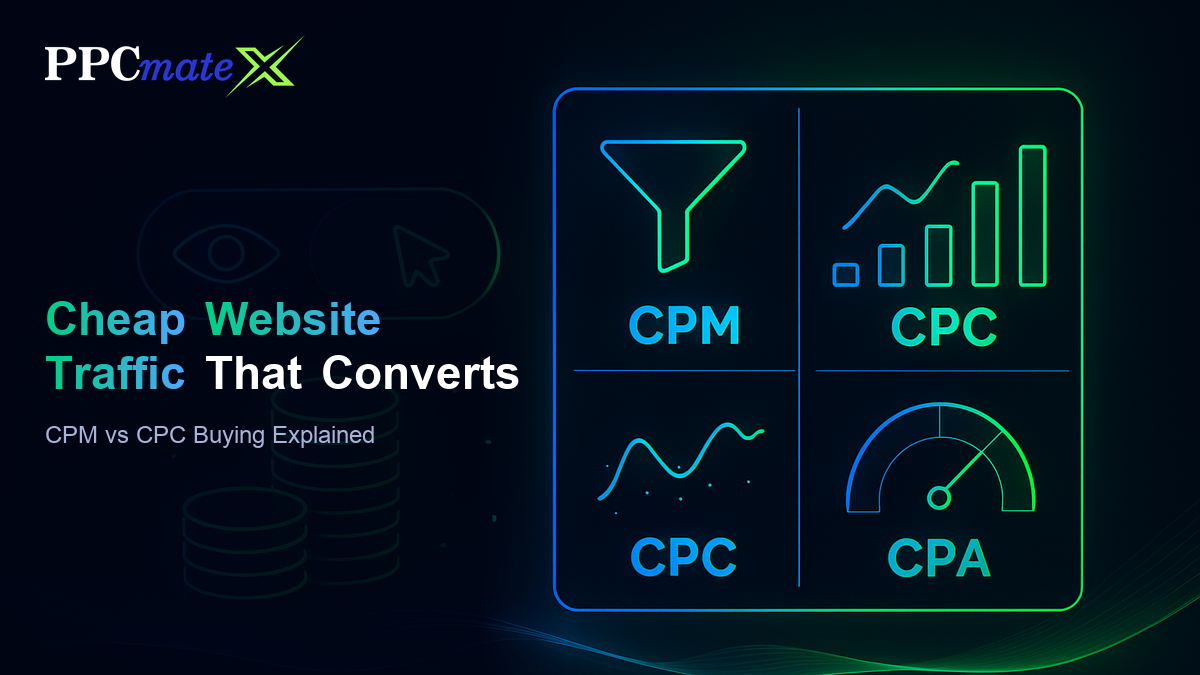
Cheap Website Traffic That Converts: CPM vs CPC Buying Explained
Almost every advertiser who searches for cheap website traffic wants the same thing: more visitors for less money, without paying for people who never buy. The catch is that “cheap” depends on what you are billed for. A low CPM can produce expensive visits, and a low CPC can produce expensive conversions. This guide explains how CPM and CPC buying actually work, how to convert any price into a cost per visit and a cost per conversion, and how to choose the right model for popunder, push and other paid traffic.
What Does “Cheap Website Traffic” Really Mean?
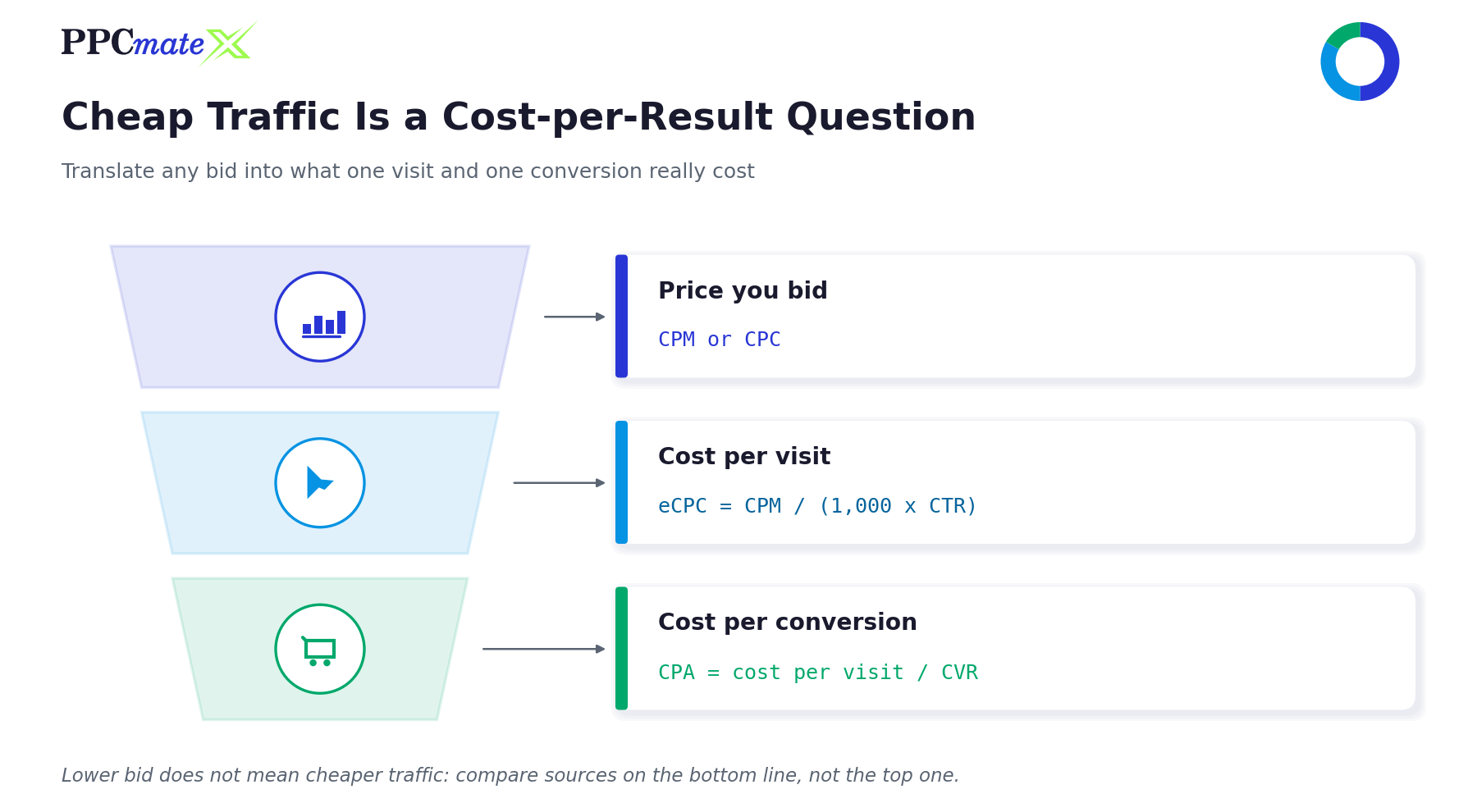
Cheap website traffic is traffic whose cost per result is low, not traffic with the lowest headline price. The headline price is only the first of three numbers that matter:
- Price you bid: the CPM (cost per 1,000 impressions) or CPC (cost per click) you agree to pay.
- Cost per visit: what one real landing-page visit ends up costing once click-through rate is applied.
- Cost per conversion (CPA): what one sale, lead, sign-up or install ends up costing once conversion rate is applied.
Two traffic sources can sit at opposite ends of the price list and still land at the same CPA, or the reverse. That is why experienced media buyers judge sources on the bottom line, using conversion tracking, rather than on the bid. If you want a broader look at what separates useful visitors from wasted ones, see our guide on how to buy high quality website traffic.
How CPM Buying Works
With CPM, you pay for every 1,000 times your ad is shown. Whether anyone clicks is your problem, not the network’s, so the click-through risk sits with you. In exchange, CPM usually gives you more control: you can raise or lower bids by source, and on a real-time bidding platform you compete for each impression individually.
Why popunder is bought on CPM
A popunder impression is a page visit: the ad opens your landing page in a new window behind the one the user is viewing. There is no separate click to bill, so popunder is bought on CPM, and that is how PPCmate prices its popunder ads. For pop traffic, your CPM divided by 1,000 is very close to your cost per visit, which makes the format easy to model.
What CPM unlocks on PPCmate
According to PPCmate’s pricing page (as of October 2026), CPM campaigns support both fixed and dynamic bid rates, include CTR and CPA optimization, and are the only campaign type that can use target-CPA bidding. CPM rates are listed as starting from $0.10 per 1,000 impressions. That is a starting point, not a typical price: what you actually pay depends on the country, device and competition for each impression.
How CPC Buying Works
With CPC, you pay only when someone clicks your ad. The network carries the click-through risk: if your creative is weak and nobody clicks, you spend nothing. That makes CPC attractive while you are still testing angles and do not yet know which message works.
Why push is bought on CPC
Push notification ads are delivered to subscribers, who choose whether to tap. The click is the natural billing event, so push is priced on a cost-per-click basis. PPCmate’s push notification ads work this way.
What CPC trades away
On PPCmate, CPC is offered at a fixed rate with manual optimization and a CPC-optimization setting for click quality, with rates listed as starting from $0.001 per click (pricing page, October 2026). You give up dynamic bidding and target-CPA bidding, which are CPM-only. You can switch a campaign between CPM and CPC later if your needs change.
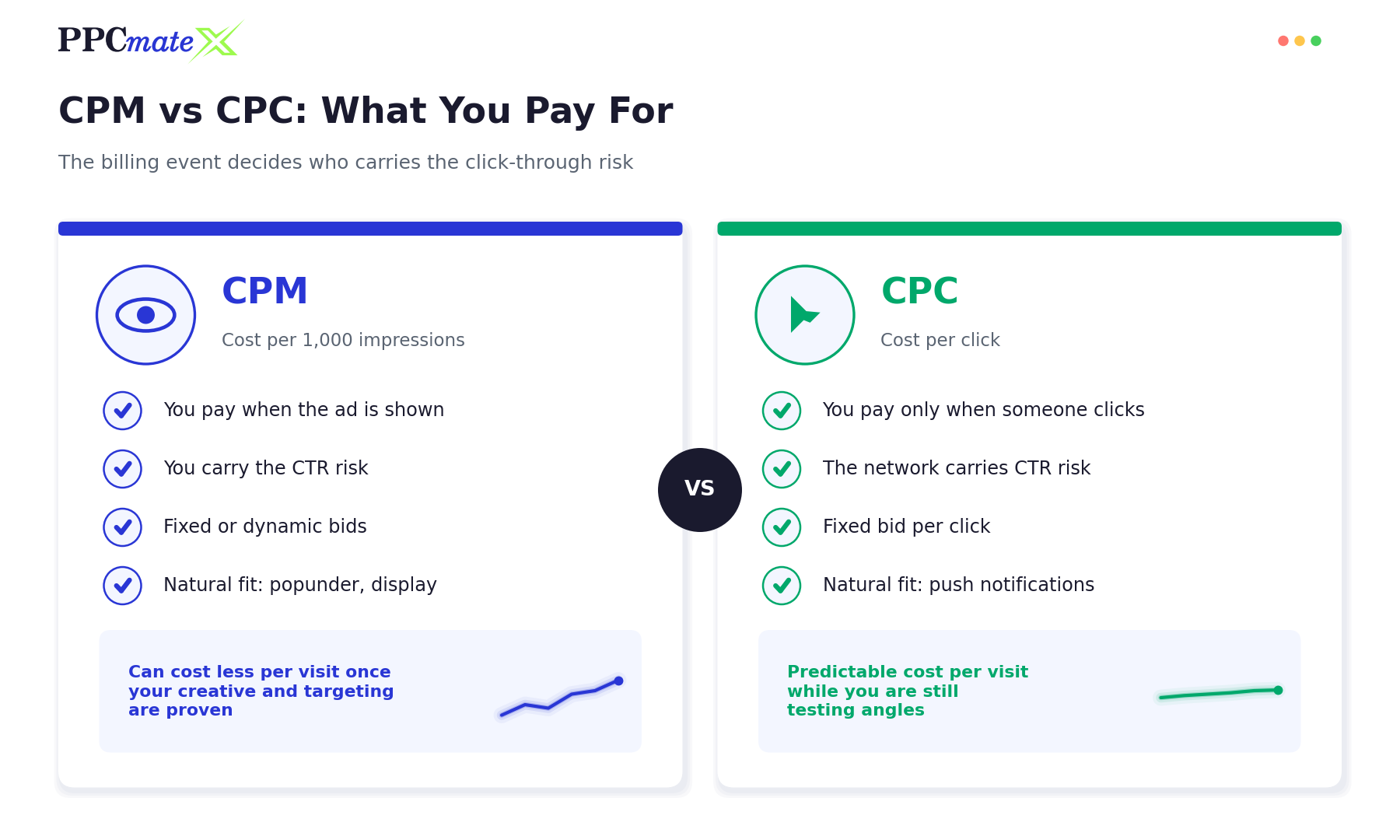
CPM vs CPC: Side-by-Side Comparison
| Factor | CPM (cost per 1,000 impressions) | CPC (cost per click) |
| You pay when | The ad is shown | Someone clicks |
| Who carries CTR risk | You | The network |
| Bid control on PPCmate | Fixed or dynamic bids | Fixed rate only |
| Optimization on PPCmate | CTR and CPA optimization, target-CPA bidding | CPC optimization, manual adjustments |
| Natural formats | Popunder, display, native | Push notifications |
| Cost per visit | Falls as your CTR improves | Known in advance |
| Best stage | Scaling proven offers and creatives | Testing new angles with capped risk |
Convert Any Bid Into a Cost per Conversion
To compare CPM and CPC fairly, translate both into the same two numbers. The formulas are simple:
- Effective CPC (eCPC) = CPM / (1,000 x CTR). For popunder, where each impression is a visit, this is simply CPM / 1,000.
- Cost per conversion (CPA) = cost per visit / conversion rate (CVR).
Illustrative numbers only, not benchmarks: suppose Source A sells display traffic at a $2.00 CPM and your banner gets a 0.5% CTR. That works out to $2.00 / 5 = $0.40 per visit. Source B sells clicks at a fixed $0.25. Source B looks cheaper per visit. But if Source A’s visitors convert at 2% and Source B’s at 1%, Source A costs $0.40 / 0.02 = $20 per conversion while Source B costs $0.25 / 0.01 = $25. The “expensive” source is the cheaper one where it counts.
You can only run this math if conversions are tracked back to the source. Set up pixel or S2S postback tracking (PPCmate passes a {TRACKING_ID} macro for this) before you spend, then read results at source level. Our walkthrough on reading a source-level report covers what to cut and what to keep.
Which Should You Choose?
- Choose CPM if you are buying popunder traffic, since every impression is already a visit.
- Choose CPM if you have a proven creative and want dynamic bids, CPA optimization or target-CPA bidding to scale.
- Choose CPM if you want to bid differently per source and per placement in real time.
- Choose CPC if you are running push notification ads, where the click is the natural billing event.
- Choose CPC if you are testing new angles and want to cap the cost of creatives nobody clicks.
- Choose CPC if you need a predictable cost per visit for budgeting before conversion data exists.
- Run both when your offer works on more than one format: push on CPC and popunder on CPM, then compare on CPA. Our push ads vs popunder ads comparison helps with the format choice.
How to Buy Cheap Traffic That Converts: 6 Steps
- Define the conversion first. Decide what a result is (sale, lead, install) and what you can afford to pay for one.
- Install tracking. Add a pixel or S2S postback so every conversion is tied to a source.
- Pick the model by format. CPM for popunder and display, CPC for push.
- Start narrow. Target one country, one device type and one offer so the data is clean.
- Test with a small budget. PPCmate’s minimum deposit is $25 (pricing page, October 2026), enough for a first read on a narrow test.
- Cut by CPA, scale by CPA. Block sources that spend without converting, whitelist the ones that do, and only then raise bids.
Common Mistakes to Avoid
- Ranking sources by bid price. The lowest CPM or CPC is rarely the lowest CPA.
- Launching without conversion tracking. Without it, you can only measure cost per visit and you cannot see which source makes money.
- Forcing the wrong model on a format. Popunder has no click to bill; push has no meaningful impression to judge.
- Judging too early. A handful of conversions is noise. Let each source collect enough data before cutting it.
- Ignoring traffic quality. Very cheap visits that bounce instantly can be a sign of low-quality or invalid traffic. See what a traffic quality score measures.
- Scaling the bid before the source list. Raising bids on an unfiltered campaign scales the bad sources along with the good.
Start Buying Traffic on CPM or CPC With PPCmate
PPCmate is a self-serve DSP for popunder, push and other website traffic, with geo, device and OS targeting, S2S postback tracking and real-time reporting. You can launch a CPM or CPC campaign from a $25 deposit and compare sources on the number that matters. Explore our website traffic solutions or check the pricing page to get started.
FAQs
What is the difference between CPM and CPC?
CPM charges for every 1,000 ad impressions, whether or not anyone clicks. CPC charges only when someone clicks. With CPM you carry the click-through risk; with CPC the network does.
Is CPM or CPC cheaper for website traffic?
Neither is cheaper by default. CPM can cost less per visit once your click-through rate is strong, while CPC gives a fixed cost per visit. Compare both on cost per conversion.
How do I convert CPM to cost per click?
Use eCPC = CPM / (1,000 x CTR). For example, a $2.00 CPM at a 0.5% CTR equals $0.40 per click. For popunder, each impression is a visit, so cost per visit is CPM / 1,000.
Why is popunder traffic sold on CPM?
A popunder impression opens your landing page directly, so there is no separate click to bill. The impression is the visit, which makes CPM the natural model.
Why are push ads sold on CPC?
Push notifications are shown to subscribers who decide whether to tap. The click is the meaningful action, so push is priced per click.
What is the minimum budget to buy traffic on PPCmate?
PPCmate’s pricing page lists a $25 minimum deposit (as of October 2026). Billing is deducted from your deposited balance as impressions or clicks are delivered.
Can I switch a campaign from CPC to CPM?
Yes. PPCmate lets you switch between CPM and CPC models, and support can help with the change. Switch to CPM when you want dynamic bidding or CPA optimization.
How do I know if cheap traffic is converting?
Install a conversion pixel or S2S postback before launch, then review cost per conversion by source. Sources that spend without converting should be blocked.