What Is a Traffic Quality Score and How Should Advertisers Use One
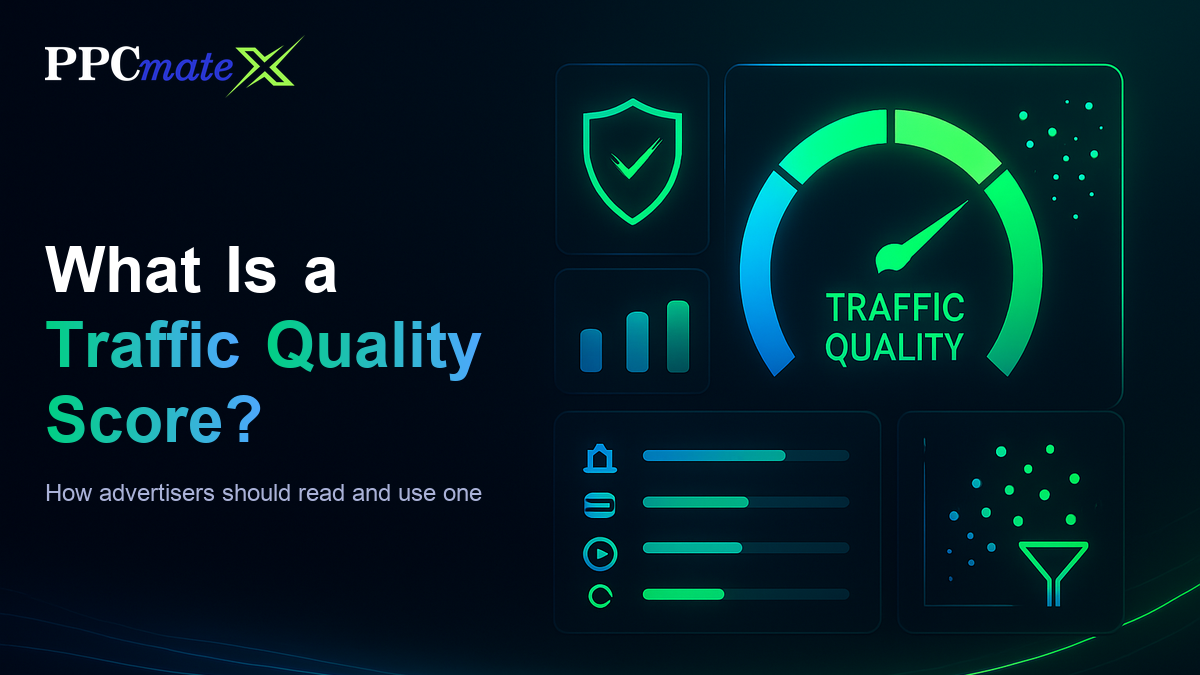
Most ad platforms, fraud tools and trackers now put some kind of quality label next to your traffic: a score, a grade, a colour or a trust band. It looks precise, and it is tempting to treat it as the final word on whether a source is good. In practice a traffic quality score is a summary of evidence, not a verdict, and advertisers who use it well treat it as a way to decide where to look first. This guide explains what goes into a quality score, what it can and cannot tell you, and a simple process for turning it into bid, budget and blocking decisions.
What a Traffic Quality Score Actually Is
A traffic quality score is a single figure or label that summarises how trustworthy a slice of traffic looks. That slice is usually a source: a website, an app, a publisher zone or a placement. Instead of asking you to read a dozen separate signals for every source, the scoring system combines them into one value you can sort and filter by.
The key word is combines. No single signal proves that traffic is fake or real. A visit from a data-center IP address is suspicious, but some real users browse through corporate networks. A very fast click is suspicious, but not every fast click is a bot. A score exists because many weak signals, taken together and measured over enough volume, are far more reliable than any one of them alone.
Score, filter and verdict are three different things
It helps to separate three ideas that are often blurred together:
- A filter acts on a single request or click, in real time, and either lets it through or refuses it. This is where most invalid traffic should be stopped.
- A score describes a source over time. It tells you how that source has behaved across many requests, including the ones filters let through.
- A verdict is the decision you make: scale, watch, cap or cut. The score informs it, but your own conversion data has to confirm it.
If you are new to the underlying problem, our guide to ad fraud and invalid traffic (IVT) covers the types of fake activity these systems are designed to catch.
The Signals Behind a Quality Score
Every vendor weights its inputs differently, and most do not publish their exact formulas, partly so that fraudsters cannot reverse-engineer them. The categories of evidence, though, are broadly similar across the industry.
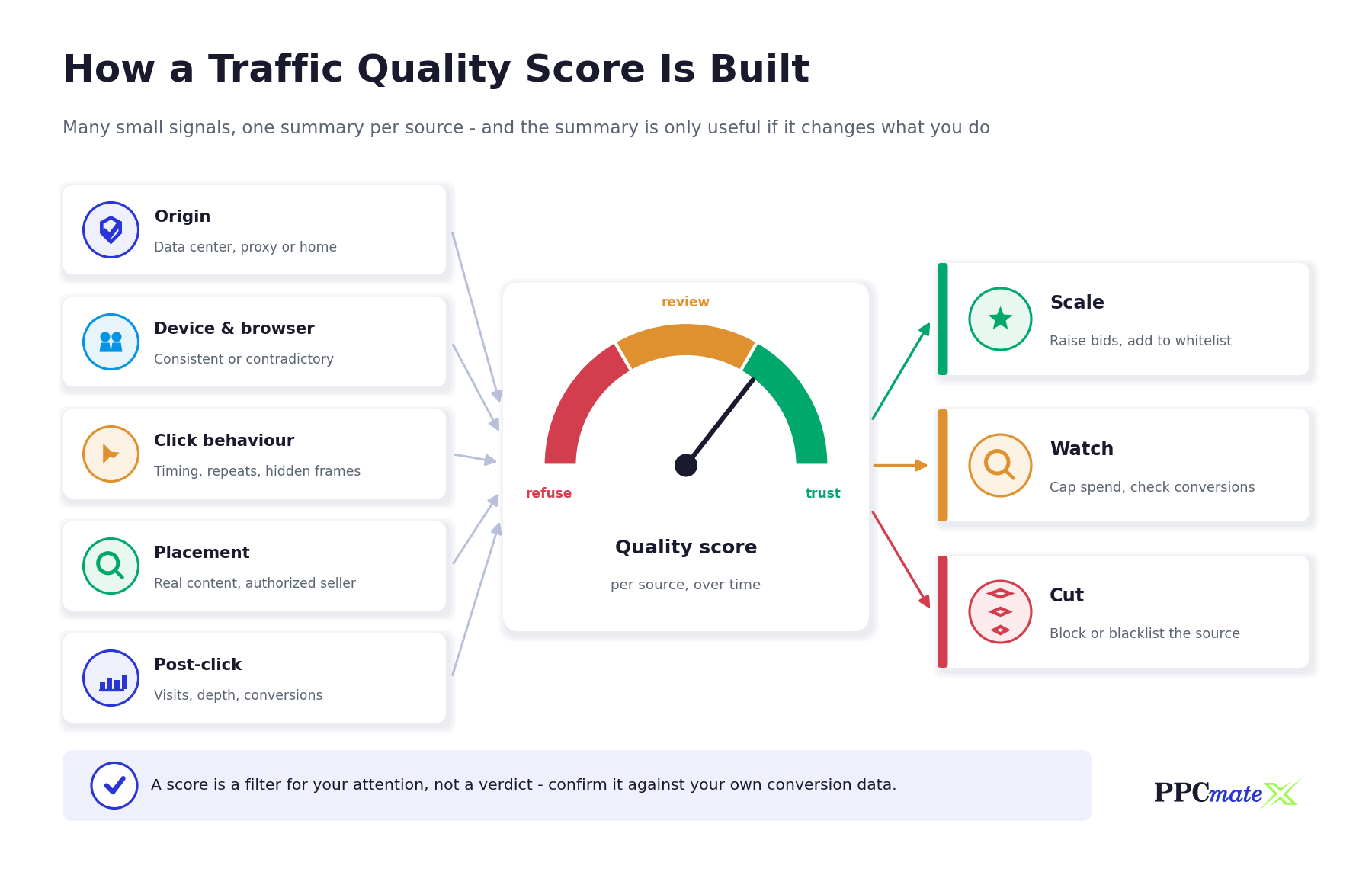
Origin signals
Where the request physically comes from. Traffic from hosting providers, cloud servers and known proxy or VPN networks is far more likely to be automated than traffic from residential and mobile connections. A mismatch between the declared location and the real network location is another warning sign.
Device and browser signals
Whether the device and browser details are internally consistent. Real devices tend to report details that agree with each other; automated traffic often reports outdated, impossible or contradictory combinations.
Click and interaction signals
How people interact with the ad. Clicks that land impossibly soon after the impression, repeated clicks from the same connection, clicks from hidden frames and clicks with no matching ad view all push a score down.
Placement and supply-chain signals
Whether the site or app is real and legitimately sold. That includes checking that the seller is authorised through ads.txt or app-ads.txt, that the supply chain is declared, and that the page content is what it claims to be rather than a spoofed or junk domain.
Post-click signals
What happens after the click, which is where your own data matters most. Landing page visits, time on site, scroll depth and conversions are the hardest signals to fake at scale, and they are the ones only you and your tracker can see in full.
What a Quality Score Can and Cannot Tell You
A score is useful precisely because it simplifies. That simplification also creates blind spots, and knowing them keeps you from over- or under-reacting.
| Question | What the score can tell you | What it cannot tell you |
| Is this source likely automated? | Yes, especially at volume, when many signals agree | Whether one specific click was a bot |
| Will this source convert for my offer? | Only indirectly, through engagement signals | Offer fit, pricing or landing page problems |
| Should I block this source today? | Whether it belongs on your review list | The final decision without your conversion data |
| Is a high-scoring source safe forever? | That it has behaved well so far | Whether it will stay clean next month |
| Why did the score change? | That its behaviour shifted | The exact cause, unless the vendor shows the reasons |
The middle row is the one advertisers miss most often. A source can be made of entirely real people and still be wrong for your offer. That is a targeting or creative problem, not a quality problem, and our guide to bot traffic vs low-quality traffic explains how to tell the two apart.
How to Use a Traffic Quality Score, Step by Step
The goal is to let the score direct your attention and your own data make the decision. This routine works on any platform that shows quality data at source level.
- Make sure conversions are tracked by source. Without a working postback, a score is the only evidence you have, which is not enough to act on. Set up postback tracking first.
- Wait for enough volume. A score based on a handful of requests is noise. Judge a source once it has had a meaningful amount of spend and traffic for your format.
- Sort the source report by spend, then look at quality. A poor score on a source that spent almost nothing matters less than a middling score on one of your biggest sources. Our guide to reading a source-level report covers this in detail.
- Place each source in one of four groups by reading its score next to its conversion performance, as shown in the matrix below.
- Act on the group, not on the score alone. Scale clean converters, cap and investigate the uncertain ones, and cut sources that are poor on both counts.
- Record the decision. Move proven sources to a whitelist and confirmed bad ones to a blacklist so the decision sticks. See whitelist vs blacklist targeting.
- Re-check on a schedule. Scores drift as supply changes. A weekly review per source catches decay before it becomes expensive.
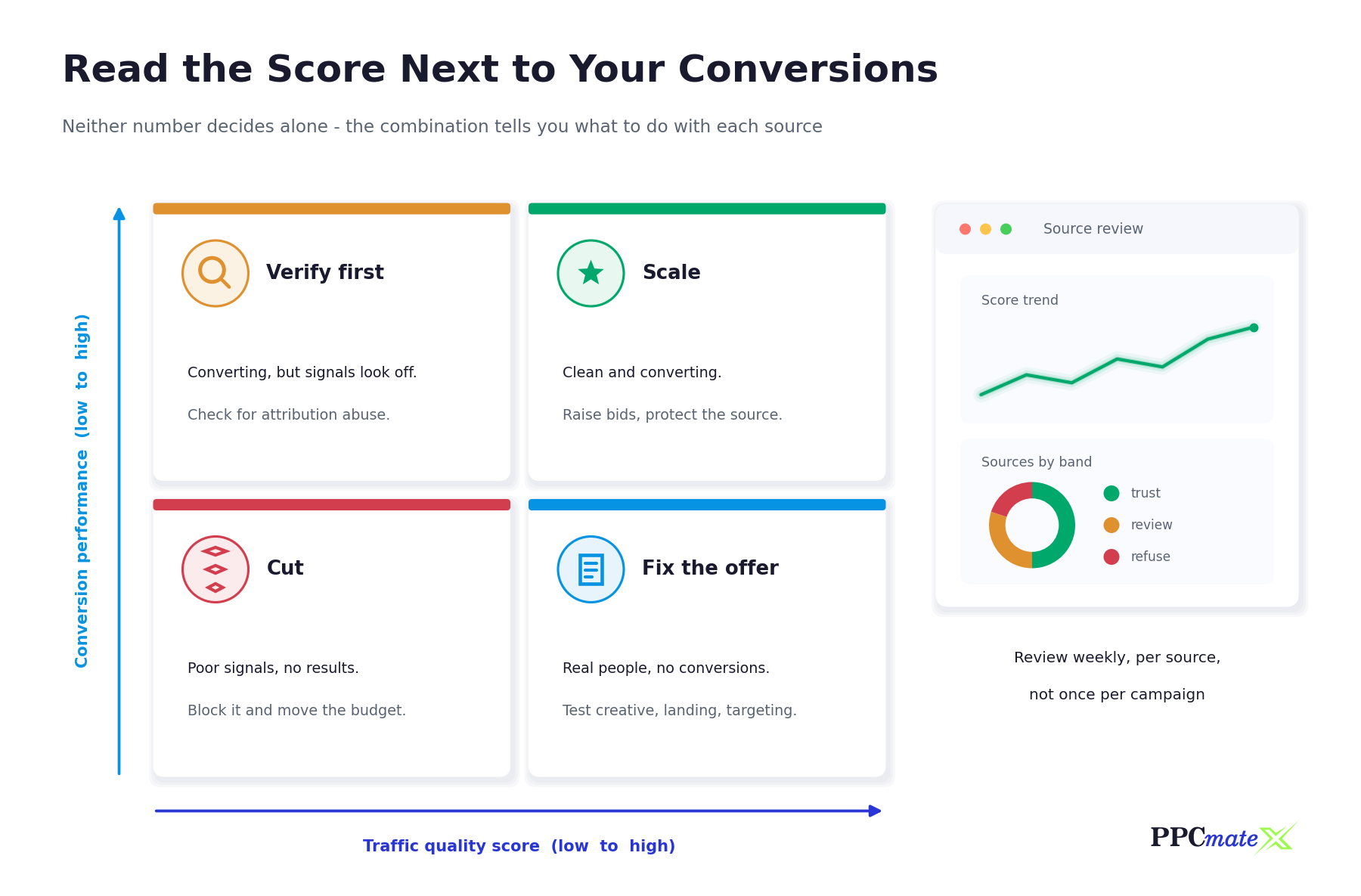
The four combinations
- High score, converting: your best sources. Raise bids gradually and protect them on a whitelist.
- High score, not converting: real people who are not responding. Test the creative, the landing page and the targeting before blaming the traffic.
- Low score, converting: treat with care. It may be a genuine source with an unusual audience, or conversions that are themselves not genuine. Verify conversion quality with the offer owner before scaling.
- Low score, not converting: the easy decision. Block it and move the budget to sources that are working.
Quality Score vs Viewability vs Conversion Rate
Quality scores are often confused with two other metrics. Viewability measures whether an ad had a real chance to be seen; it says nothing about whether the viewer was human (our viewability guide covers this). Conversion rate measures outcomes for your specific offer. A quality score sits between them: it estimates whether the traffic was genuine and engaged, regardless of your offer. All three together give a much clearer picture than any one of them.
Common Mistakes to Avoid
- Treating the score as a verdict. Blocking every source below an arbitrary threshold removes cheap, converting inventory along with the bad.
- Judging on too little data. Early scores swing widely. Give sources enough volume before you draw conclusions.
- Comparing scores across vendors. Each system uses its own inputs and scale. A value from one tool does not mean the same thing in another.
- Ignoring the reasons. Where a platform shows why traffic was refused or flagged, read it. The reason tells you whether to block, adjust targeting or simply wait.
- Setting and forgetting. A source that was clean last month can decline. Review on a schedule, not only when results drop.
- Scaling low-score converters blindly. Conversions that look too good on suspicious traffic deserve a check with the offer owner before you raise bids.
How PPCmate Handles Traffic Quality
On PPCmate, most protection happens before a bid is placed: requests from known bad sources, data centers, inconsistent devices and unauthorised sellers are refused rather than bought. Anything refused after delivery is excluded from your bill, and every campaign has a Quality Receipt showing where your ads ran, what was filtered and why. The full list of checks is published on our Traffic Quality & IVT Policy page. That means the source report you optimise from starts cleaner, and your quality review can focus on fit and performance rather than on basic fraud.
Want to see what gets filtered before you pay for it? Read the PPCmate Traffic Quality policy, then launch a campaign and open its Quality Receipt from your Campaigns list.
FAQs
What is a traffic quality score?
A traffic quality score is a single value or label that summarises how trustworthy a traffic source looks, based on many signals such as origin, device consistency, click behaviour, placement and post-click engagement.
Is a traffic quality score the same as a fraud score?
They overlap but are not identical. A fraud score focuses on the likelihood that traffic is automated or fake, while a broader quality score can also reflect engagement and placement quality among real users.
Should I block every source with a low quality score?
No. Use a low score to put a source on your review list, then check its conversions. Block it once poor quality and poor results agree, or when the platform shows a clear invalid-traffic reason.
How much data do I need before trusting a score?
Enough that the score has stopped swinging from day to day. The exact volume depends on your format and budget, but a few dozen clicks is rarely enough to judge a source.
Can I compare quality scores between different platforms?
Not directly. Each vendor uses its own inputs, weighting and scale, so the same number can mean different things in different tools. Compare trends within one system instead.
Why does a high-quality source sometimes not convert?
Because quality measures whether the traffic is genuine, not whether it suits your offer. Real people can still be the wrong audience, or be put off by the creative or landing page.
How often should I review traffic quality?
Weekly at source level is a sensible default for active campaigns, plus an immediate check whenever spend or conversion rate on a major source changes sharply.
Does PPCmate charge for traffic it refuses?
No. According to PPCmate’s published traffic quality policy, any view or click refused after delivery is excluded from your bill and shown as not charged in your reports.