Bot Traffic vs Low-Quality Traffic: How to Tell Them Apart
A source is burning budget and returning almost nothing. Before you decide what to do about it, you have to answer one question: is this traffic non-human, or is it human traffic that simply is not worth what you are paying for it? The two problems produce reports that look almost identical, but they call for opposite responses. Blocking a merely mediocre source throws away reach you could have fixed with a bid change, while trying to optimise your way out of bot traffic just moves the same worthless inventory into a different line item.
This guide covers the difference between the two, the signals that separate them, a diagnostic sequence you can run on any source, and what to do once you have your answer.
What Each Term Actually Means
The two terms get used interchangeably in campaign post-mortems, which is exactly why so many media buyers apply the wrong fix. They describe different things.
Bot Traffic (Invalid Traffic)
Bot traffic is activity generated by software rather than a person: crawlers, scripts, automated browsers, click farms running headless sessions, and hijacked devices. In the programmatic world this sits under the broader label of invalid traffic, or IVT. The defining characteristic is that no human being was ever going to see or act on your ad. There is no version of this impression that converts, at any bid, with any creative. Our explainer on what ad fraud (IVT) is in programmatic advertising covers the categories in more detail.
Low-Quality Traffic
Low-quality traffic is real people who are a poor match for your offer, or who arrive in a context that makes them unlikely to act. Accidental clicks on a cluttered page, an audience in the wrong country or income bracket, users who came for content unrelated to your product, or visitors landing on a page that does not deliver what the ad promised. These are humans. They can, in principle, be converted, or at least bought at a price that makes sense. The problem is fit and price, not existence. Our guide to what quality website traffic is and why it matters goes deeper on what “quality” means on the buying side.
Why the Distinction Changes Your Next Move
Bot traffic is a supply integrity problem. The correct response is removal and escalation: you stop buying the source and you tell your platform, because the same operator usually sits behind neighbouring placements too. Low-quality traffic is an optimisation problem. The correct response is adjustment: narrow the targeting, fix the creative-to-landing-page promise, and lower the bid to what that audience is genuinely worth to you. Confusing the two either wastes inventory or lets fraud keep running.
The Signals That Separate Them
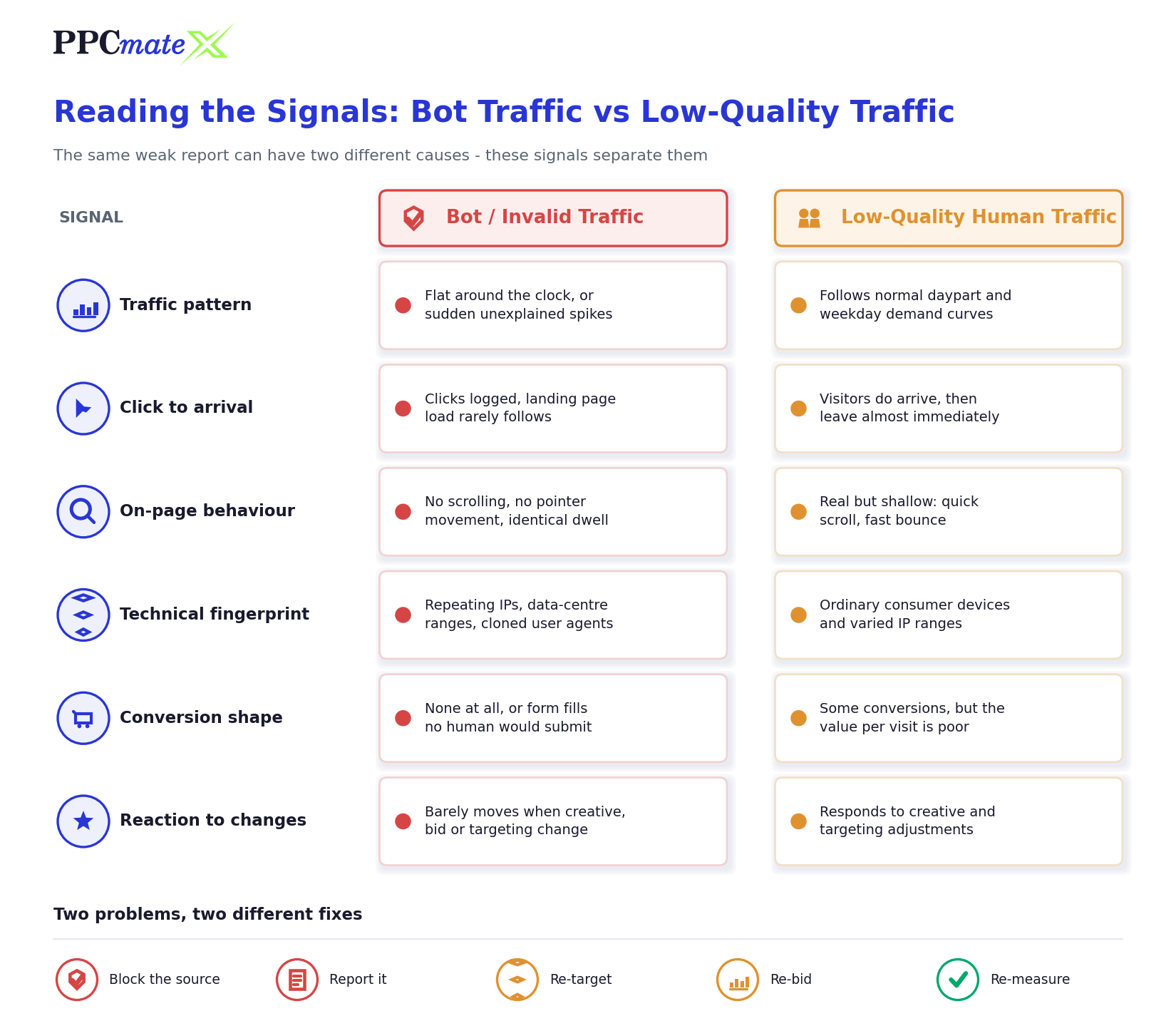
No single metric proves anything on its own. A high bounce rate can be a bot, a bad landing page, or an impatient but genuine audience. What gives you a reliable read is the combination of signals pointing the same way. Here is how the two profiles typically differ across the six things worth checking.
Traffic Pattern Over Time
Human audiences follow rhythms. Volume rises and falls across the day, dips overnight in the target geo, and looks different on weekends. Automated traffic often has no such shape: it runs flat around the clock, or arrives in sudden blocks that start and stop at unnatural boundaries. Pull an hourly view of the source before you judge it on daily totals, because daily aggregation hides exactly this signal.
The Gap Between Clicks and Arrivals
Compare the clicks your DSP reports against the sessions your analytics or tracker records on the landing page. Genuine traffic loses some volume here for ordinary reasons: slow connections, people backing out, tracking blockers. A source where clicks are logged in volume but almost no landing page loads follow is behaving as though nothing is on the other end of the click, because usually nothing is.
On-Page Behaviour
Low-quality human visitors are shallow but varied, and the spread of session lengths is messy in the way real behaviour is messy. Automated sessions tend to be uniform: identical dwell times, no scroll depth, no pointer movement, and an implausibly consistent path through the page.
Technical Fingerprint
Real audiences are technically diverse: many consumer ISPs, a long tail of device and browser versions, ordinary geographic spread within the target. Automated traffic tends to cluster tightly, with the same IP ranges repeating, data-centre address space where you would expect residential connections, or a narrow set of user agent strings.
The Shape of Conversions
Poor human traffic converts badly. Automated traffic usually does not convert at all, or converts in ways no person would: form fills with nonsense values, or sign-ups from addresses that never confirm. A source with a low but genuinely variable conversion rate is far more likely to be a targeting problem than a fraud problem.
How the Source Responds to Changes
This is the confirming test, and the one most advertisers skip. Change something meaningful, such as the creative, the bid, or a targeting layer, and watch whether the source reacts. Real audiences respond to relevance and to price. If performance is completely indifferent to every change you make, you are probably not buying an audience at all.
A Step-by-Step Diagnostic Sequence
Run these in order on any source you suspect. The sequence is deliberately cheap first and expensive last, so you rule out ordinary explanations before you go looking for fraud.
- Confirm the problem is source-specific. Compare the suspect source against the rest of the campaign over the same period. If every source degraded at once, the cause is more likely your creative, your offer, or your landing page than any single placement.
- Check for tracking and measurement breakage first. A broken postback, an expired tag, or a redirect that drops parameters produces a source that looks dead but is not. Rule this out before you draw conclusions about the traffic itself.
- Pull the hourly volume curve. Look for a plausible human daypart shape in the target geo. Flat 24-hour delivery or abrupt volume blocks are your first real warning sign.
- Compare clicks to landing page sessions. A large, persistent gap between what the platform reports and what your own tracker sees is the single strongest indicator that the click has no person behind it.
- Inspect on-page engagement depth. Look at the distribution, not the average. Uniformity is the signal; messiness is normal.
- Review the technical spread. Check IP diversity, device and browser variety, and whether the geography matches what you targeted.
- Run a deliberate change test. Adjust creative or targeting and give it enough volume to read. Indifference to change is your confirmation.
- Act, then re-measure on clean data. Once the source is removed or adjusted, compare only periods after that change, so the old numbers do not contaminate your read.
Bot Traffic vs Low-Quality Traffic: Side by Side
A compact reference for the difference, including what each one costs you and what actually fixes it.
| Aspect | Bot / Invalid Traffic | Low-Quality Human Traffic |
| Who is behind the click | Software: scripts, crawlers, automated browsers, hijacked devices | A real person, but a poor match for the offer or context |
| Can it ever convert | No, at any bid or with any creative | Yes, at the right price and with better targeting or a better landing page |
| Typical volume pattern | Flat around the clock or arriving in unnatural blocks | Follows normal daypart and weekday demand curves |
| Behaviour on the landing page | Uniform: no scroll, no pointer movement, identical dwell | Shallow but varied, with a messy spread of session lengths |
| Response to optimisation | Largely indifferent to creative, bid and targeting changes | Reacts to relevance and price adjustments |
| Correct response | Block the source and escalate it to your platform | Tighten targeting, fix the click promise, and re-bid to real value |
| Risk of the wrong response | Optimising around it keeps paying for worthless inventory | Blocking it removes reach you could have made profitable |
What to Do Once You Know Which One You Have
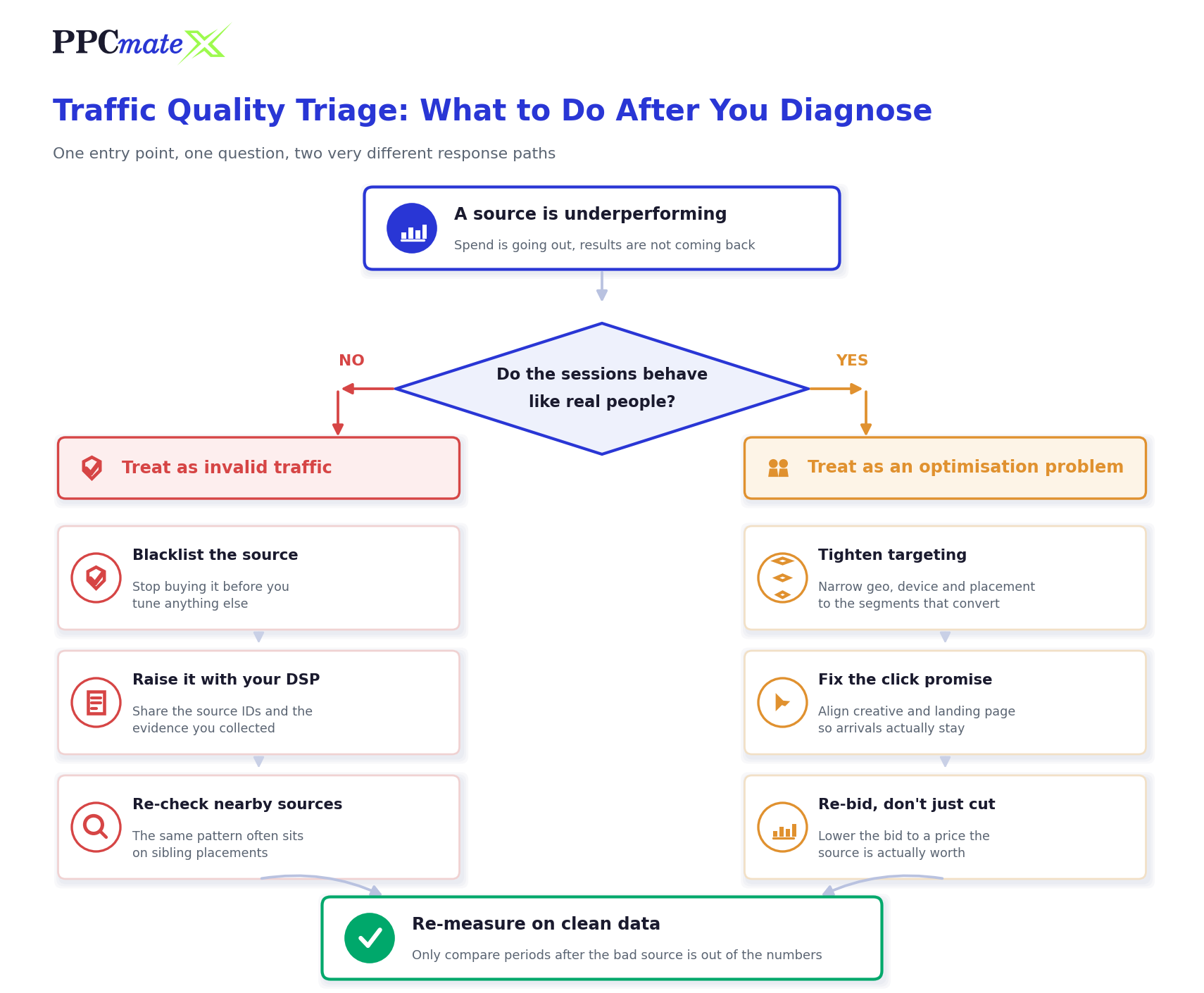
The diagnosis only matters if it changes your action. These are the two paths, and they converge on the same final step.
If It Looks Like Invalid Traffic
Stop buying the source before you tune anything else, then raise it with your platform and share the source IDs along with the evidence you collected. Check the neighbouring placements too, because the same pattern frequently sits on sibling inventory from the same operator. Building a considered source list is the durable version of this work, and our guide on whitelist vs blacklist targeting covers how to run one without over-pruning.
If It Looks Like Low-Quality Human Traffic
Treat it as an optimisation problem. Narrow geo, device and placement targeting toward the segments that actually convert. Align the creative with the landing page so the people who do arrive are not immediately disappointed. Then re-bid rather than simply cutting: a source that is unprofitable at one price is often perfectly reasonable at a lower one, and cutting it outright removes reach you could have kept.
Do Not Skip the Re-Measurement
Whichever path you took, compare only the periods after the change. If your “before and after” window still contains the bad source, the improvement you are looking at is partly an artefact of the old data rather than a result of the fix.
Where Viewability Fits In
Viewability is a third thing that often gets folded into this conversation, and it should not be. An impression can be perfectly valid and served to a real person while still never entering the viewport. Keep the “was it seen” question separate from “was it human” and “was it the right human”, because each has its own fix. Our post on what viewability is in display advertising covers that side, and how fake followers distort paid campaign performance covers a related distortion further down the funnel.
Common Mistakes to Avoid
- Judging a source on a single metric. Bounce rate alone, or conversion rate alone, cannot distinguish a bot from a badly matched human. Only the combination of signals gives you a reliable read.
- Blocking everything that underperforms. Blacklisting is the right tool for invalid traffic and the wrong tool for a source that just needs a lower bid. Over-pruning quietly shrinks your reach.
- Optimising around traffic that has no human behind it. New creative and refined targeting cannot rescue impressions nobody was ever going to see.
- Calling it fraud before checking your own tracking. Broken postbacks and expired tags produce exactly the same “clicks but no sessions” symptom. Rule out measurement breakage first.
- Judging on daily totals only. Daily aggregation hides the hourly pattern, which is often where the clearest evidence lives.
- Deciding on too little volume. A handful of clicks will look strange for entirely innocent reasons. Wait for enough data that the pattern is stable.
- Never re-checking after you act. Both fixes need a clean measurement window afterwards, or you cannot tell whether anything actually improved.
Running Campaigns With Traffic Quality Controls Built In
Diagnosing traffic after the fact is necessary, but the less of it you have to do, the better. PPCmate scans traffic through multiple anti-fraud filters before it reaches your campaigns, combining internal filtering with third-party verification partners, so that more of the diagnosis described above is handled before you are paying for the impression. You can read how that layer works on our Real-Time Ad Protection page, and combine it with source-level reporting to keep the remaining optimisation work honest.
FAQs
What is the difference between bot traffic and low-quality traffic?
Bot traffic is generated by software rather than a person, so it can never convert. Low-quality traffic comes from real people who are a poor match for your offer or context, so it can convert at the right price with better targeting. Bot traffic needs to be blocked; low-quality traffic needs to be optimised.
How can I tell if a traffic source is sending bots?
Look for several signals pointing the same way: a flat 24-hour volume pattern, clicks that are logged without matching landing page sessions, uniform on-page behaviour with no scroll or pointer movement, clustered IPs or data-centre address ranges, and performance that does not change when you adjust creative or targeting.
Is a high bounce rate a sign of bot traffic?
Not on its own. A high bounce rate can equally mean a slow or mismatched landing page, or a real audience that is simply not interested. Bounce rate only becomes evidence of automation when it appears alongside other signals, particularly uniform session behaviour and a large gap between clicks and recorded sessions.
Should I block low-quality traffic sources?
Usually not straight away. If the traffic is human, the first moves are tighter targeting, better creative-to-landing-page alignment, and a lower bid that reflects what that audience is actually worth. Blocking is appropriate when a source is invalid, or when it stays unprofitable even at a minimum bid.
Why do clicks and landing page sessions not match?
Some gap is normal and comes from slow connections, users backing out, and tracking blockers. A large and persistent gap on one specific source is different, and usually means the click is being recorded without a real browser ever loading the page. Always rule out broken tracking before concluding it is invalid traffic.
Does invalid traffic mean the same thing as ad fraud?
They overlap but are not identical. Invalid traffic (IVT) covers all non-human or otherwise non-billable activity, including innocent sources such as search engine crawlers. Ad fraud refers specifically to traffic generated with the deliberate intent to extract advertiser spend.
How much data do I need before judging a source?
Enough that the pattern is stable rather than a small-sample artefact. A handful of clicks will look unusual for entirely innocent reasons. Give the source enough volume that the hourly pattern, the click-to-session gap, and the behavioural spread are all readable before deciding.
What should I do after blocking a bad source?
Check nearby placements from the same operator, since the same pattern often sits on sibling inventory. Then re-measure using only periods after the block, so the removed source is not still distorting your comparison.