Ad Viewability vs Ad Fraud: What Advertisers Should Know
Viewability and ad fraud are often reported on the same screen and discussed in the same breath, so it is easy to treat them as one problem with one fix. They are not. Viewability asks whether an ad had a real chance to be seen. Ad fraud asks whether there was a genuine person and a genuine placement behind the impression at all. An impression can pass one test and fail the other, and advertisers who confuse the two end up blocking good placements or paying for bad traffic that happens to look visible. This guide explains the difference, where the two overlap, and how to diagnose which one you are dealing with.
Viewability and Ad Fraud Answer Different Questions
The simplest way to keep them apart is to remember the question each one answers.
Viewability: could the ad be seen?
Viewability is a measurement of opportunity. Under the widely used Media Rating Council (MRC) baseline, a display impression counts as viewable when at least half of its pixels are on screen for one continuous second, and a video impression when half of the player is on screen for two continuous seconds. An ad that loads below the fold, in a tab the user never opens, or in a slot that is scrolled past instantly is served but not viewable. Nothing dishonest has to happen for that to be the case. Our guide to viewability in display advertising covers the standard and how it is measured in detail.
Ad fraud: was anyone genuine there?
Ad fraud, reported in the industry as invalid traffic (IVT), is about authenticity. It covers impressions and clicks that do not come from a real person with real interest, or that are sold under false pretences: bots and scripts, traffic from data centers, spoofed domains, fake apps, and ads deliberately hidden from view while still being billed. The MRC separates it into general invalid traffic, which is caught by routine filters such as known bot and data-center lists, and sophisticated invalid traffic, which is built to imitate people and needs deeper analysis. Our guide to ad fraud and invalid traffic (IVT) explains the main types.
Put side by side: viewability is a quality-of-placement metric that applies to real audiences, while fraud is a validity question that decides whether the impression should count in the first place.
Viewability vs Ad Fraud: Side-by-Side Comparison
| Aspect | Viewability | Ad fraud (invalid traffic) |
| Question it answers | Did the ad have a chance to be seen? | Was the impression or click genuine? |
| Typical cause | Page layout, slot position, user scrolling behaviour | Deliberate deception or automated activity |
| Is anyone at fault? | Usually not; it is a property of the placement | Yes; someone is misrepresenting traffic or inventory |
| How it is detected | Measurement script watching the ad’s position in the browser window | Pre-bid filters, behavioural analysis, supply-chain checks |
| Where it shows in reports | Viewable rate per placement or source | Refused, filtered or invalid traffic per source |
| Usual fix | Change bids, exclude the slot, choose better positions | Block the source and rely on pre-bid filtering |
| Should you pay for it? | Depends on your buying model and goals | No; invalid traffic should not be billed |
The last two rows matter most in practice. Low viewability is a reason to optimise. Invalid traffic is a reason to refuse the traffic altogether.
The Four Combinations Every Impression Can Fall Into
Because the two checks are independent, every impression lands in one of four groups.
- Real and viewable. A person was there and the ad was on screen. This is the only group that can actually influence anyone, and it is what your budget is meant to buy.
- Real but not viewable. A person loaded the page, but the ad sat below the fold or was scrolled past. The traffic is honest; the placement is weak.
- Invalid but viewable. A bot running a full browser can load a page, scroll and keep an ad on screen long enough to be counted as viewable. The viewability report looks healthy while no person saw anything.
- Invalid and not viewable. Hidden-ad schemes such as stacked or tiny invisible ads. Both checks fail, and it is the easiest group to catch when both are measured.
The third group is the one that surprises advertisers. A high viewable rate is not evidence of human traffic. In fact, a source with near-perfect viewability and no engagement at all deserves a closer look rather than a bigger budget.
Where Viewability and Ad Fraud Overlap
There is a narrow area where the two meet: fraud techniques that work by hiding the ad. These are fraud by intent and non-viewable by result.
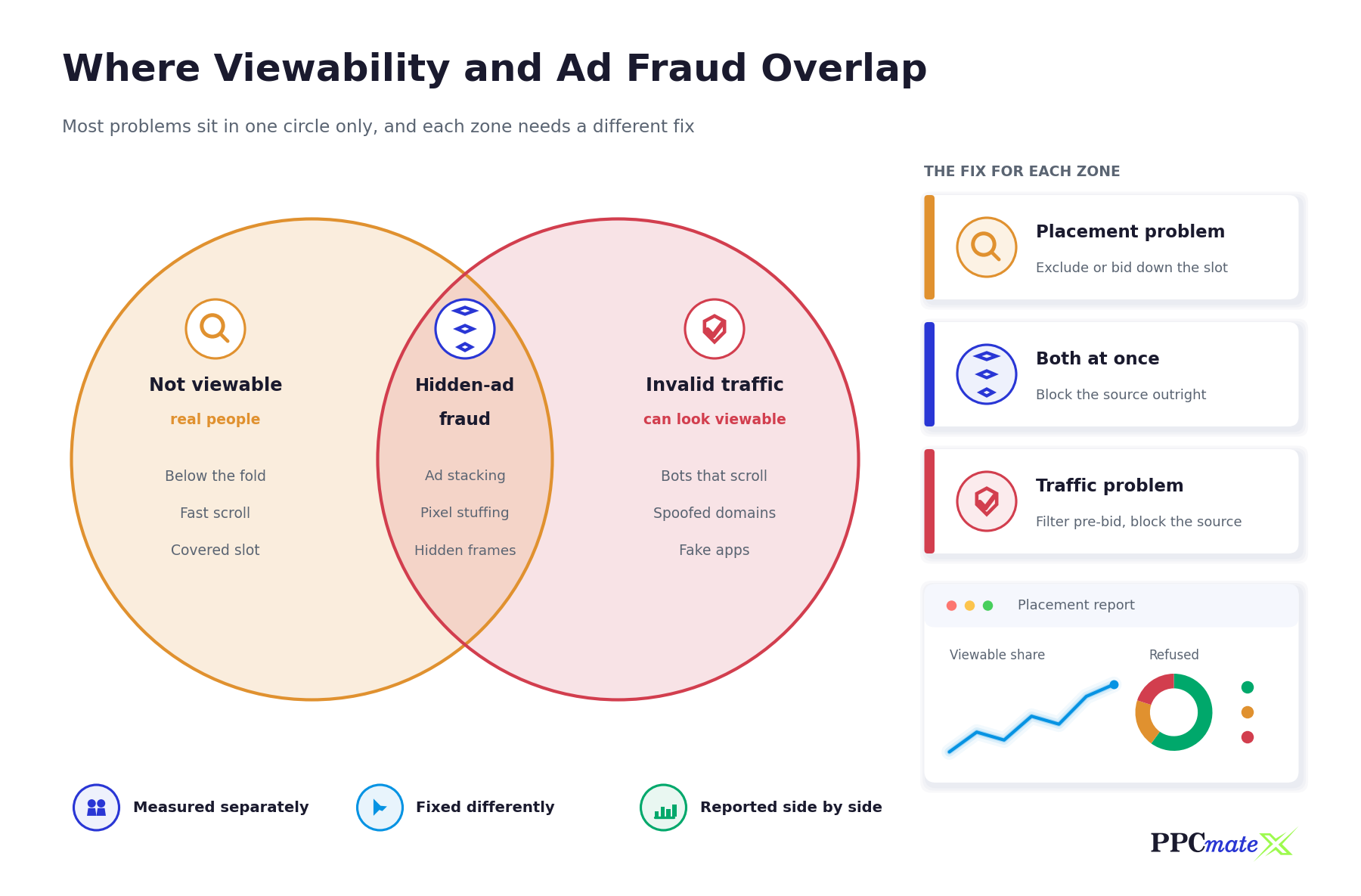
Ad stacking
Several ads are layered on top of each other in one slot. Only the top one can be seen, but an impression is recorded for every layer.
Pixel stuffing
A full-size ad is loaded into a frame so small that it cannot be seen. The ad server records a normal impression for an ad that occupies almost no screen space.
Hidden frames and background loads
Ads are loaded in frames positioned off-screen, behind other content, or in pages that open without the user noticing. The publisher side collects impressions while the visitor sees nothing.
Viewability measurement is useful against this group because a hidden ad cannot meet the on-screen threshold. It does nothing, however, against fraud that is designed to look visible, which is why viewability can support fraud detection but never replace it.
How to Tell Which Problem You Have
When a source underperforms, work through the checks in order. The aim is to avoid treating a placement problem as fraud, or fraud as a placement problem.
- Pull the report by source and placement, not by campaign. Campaign averages hide the individual sites and zones where the problem sits. See our guide to reading a source-level report.
- Check invalid-traffic signals first. Look at how much traffic from the source was refused or flagged, and why. If your platform provides a quality label, use it as a pointer; our guide to traffic quality scores explains how to read one.
- Then look at the viewable rate. Compare each source with the others in the same campaign and format, not with a universal target. Formats and devices behave differently.
- Compare viewability with engagement. Real audiences produce a believable pattern: viewable impressions lead to some clicks, visits and time on site. Very high viewability with no downstream activity, or clicks without matching viewable impressions, points towards invalid traffic.
- Check your own post-click data. Landing page visits and conversions recorded by your tracker are the hardest signals to fake at scale. They also help separate bots from real visitors who are simply the wrong audience, a distinction covered in bot traffic vs low-quality traffic.
- Decide the action by diagnosis. Honest but poorly viewable placements get a lower bid or an exclusion. Sources showing invalid-traffic patterns get blocked, whatever their viewable rate.
- Record the decision. Add proven sources to a whitelist and confirmed bad ones to a blacklist so the result carries over to future campaigns. See whitelist vs blacklist targeting.
Quick symptom guide
- Low viewable rate, normal engagement from the viewable part: a placement problem. Optimise position and bids.
- Low viewable rate and impressions far out of proportion to visits: possible hidden-ad fraud. Block and report the source.
- High viewable rate, no clicks, visits or conversions over meaningful volume: possible automated traffic. Review the invalid-traffic signals before spending more.
- High viewable rate with healthy engagement: working as intended. Protect the source and scale carefully.
Why the Order of the Two Checks Matters
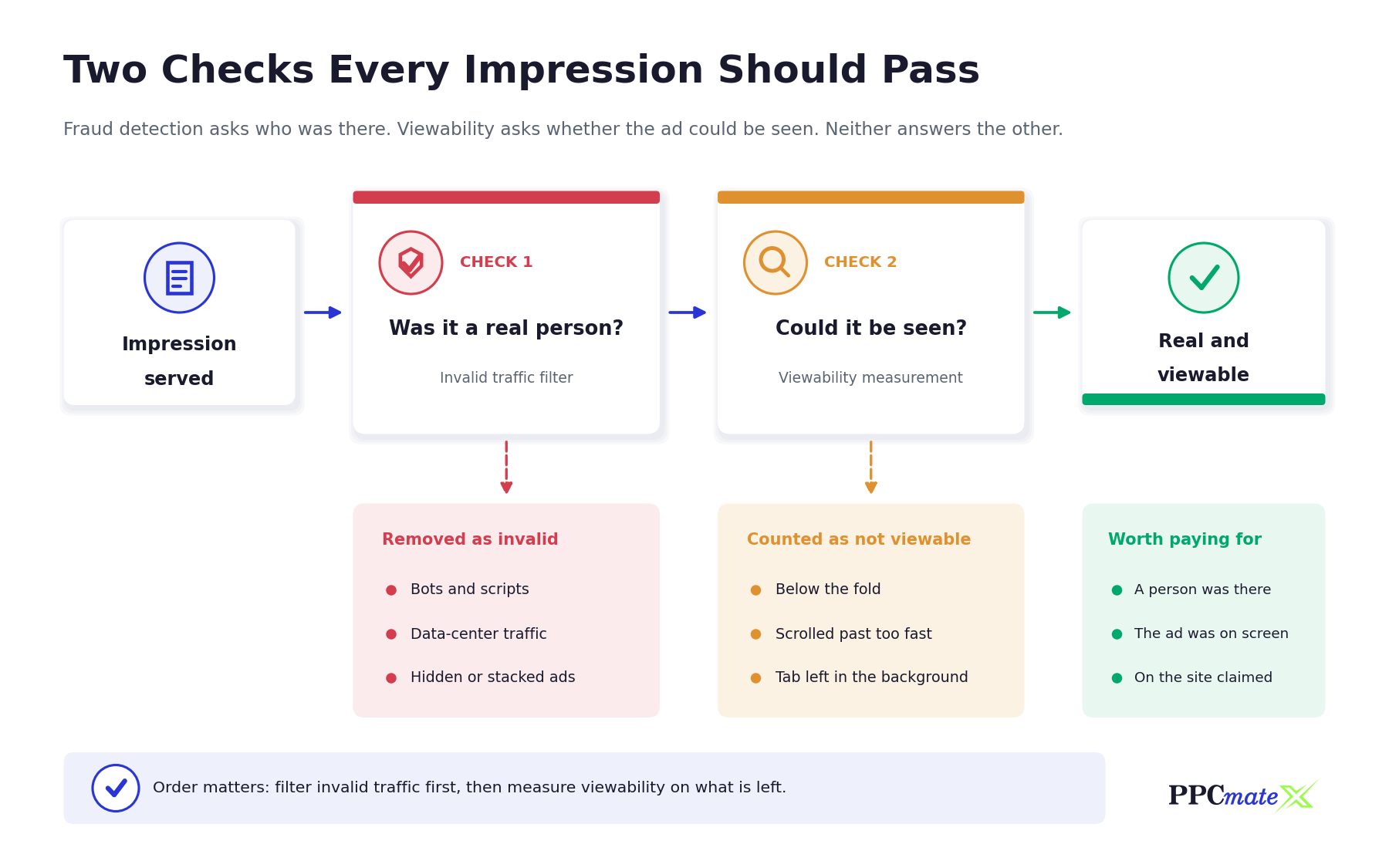
Industry measurement guidelines treat invalid traffic filtering as a step that comes before viewability reporting: invalid impressions are meant to be removed first, and the viewable rate calculated on what remains. The logic is straightforward. If bot impressions are left in, they can raise or lower the viewable rate depending on how the bot behaves, and the figure stops describing your real audience.
For an advertiser this has two practical consequences. First, a viewable rate is only as trustworthy as the fraud filtering underneath it, so it is worth knowing whether your platform filters before or after it measures. Second, paying only for viewable impressions does not by itself protect you from fraud, because some invalid traffic is viewable by design.
Common Mistakes to Avoid
- Treating high viewability as proof of human traffic. Automated browsers can keep an ad on screen. Viewability measures the screen, not the viewer.
- Calling every low-viewability placement fraud. Most non-viewable impressions come from ordinary page layout and scrolling, and the right response is a bid or placement change.
- Optimising for viewable rate alone. Chasing the highest figure can push budget towards sources that have learned to look good on that one metric.
- Judging on campaign averages. Both problems are concentrated in specific sources. An acceptable average can hide a few very poor placements.
- Comparing formats on one threshold. A pop-under, a banner and a video unit have different viewability standards and typical ranges. Compare like with like.
- Ignoring post-click data. Without conversions tracked by source, you cannot confirm whether viewable impressions reached real, interested people.
- Reacting to tiny samples. A handful of impressions tells you nothing about either metric. Wait for meaningful volume before blocking or scaling.
How PPCmate Handles Both Checks
PPCmate treats the two as separate layers. According to our published Traffic Quality & IVT Policy, most protection happens before a bid is placed: requests from known bad sources, data centers, fake browsers, spoofed domains and unauthorised sellers are refused rather than bought. Views and clicks are checked again after delivery, and anything refused is not charged. Separately, we measure whether pop-under and banner ads were actually visible, and advertisers can require a minimum viewable percentage per campaign.
Every active campaign also has a Quality Receipt that shows where your ads ran, how much traffic was refused before and after delivery and why, and viewability against the platform norm, so both checks are visible in one place.
Want to see what is filtered and what is viewable on your own campaigns? Read the PPCmate Traffic Quality policy, then launch a campaign and open its Quality Receipt from your Campaigns list.
FAQs
What is the difference between viewability and ad fraud?
Viewability measures whether an ad had a real chance to be seen on screen. Ad fraud concerns whether the impression or click came from a genuine person and a genuine placement. An impression can pass one test and fail the other.
Is a non-viewable impression fraudulent?
Usually not. Most non-viewable impressions are caused by normal page layout and scrolling, such as an ad placed below the fold. It becomes fraud only when the ad is deliberately hidden while still being billed.
Can bot traffic be viewable?
Yes. A bot running a full browser can load a page and keep an ad on screen long enough to meet the viewability threshold, which is why a high viewable rate does not prove that people saw the ad.
Does high viewability mean my traffic is clean?
No. Viewability describes where the ad appeared on the screen, not who or what was behind the screen. Confirm traffic quality with invalid-traffic reporting and your own post-click data.
Which types of ad fraud affect viewability?
Hidden-ad techniques such as ad stacking, pixel stuffing and off-screen frames. They record impressions for ads that cannot be seen, so they fail viewability measurement as well as being fraud.
Should invalid traffic be removed before viewability is measured?
Yes. Industry measurement guidelines expect invalid traffic to be filtered out first, so that the viewable rate describes real audiences rather than a mix of people and bots.
How should I respond to low viewability compared with invalid traffic?
For low viewability on honest traffic, lower the bid or exclude the placement. For invalid traffic, block the source entirely, whatever its viewable rate.
Does PPCmate measure viewability and filter invalid traffic?
Yes. According to PPCmate’s published traffic quality policy, traffic is checked before bidding and after delivery, refused traffic is not charged, and viewability is measured for pop-under and banner ads with an optional minimum per campaign.