Common Native Advertising Mistakes Advertisers Should Avoid
Native advertising rewards campaigns that fit the page they appear on, which is exactly why it punishes habits carried over from display or search. A campaign can look busy — impressions delivered, clicks arriving, budget spending on schedule — while every one of those clicks lands somewhere that was never going to convert.
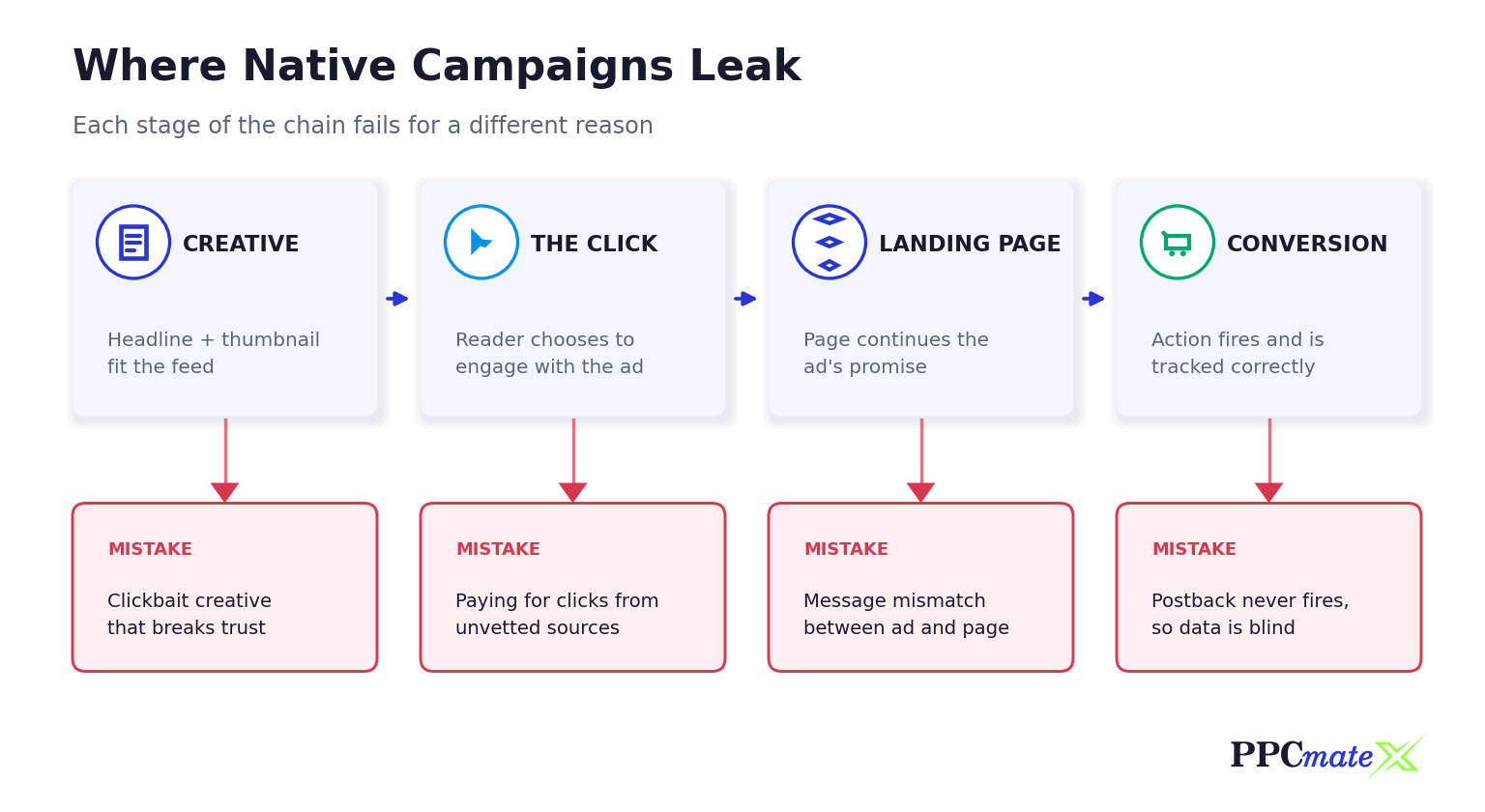
The mistakes below are the ones that show up most often when a native campaign underperforms, grouped by where in the chain they actually break something: the creative, the click, the landing page, the tracking, and the way the campaign is managed after launch. Each one includes what to do instead.
Why Native Campaigns Fail Differently From Display
A display banner is understood as an ad the moment it loads. A native ad is not — it sits inside a content feed and earns attention by looking like it belongs there. That single difference changes what counts as a mistake. Aggressive creative that merely underperforms in display can actively damage a native campaign, because the reader clicked expecting content and got something else. The mechanics of that fit are covered in how native ads work, and the format-level differences in native ads vs display ads.
It also changes where a campaign leaks. In native, the gap between a click and a conversion is usually wider than in search, because the reader was not looking for the product — they were reading something else. Every extra mismatch between the ad and what follows it widens that gap.
Creative Mistakes That Break Native Performance
Writing Clickbait Headlines Instead of Honest Ones
Curiosity-gap headlines reliably lift click-through rate and just as reliably damage everything downstream. The reader arrives already suspicious, bounces quickly, and the platform’s relevance signals register the poor engagement. The click was paid for; the visit was wasted. A headline that states the actual offer attracts fewer clicks, and a much higher share of them are worth having.
Using Stock Imagery That Looks Like an Ad
Polished product renders and corporate stock photography read as advertising instantly, which defeats the point of the format. Native thumbnails perform better when they look like the images already in the feed: real, specific, slightly imperfect. If a thumbnail would look out of place in the surrounding content, it will be scrolled past.
Running a Single Creative and Calling It a Test
One headline and one image cannot tell you whether the creative or the targeting is the constraint. Native creative also fatigues faster than display creative, because the same readers return to the same feeds. A campaign with a single ad has no way to distinguish fatigue from a genuine audience problem.
Targeting and Source Mistakes
Treating All Traffic Sources as One Audience
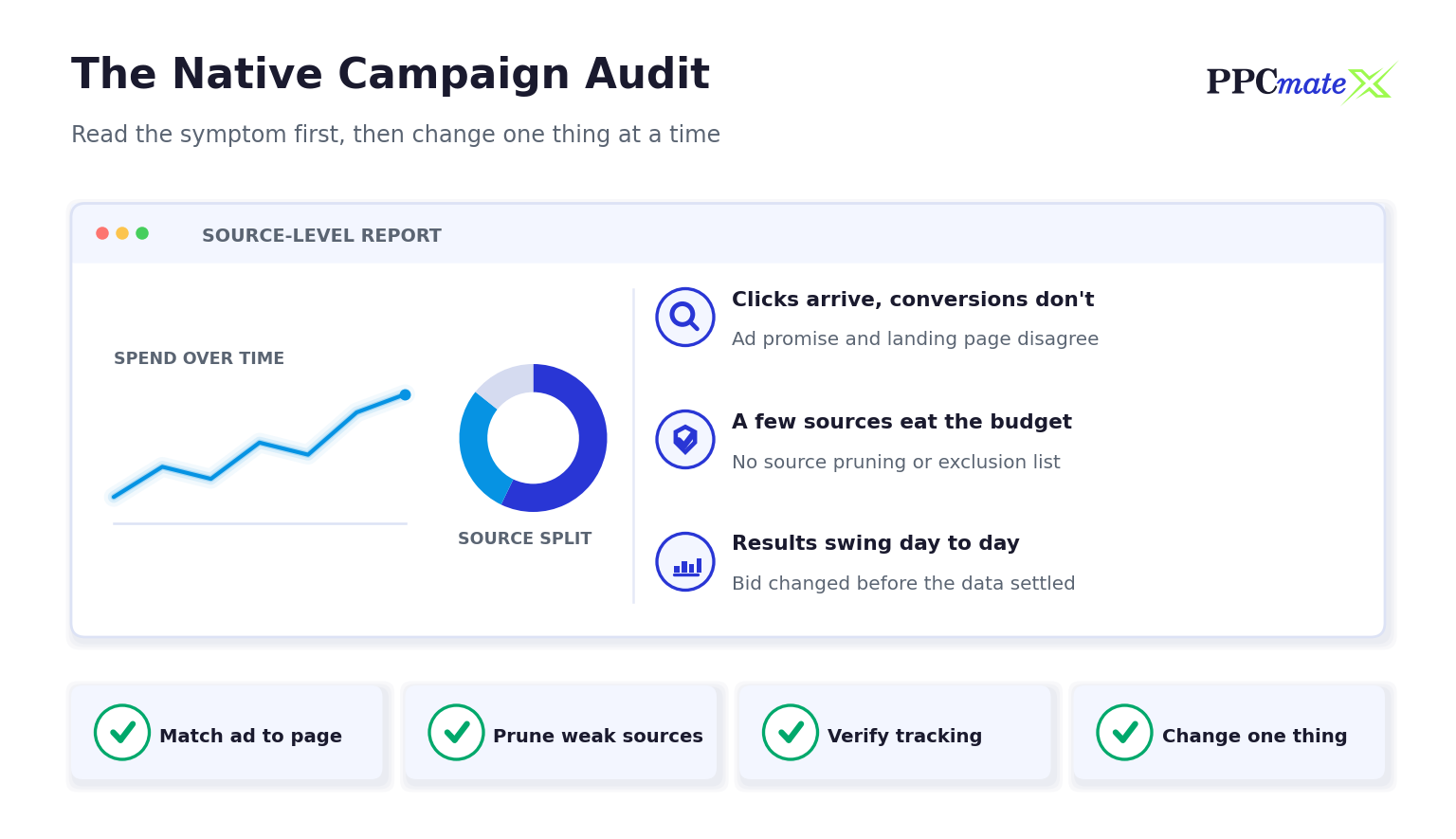
Native inventory is bought across many publishers and placements, and their performance is rarely close to even. Reviewing results only at the campaign level hides that spread completely: a handful of sources can absorb most of the budget while contributing almost nothing, and the campaign average looks merely mediocre rather than broken. Source-level reporting is the minimum granularity for native.
Never Building an Exclusion List
Sources that consistently deliver clicks without conversions do not improve on their own. Excluding them is the single highest-leverage optimisation in native, and it compounds — every excluded source redirects budget toward inventory that has already proven itself. The practical approach to building and maintaining those lists is covered in whitelist vs blacklist targeting.
Targeting Too Narrowly at Launch
Stacking device, geo, browser, operating system, and interest filters on day one leaves the campaign with too little volume to learn from. Native optimisation is a subtraction process: start broad enough to generate signal, then remove what does not work. Starting narrow removes the evidence you would need to know what to remove.
Ignoring Frequency
Without a frequency cap, the same readers see the same ad repeatedly in the same feeds. The impressions are billed, but the incremental chance of conversion falls with each repeat. See frequency capping for how to set a sensible ceiling.
Landing Page and Tracking Mistakes
Sending Native Traffic to a Hard-Sell Page
Search traffic arrives with intent; native traffic arrives mid-scroll. A page that opens with a pricing table and a signup form asks for a decision the reader has not begun to make. Native converts better into pages that continue the ad’s story first — an article, a comparison, a short explainer — with the offer placed after the reader has a reason to care.
Message Mismatch Between the Ad and the Page
If the ad promises one thing and the landing page headline says another, the reader has to work out whether they are in the right place. Most will not bother. The ad headline and the page headline should be recognisably the same promise, in the same words where possible.
Launching Before Conversion Tracking Is Verified
A campaign without working conversion tracking is not a campaign, it is an expense. Postbacks that were never tested, click IDs that are not passed through, and conversion events that fire on the wrong page all produce the same outcome: the reporting shows clicks and no conversions, and there is no way to tell whether the traffic is bad or the measurement is. Fire a test conversion end to end before spending.
Ignoring Mobile Page Speed
Most native inventory is mobile. A landing page that takes several seconds to become usable loses a meaningful share of the traffic that was just paid for, before any of the copy has a chance to work.
Campaign Management Mistakes After Launch
The remaining mistakes are not about setup at all — they are about what happens in the first week, when the temptation to intervene is strongest and the data is weakest.
Judging a Campaign Before It Has Data
Native campaigns need a learning window before their numbers mean anything — typically 24 to 72 hours, depending on daily volume. Pausing or overhauling a campaign inside that window reacts to noise, and it also resets whatever the platform had begun to learn about which placements suit the ad.
Changing Several Variables at Once
Raising the bid, widening the geo, swapping the creative, and lifting the daily cap in a single session guarantees that the result — better or worse — cannot be attributed to anything. Change one variable, let it run long enough to read, then change the next.
Setting the Bid by Instinct Rather Than by Delivery
Bidding too low starves a campaign of the volume it needs to learn; bidding too high buys impressions the campaign cannot convert profitably. Bid decisions belong to delivery data and source-level results, not to a starting guess — the full method is in the native ads bidding strategy guide.
Optimising for Clicks Instead of the Business Metric
Click-through rate is a diagnostic, not a goal. Optimising toward it selects for exactly the creative that oversells — the clickbait problem, arrived at through the reporting instead of the copywriting.
Mistake vs Correction at a Glance
| Common mistake | What it costs | What to do instead |
| Clickbait headline | High CTR, poor engagement, weakened relevance signals | State the real offer; accept fewer, better-qualified clicks |
| No source-level review | Weak placements quietly absorb budget | Review by source and build an exclusion list as evidence accumulates |
| Over-filtered targeting at launch | Too little volume to learn anything | Start broad, subtract what underperforms |
| Hard-sell landing page | Mid-scroll readers bounce before the offer | Continue the ad’s story first, then present the offer |
| Unverified conversion tracking | Spend with no reliable signal to optimise on | Fire a test conversion end to end before launching |
| Multiple changes at once | No way to attribute a result to a cause | Change one variable per test window |
| Judging results too early | Reacting to noise and resetting the learning phase | Hold changes through a full learning window |
How to Audit a Native Campaign That Is Underperforming
When a campaign is already running and results are poor, work through it in this order. The sequence matters: each step rules out a cause before you spend money testing the next one.
- Confirm tracking works. Fire a test conversion through the full path and check it appears in reporting. Everything downstream is unreliable until this is verified.
- Check delivery. If impressions are far below the budget, the bid is likely below the effective floor for the sources being targeted — a delivery problem, not a creative one.
- Break results down by source. Sort by spend and look for placements consuming budget without conversions. Exclude the clearest offenders.
- Compare click-through rate against conversion rate. Strong clicks with weak conversions points at the landing page or the offer, not the targeting.
- Re-read the ad and the landing page together. If the promises differ, fix the page before touching bids or targeting.
- Review creative fatigue. If performance decayed gradually rather than starting poor, rotate in new headlines and thumbnails before changing anything else.
- Only then adjust the bid, one change at a time, and let each change run through a full learning window before reading the result.
Common Mistakes to Avoid
- Copying display creative directly into native placements, where banner-style visuals read as advertising and get skipped.
- Reviewing performance only in aggregate, which hides the source-level spread that drives most native outcomes.
- Launching without an exclusion list plan, so weak placements keep being paid for week after week.
- Treating click-through rate as the objective rather than as a diagnostic signal.
- Assuming the traffic is fraudulent before checking tracking, page speed, and message match — the ordinary explanations are far more common.
- Leaving a single creative running for weeks and reading its decline as an audience problem instead of fatigue.
- Rebuilding a campaign from scratch instead of fixing the one component that failed, which discards the learning already paid for.
Run Native Campaigns With the Data to Catch These Early
Most of these mistakes are only expensive because they stay invisible. PPCmate’s native ads platform gives advertisers source-level reporting, exclusion controls, and direct bid control in one place, so a weak placement or a broken tracking path shows up while the budget is still small. If you are setting up a first native campaign, the native advertising guide walks through formats, targeting, and creative setup before launch.
FAQs
What is the most common native advertising mistake?
Judging a campaign before it has enough data. Native campaigns need a learning window of roughly 24 to 72 hours, and changes made inside it react to noise rather than to a trend.
Why do my native ads get clicks but no conversions?
The usual causes, in order of likelihood: conversion tracking is not firing correctly, the landing page does not match the ad’s promise, or a few weak traffic sources are supplying most of the clicks. Check tracking first, then source-level reporting.
Is clickbait ever worth it in native advertising?
No. It inflates click-through rate while degrading engagement, conversion rate, and the relevance signals that determine what an advertiser pays for future placements.
How long should I run a native campaign before optimising it?
Give it a full learning window — commonly 24 to 72 hours depending on daily volume — and enough conversion volume that a difference between sources is not just chance.
Should I start native targeting broad or narrow?
Broad enough to generate meaningful volume, then subtract. Over-filtering at launch leaves the campaign without the data needed to identify what actually works.
Why does my native campaign spend so much on a few placements?
Native inventory volume is uneven across publishers, so without source-level review and an exclusion list a handful of high-volume placements can absorb most of a budget regardless of how they perform.
Do native ads need a different landing page than search ads?
Usually yes. Search visitors arrive with intent and tolerate a direct offer; native visitors arrive mid-scroll and convert better on a page that continues the ad’s story before presenting the offer.
How many creatives should a native campaign start with?
Enough to separate creative performance from targeting performance — several headline and thumbnail combinations rather than one, since native creative also fatigues faster than display.