How Do Native Ads Work? A Simple Guide for Advertisers
Native ads look like they belong on the page, but behind that simple appearance is the same auction-driven delivery system that powers most programmatic advertising. Understanding what happens between a user loading a page and a native ad appearing helps advertisers set up campaigns that actually perform, instead of guessing at targeting and bids.
This guide walks through the native ad delivery process step by step, what determines which ad wins a placement, and how native compares to other formats in how it gets delivered.
What Happens When a Native Ad Loads
Every native ad placement starts the same way: a publisher’s page or app has a native ad slot built into its content or feed. When a user opens that page, the slot sends a request for an ad, and a real-time auction decides which advertiser’s creative fills it, all within a few hundred milliseconds.
A platform built for DSP media buying handles this process for advertisers, managing bids, targeting rules, and creative delivery across many publishers from one dashboard instead of negotiating placements one at a time.
Compare This to How Display Ads Load
The underlying auction mechanics are the same ones covered in how display ads work – the difference with native is mainly in the creative format and where the ad slot sits inside the content, not in how the bidding itself happens.
The Native Ad Auction, Step by Step
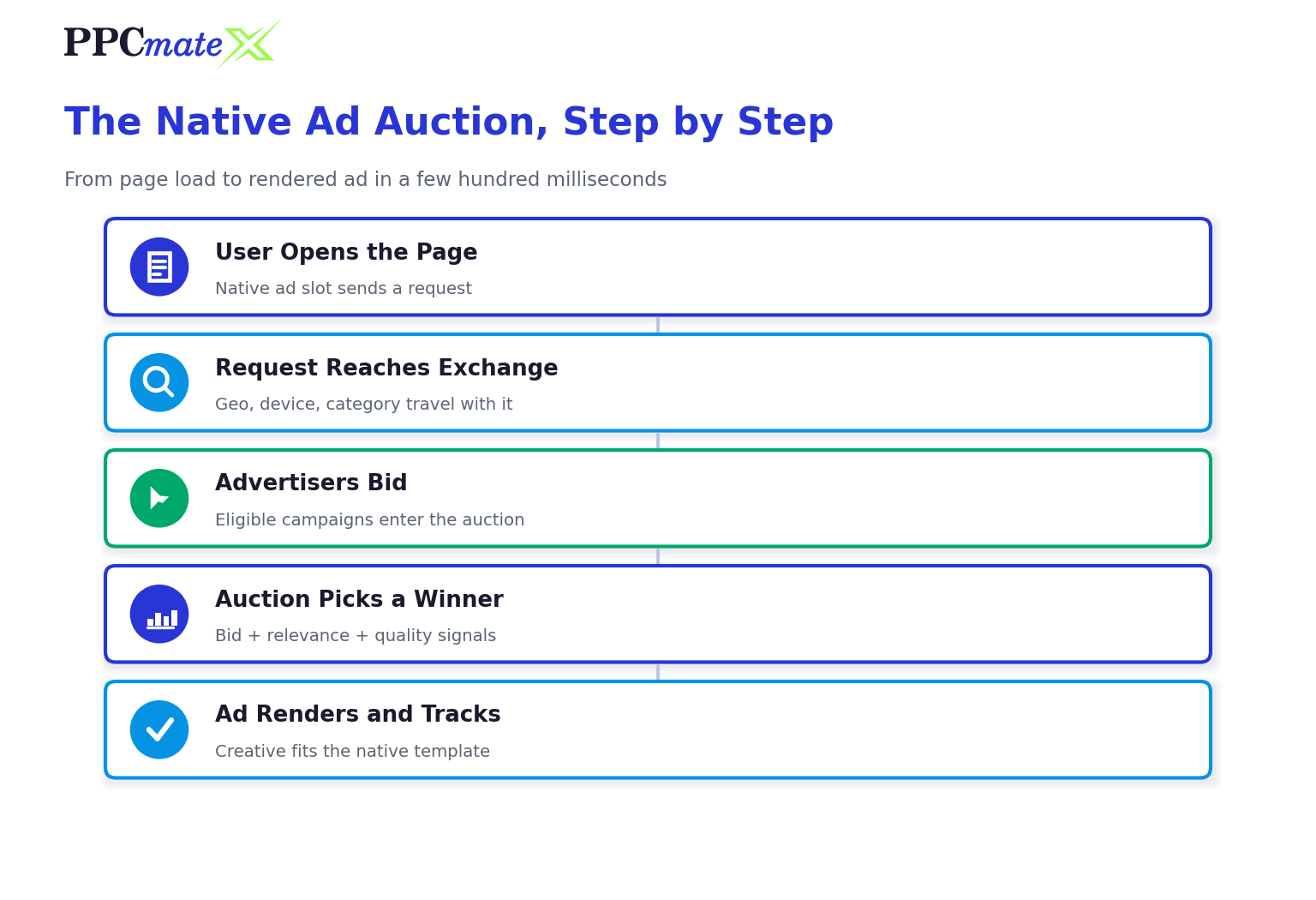
- User opens a page or app with a native ad slot
The publisher’s site sends an ad request the moment the slot becomes visible. - The request reaches the ad exchange
Details like page category, device, geo, and language travel with the request so advertisers can evaluate the match. - Eligible advertisers submit bids
Campaigns whose targeting rules match the request enter the auction, each with a bid based on how they value that impression. - The auction picks a winner
The winning bid is chosen based on bid amount combined with relevance and creative quality signals, not price alone. - The winning creative is assembled to fit the slot
Native ads pull the advertiser’s title, image, and description into the publisher’s own template so it matches the surrounding content style. - The ad renders and impression tracking fires
The platform logs the impression, and click or conversion tracking activates for that placement.
Where Real-Time Bidding Fits
Steps 3 and 4 above are real-time bidding in action – the auction that runs in the background of nearly every native, display, push, and video impression bought programmatically.
What Decides Which Native Ad Wins the Placement
Winning a native placement is rarely just about the highest bid. Platforms weigh several signals together:
- Bid amount – what the advertiser is willing to pay for that specific impression
- Content category match – how well the offer fits the publisher’s content, since native performs best in-context
- Targeting match quality – geo, device, and audience rules matching the actual user
- Creative quality signals – expected engagement based on past performance of similar creative
- Frequency and pacing rules – whether the campaign has budget and frequency room left to serve
This is why two advertisers bidding the same amount can get very different results – the one with better targeting and quality signals wins more of the placements that matter.
How Native Ad Delivery Differs by Placement Type
| Placement Type | How It’s Delivered | Typical Use |
| In-feed native | Inserted directly into a content or social feed | Publisher sites, social-style apps |
| Content recommendation widget | Served after an article as a “you may also like” unit | News and content sites |
| In-ad native | Delivered into a standard ad slot but styled to match the page | Sites without dedicated native slots |
| Search and listing native | Blended into organic search or marketplace results | Search engines, marketplaces |
All four placement types run through the same auction mechanics described above – what changes is where the winning creative ends up rendering.
Common Mistakes to Avoid
- Assuming the highest bid always wins, and ignoring content-match and quality signals
- Using the same creative across every placement type instead of adapting to each layout
- Not checking which content categories the campaign is actually delivering into
- Treating native the same as display in targeting setup, when context match matters more for native
- Ignoring frequency and pacing settings, which affect how much of the auction a campaign can compete in
Ready to Launch Native Campaigns That Understand the Auction?
PPCmate’s native ads platform gives advertisers direct control over targeting, bidding, and source-level reporting, so campaigns can compete for the right placements instead of just the cheapest ones.
FAQs
How do native ads actually get delivered?
A publisher’s native ad slot sends a request the moment a user views the page, a real-time auction picks a winning advertiser, and that advertiser’s title, image, and description are assembled into the publisher’s own native template.
Does the highest bidder always win a native placement?
No. Bid amount is combined with content-category match, targeting match quality, and creative quality signals, so a lower bid with a stronger match can still win over a higher bid with a weak match.
How fast does the native ad auction happen?
The entire request, auction, and creative delivery process typically completes in a few hundred milliseconds, before the page finishes rendering for the user.
What is the difference between in-feed native and a recommendation widget?
In-feed native is inserted directly into a content or social feed as if it were the next post, while a recommendation widget appears after an article as a “you may also like” style unit, usually with several ads shown together.
Is native ad delivery different from display ad delivery?
The underlying real-time bidding auction works the same way for both formats. The difference is mainly in creative format and placement style – native blends into the page’s own content template, while display renders as a distinct banner.
What signals can advertisers control to win more native placements?
Advertisers can adjust bids, refine targeting to better match relevant content categories, and improve creative quality – all three directly influence how competitively a campaign performs in the auction.
Why does content-category match matter so much for native?
Native ads rely on blending into their surroundings, so an offer that matches the publisher’s content topic reads as more trustworthy and relevant, which improves both auction performance and post-click results.