Native Ads vs Display Ads: What’s the Difference?
Native ads and display ads are both paid placements that run through the same programmatic pipes, but they look, target, and price out differently. Advertisers who treat them as interchangeable often end up with the wrong format for the goal — a banner where a native ad would convert better, or a native unit where a banner would reach a wider audience faster.
This guide breaks down what separates native ads from display ads, how each one is targeted and priced, and how to decide which format — or which mix of both — fits a given campaign.
Native Ads vs Display Ads: The Core Difference
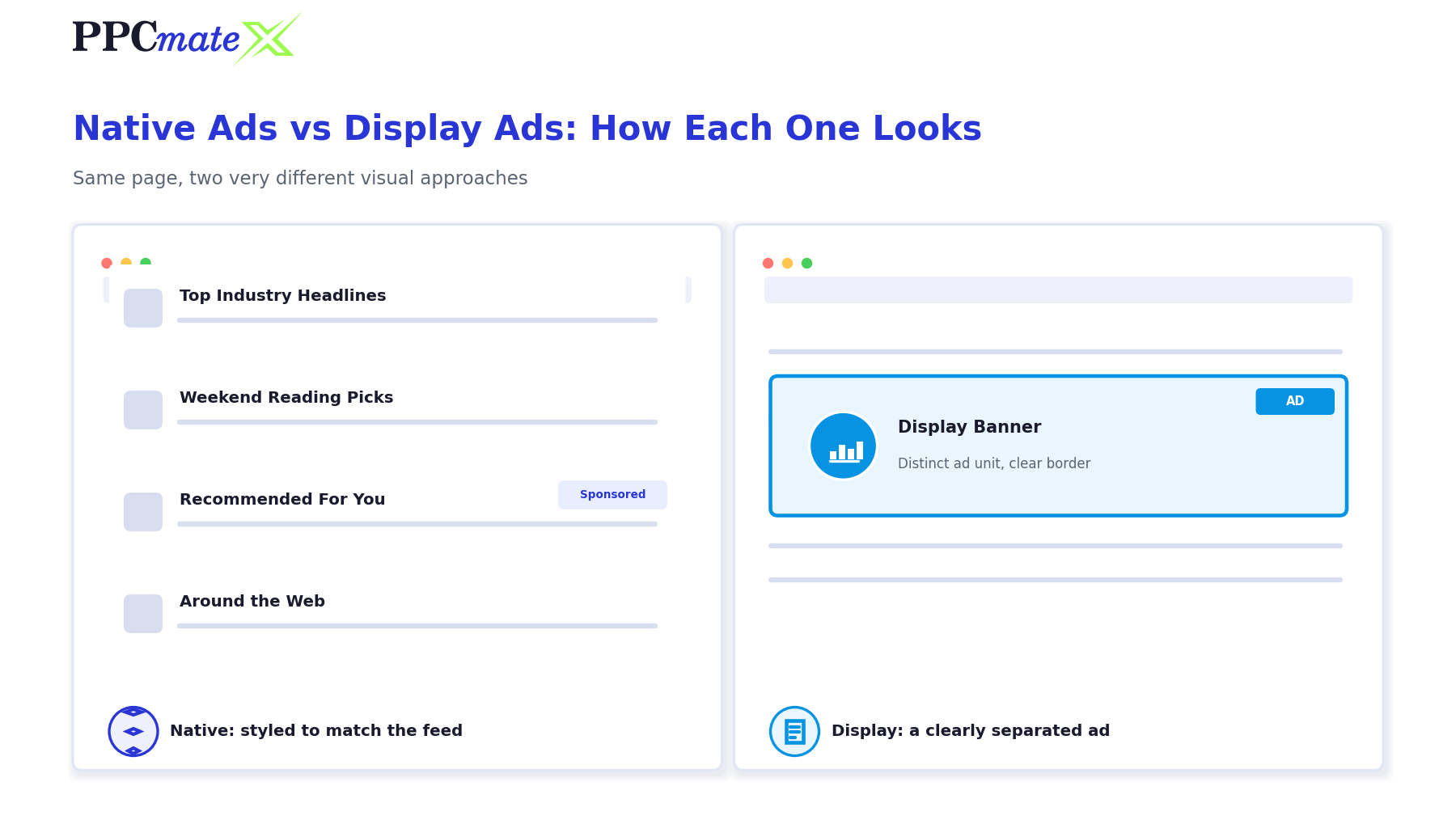
Native ads are designed to match the visual style of the page or feed they appear in. A native ad in a content feed looks like the next feed item; a native ad on a news site looks like a recommended article. The promotional intent is disclosed with a “Sponsored” or “Promoted” label, but the ad does not visually interrupt the page.
Display ads are visual ads — banners, rich media, interstitials — that sit in a clearly defined ad slot with its own border, size, and placement, separate from the surrounding content. Readers instantly recognize them as ads because they look different from the page around them.
That single distinction — blending in versus standing out — is what drives most of the other differences between the two formats: how users respond to them, how they’re targeted, and how they’re priced.
How Native Ads and Display Ads Actually Work
How Native Ads Work
A DSP matches an advertiser’s native creative — a headline, thumbnail image, and short description — to available in-feed or content-recommendation slots. The publisher’s template controls the final look, so the same native ad can render slightly differently across sources while still fitting each page’s style. See the full native ad auction walkthrough for the step-by-step mechanics.
How Display Ads Work
A display campaign submits a fixed-size creative — a banner or rich media unit — into standard ad slots defined by the publisher’s layout (leaderboard, sidebar, interstitial). The creative renders the same way across every placement that supports that size, which makes display easier to test at scale across many sources at once.
Native Ads vs Display Ads: Side-by-Side Comparison
| Factor | Native Ads | Display Ads |
| Visual style | Matches the surrounding content or feed | Distinct, bordered ad unit |
| Common creative | Headline, thumbnail image, short description | Fixed-size banner or rich media unit |
| Typical bid model | CPC-leaning, priced on engagement | CPM-leaning, priced on impressions |
| Best suited for | Considered offers that benefit from a story-driven lead-in | Broad reach, retargeting, fast creative testing |
| Creative testing speed | Slower — each headline/image pair needs time to read performance | Faster — standard sizes make it easy to rotate many creatives |
| User perception | Lower banner blindness, reads as content | Instantly recognized as an ad |
Targeting: What Changes Between the Two Formats
The underlying targeting signals are the same for both formats — geo, device, source, audience segment, and time of day — because both run through the same DSP. What changes is how those signals interact with the creative:
- Placement matters more for native. A native ad’s performance depends heavily on how well the creative fits the specific feed or content type it lands in, so source-level targeting and testing carry more weight.
- Frequency matters more for display. Because display ads are visually obvious, users notice repetition faster. Frequency capping is a bigger lever for display campaigns than for native ones.
- Retargeting favors display. A recognizable banner reminds a past visitor of the brand more directly than a native unit that blends into whatever page it lands on.
- Lookalike and audience targeting apply to both. Lookalike audiences built from converting users work the same way regardless of which format the campaign runs.
Bidding and Cost: CPC vs CPM
Native campaigns typically lean toward cost-per-click (CPC) bidding, since the format is built to earn a deliberate click rather than a passive glance. Display campaigns typically lean toward cost-per-thousand-impressions (CPM) bidding, since the goal is often reach or repeated exposure rather than an immediate click.
Neither rule is fixed — a real-time bidding platform lets advertisers run either format on either model. But the default alignment (native/CPC, display/CPM) reflects how each format is typically consumed: native for a considered click, display for volume and visibility.
How to Choose the Right Format for Your Campaign
- Start with the goal. Awareness and reach favor display; a considered click on a specific offer favors native.
- Look at the offer type. Content, finance, health, and subscription offers that benefit from context tend to perform better as native.
- Check the funnel stage. Top-of-funnel reach and retargeting typically run better on display; native fits mid-funnel engagement.
- Match the creative you have. A strong headline-and-thumbnail story favors native; a polished banner set favors display.
- Test both at a small budget first. Run a limited split test before committing most of the budget to one format.
- Let source-level data decide the mix. Once results come in, shift budget toward whichever format is converting better on the sources that matter most.
Signs You Should Run Both Formats Together
- The campaign has both an awareness goal and a direct-response goal in the same funnel
- The offer works for a broad audience but also has a considered-purchase angle worth testing
- Budget is large enough to properly test two formats without starving either one
- The traffic sources available include strong inventory for both content feeds and standard ad slots
Common Mistakes to Avoid
- Using the same creative for both formats. A banner resized into a native slot looks out of place, and a native headline dropped into a banner loses its context.
- Judging native by display benchmarks. Native click-through patterns differ from display, so comparing raw CTR across formats without adjusting for format is misleading.
- Ignoring frequency on display. Skipping frequency caps on a recognizable banner burns budget on users who have already tuned it out.
- Picking a format by preference instead of funnel stage. The right format depends on the campaign goal, not which one an advertiser is more used to running.
- Not testing source-level performance separately per format. A source that performs well for display may not perform the same for native, and vice versa.
Run Native and Display From One Platform
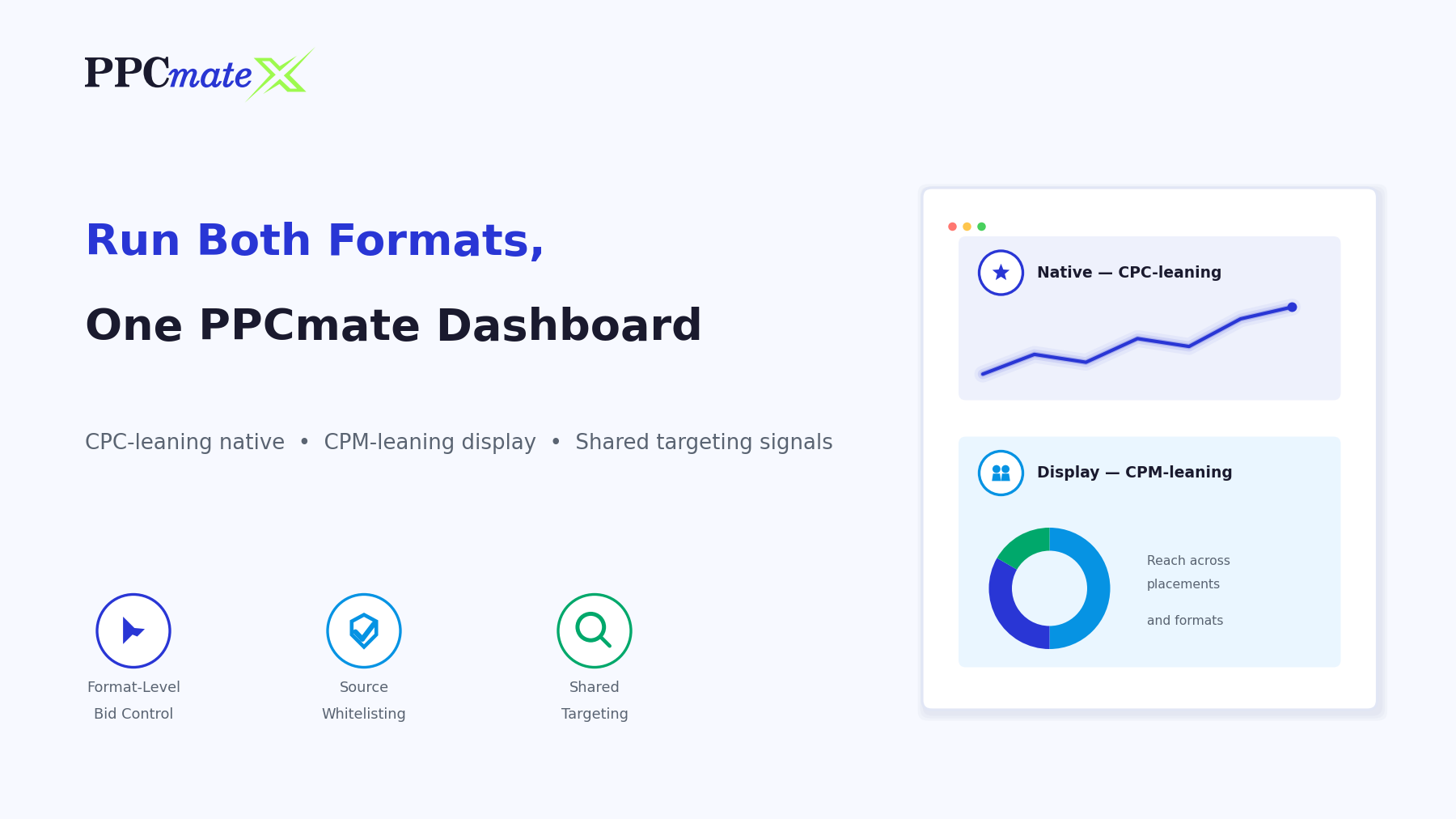
PPCmate’s self-serve DSP supports both native and display formats from the same dashboard, with shared targeting controls and format-level bid management. Explore the Native Ads and Display Ads product pages to see targeting options, supported placements, and how to launch a campaign in either format — or both.
FAQs
Are native ads more effective than display ads?
Neither is universally more effective — native tends to perform better for considered offers that benefit from context, while display tends to perform better for broad reach and retargeting.
Do native ads and display ads use the same targeting?
Yes, both run on the same core targeting signals — geo, device, source, and audience — through the same DSP. The difference is which signals matter most for each format’s creative.
Is native advertising more expensive than display advertising?
Cost depends on the bid model and competition for the placement, not the format itself. Native often runs on CPC and display on CPM, which makes a direct price comparison less useful than comparing cost per conversion.
Can I run native and display ads in the same campaign?
Yes. Many DSPs, including PPCmate, let advertisers run both formats under shared targeting and budget controls, with separate bid settings for each.
Why do native ads have lower banner blindness?
Because native ads are styled to match the surrounding content, users are less likely to automatically skip past them the way they’ve learned to skip past standard-looking banner ad slots.
Which format is better for retargeting?
Display is generally better for retargeting, since a recognizable banner reinforces brand memory more directly than a native unit designed to blend into unrelated content.
Do native ads need different creative sizes than display ads?
Yes. Native ads typically use a headline, thumbnail image, and short description that adapt to the publisher’s layout, while display ads use fixed banner dimensions that render the same everywhere.
How do I know if my campaign should use CPC or CPM bidding?
If the goal is a specific action from an engaged user, CPC bidding lets you pay only for clicks. If the goal is broad visibility or repeated exposure, CPM bidding lets you control cost per impression instead.