What Is a Lookalike Audience in Programmatic Advertising?
Most advertisers eventually run out of easy wins on their existing audience — the people who already converted, subscribed, or bought. A lookalike audience solves a specific problem: it finds new users who resemble that proven group closely enough to convert at a similar rate, without the advertiser manually rebuilding targeting criteria from scratch.
This guide covers what a lookalike audience actually is, how programmatic platforms build one from a seed audience, how it compares to retargeting and other targeting methods, how to set up a first lookalike campaign, and the mistakes that quietly cap its performance.
What a Lookalike Audience Actually Is
A lookalike audience (sometimes called a “similar audience”) is a new group of users that a platform generates by analyzing the shared characteristics of an existing “seed” audience — typically converters, high-value visitors, or subscribers — and finding other users who share enough of those same signals. The seed audience itself isn’t targeted directly; it’s the training data the matching process learns from.
The output is an expanded pool of impressions the demand-side platform (DSP) can bid on, sized and filtered by how closely each user matches the seed. Advertisers don’t pick individual users — they choose how tightly or loosely the match should be, and the platform handles the statistical matching underneath.
How Programmatic Platforms Build a Lookalike Audience
The process runs in three stages, regardless of which platform is doing it:
- Seed collection — pulling a clean, sufficiently sized group from conversion pixels, postback tracking, email lists, or app-install events
- Signal matching — comparing the seed’s behavioral, device, and engagement patterns against the broader user pool the platform has visibility into
- Tier segmentation — grouping the matched users into similarity tiers, from users who closely mirror the seed to users who share only a looser set of traits
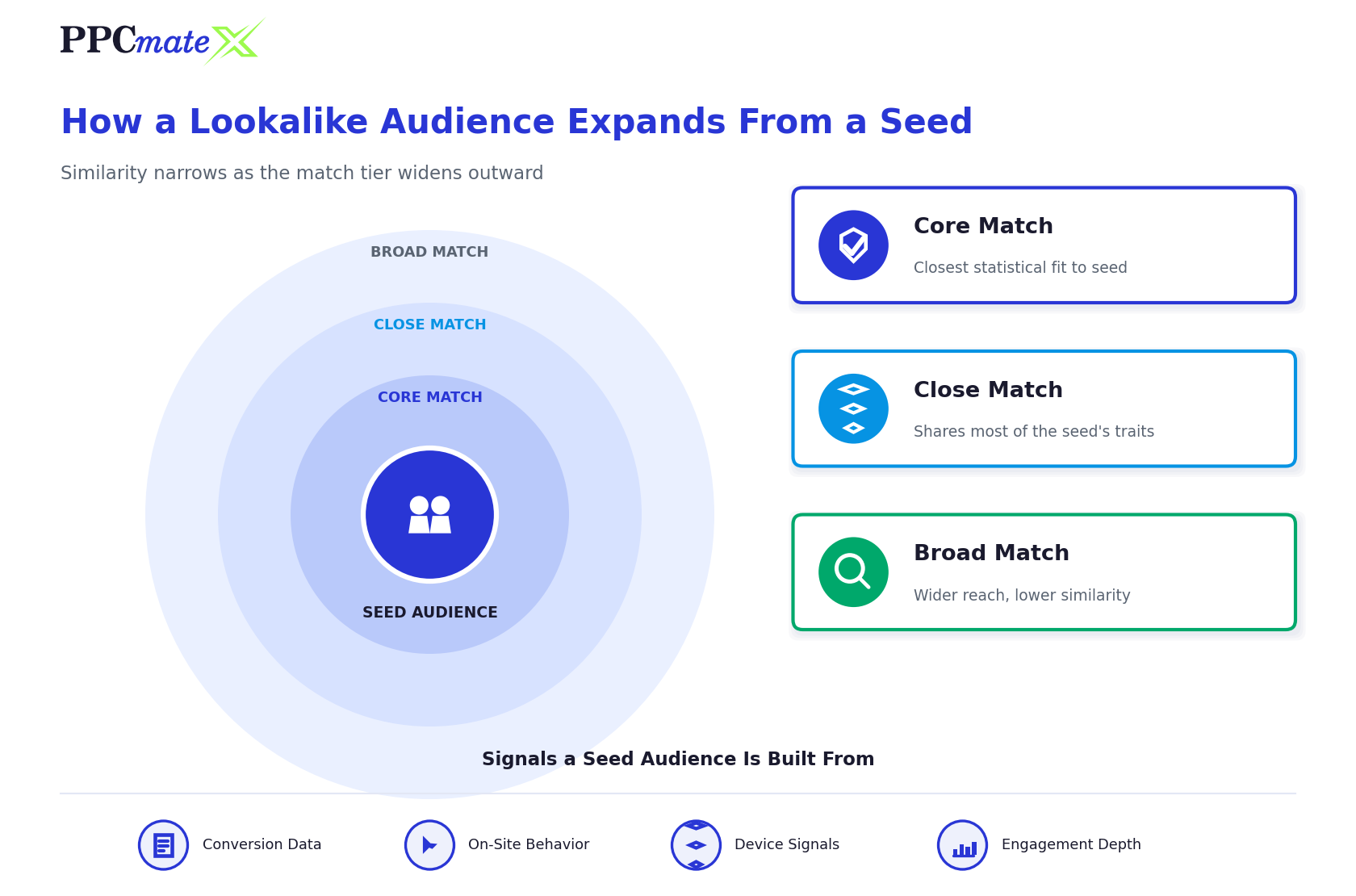
The tighter the match tier, the smaller and more precise the resulting audience tends to be, since fewer users clear the bar; broader tiers trade some precision for reach. This tradeoff is the core lever advertisers control once a lookalike audience is live inside the platform.
Lookalike Targeting vs Other Audience Methods
Lookalike targeting is one of several ways to define who an ad reaches, and it’s rarely a full replacement for the others — most campaigns combine two or more:
| Method | Data Basis | Best For | Audience Size |
| Lookalike | Seed audience’s shared traits | Scaling past an existing high-value group | Grows with match tier |
| Retargeting | Direct past interaction (site visit, cart) | Re-engaging users who already showed intent | Fixed, shrinks over time |
| Contextual | Page or content category, no user history | Privacy-safe reach, cold prospecting | Large, not user-specific |
| Demographic / Interest | Declared or inferred user attributes | Broad category targeting | Large, loosely matched |
Setting Up a Lookalike Audience Campaign
- Start with a clean seed audience. Pull the seed from a specific, well-defined event, such as a completed purchase or a qualified lead, rather than all site traffic, so the matching signal isn’t diluted.
- Make sure the seed is large enough to be meaningful. A seed of a few dozen users gives the matching process too little pattern to work with; match quality improves once the seed reaches a meaningfully larger base.
- Choose a starting match tier. Begin with a tighter, closer-match tier to confirm the lookalike audience actually converts before widening it for reach.
- Layer in geo and device filters. A lookalike audience narrows by behavior, not location or device, so those filters still need to be set separately.
- Run it as its own campaign rather than blending it into a broader targeting set, so it’s possible to see whether the lookalike pool is actually outperforming the account’s other targeting.
- Refresh the seed periodically. A seed built from data that’s months old drifts from the platform’s current user pool; refreshing it keeps the match current.
Where Lookalike Targeting Works Best
- E-commerce and subscription offers with a clear, high-value conversion event to seed from
- App-install campaigns scaling past an initial install-based seed
- Affiliates and media buyers scaling a proven offer once a source-level seed of converters exists
- Lead-generation campaigns where the seed is built from qualified, not just submitted, leads
- Native and display formats, where a broader lookalike pool has more inventory to work against than a narrow retargeting list
Common Mistakes to Avoid
- Seeding from all traffic instead of a specific conversion event — this dilutes the signal the matching process learns from
- Starting with the broadest match tier first — this can burn budget on a low-precision audience before the seed’s real conversion pattern is confirmed
- Leaving the seed static for months — the lookalike audience keeps matching against outdated behavior instead of current patterns
- Running lookalike and retargeting in the same campaign without separating them — this makes it impossible to tell which is actually driving results
- Treating match tier size as a quality signal — a bigger lookalike audience isn’t automatically a better one, just a broader one
Build Smarter Audiences With PPCmate
PPCmate gives advertisers direct control over audience layering across native, display, video, push, and pop-under inventory, with the source-level reporting needed to see which match tier is actually converting rather than guessing from a blended number. Visit Dominate Niche Markets to see how PPCmate’s targeting tools help advertisers reach specific, high-value audiences at scale.
FAQs
What is a lookalike audience?
A lookalike audience is a group of users a programmatic platform generates by matching the shared traits of an existing “seed” audience — usually converters — against the platform’s broader user pool, then targeting the users who match closely enough.
How is a lookalike audience different from retargeting?
Retargeting reaches people who already directly interacted with the advertiser, such as visiting a site or abandoning a cart. A lookalike audience reaches new users who’ve never interacted with the advertiser but share enough traits with people who converted.
How big should a seed audience be?
Bigger generally helps, but the more important factor is that the seed comes from a specific, well-defined event like a completed purchase rather than blended, unfiltered traffic. A small but precise seed usually outperforms a large but noisy one.
What’s the difference between a narrow and broad match tier?
A narrow, close-match tier includes only users who closely mirror the seed’s behavior, which is smaller but typically converts at a rate closer to the seed. A broad match tier trades some of that precision for a larger pool of reachable users.
Can a lookalike audience replace retargeting?
No. They serve different purposes — retargeting re-engages people who already showed intent, while a lookalike audience finds new people who’ve never interacted with the brand. Most campaigns run both.
How often should a seed audience be refreshed?
There’s no universal schedule, but a seed built from data that’s months old will increasingly reflect outdated behavior. Refreshing it on a regular cadence keeps the matching signal aligned with current conversion patterns.
Does lookalike targeting work for advertisers with less traffic?
Yes, as long as the seed audience is built from a specific, high-quality conversion event. Advertisers with less traffic may need to start with a broader match tier to reach a usable audience size.
What data is a lookalike audience typically built from?
Common seed sources include conversion pixel data, server-to-server postback tracking, email or customer lists, and app-install events — any dataset that reliably represents the advertiser’s actual best-performing users.