How Affiliates Use Self-Serve DSPs to Scale Paid Traffic Campaigns
Most affiliates start out buying traffic through a handful of ad networks, accepting whatever inventory, reporting, and margins those networks hand back. A self-serve DSP flips that arrangement: the affiliate picks the inventory, sets the bids, and sees the raw auction data, which is what makes it possible to scale a winning offer instead of guessing why a network campaign stalled.
This guide covers what a self-serve DSP gives affiliates that a managed network doesn’t, how to set up a first campaign the right way, how to wire up postback tracking, which traffic formats fit which offer types, and the mistakes that quietly cap scale on self-serve campaigns.
What a Self-Serve DSP Gives Affiliates That Ad Networks Don’t
A demand-side platform (DSP) is the buying side of programmatic advertising: it connects directly to exchanges and ad inventory and lets the buyer run real-time bidding auctions themselves rather than handing a budget to an account manager. “Self-serve” means the affiliate has direct login access to that buying interface — targeting, bid, creative, and budget controls — instead of relaying instructions to someone else.
For affiliates specifically, that direct access changes three things a managed network arrangement usually hides:
- Source-level visibility — which zones, apps, or placements are actually converting, not just an aggregate campaign number
- Bid control — the ability to raise spend on winning sources within minutes instead of waiting on a manager to make the change
- Direct postback integration — conversion data flows straight from the tracker back into the platform, so optimization is based on real payouts, not network-reported clicks
Why Affiliates Are Moving From Managed Networks to Self-Serve Buying
Managed ad networks still have a place, especially for affiliates just testing an offer with no tracking infrastructure in place yet. But once an offer proves out, the constraints of a managed arrangement start working against scale:
- Traffic sources are pooled and shared across advertisers, so a source performing well for one buyer can be diluted by others bidding on the same inventory
- Optimization decisions run through an account manager’s queue instead of happening the moment the data says to act
- Margins are built into the network’s rate card, which is opaque compared to bidding directly into an auction
- Reporting is limited to what the network chooses to expose, rarely down to the individual source or creative variant
A self-serve DSP removes the middle layer. The affiliate sees the same auction data the platform sees, which is what makes granular, source-level scaling possible instead of scaling a campaign as one flat number.
Setting Up a First Self-Serve Campaign
The setup sequence is the same regardless of vertical, and skipping steps here is the single biggest reason first campaigns underperform:
- Connect tracking before spending a dollar. Postback tracking needs to fire correctly from day one — optimizing on click data alone means optimizing on the wrong signal.
- Pick a traffic format that matches the offer’s decision speed. A single-step sweepstakes or subscription offer suits pop or push traffic; an offer that needs trust-building suits native.
- Start with broad geo and device targeting, then narrow. Overly narrow targeting on day one starves the algorithm of the volume it needs to find winning sources.
- Set a conservative starting bid based on the platform’s suggested range, and budget-cap the campaign rather than the individual source, so early testing doesn’t overspend on one placement.
- Let the campaign run long enough to reach statistical significance on a source before killing or scaling it — a source with 20 clicks and no conversions is not the same signal as one with 2,000.
- Review source-level performance daily for at least the first week, cutting non-converting sources and raising bids on converting ones.
Connecting Postback Tracking
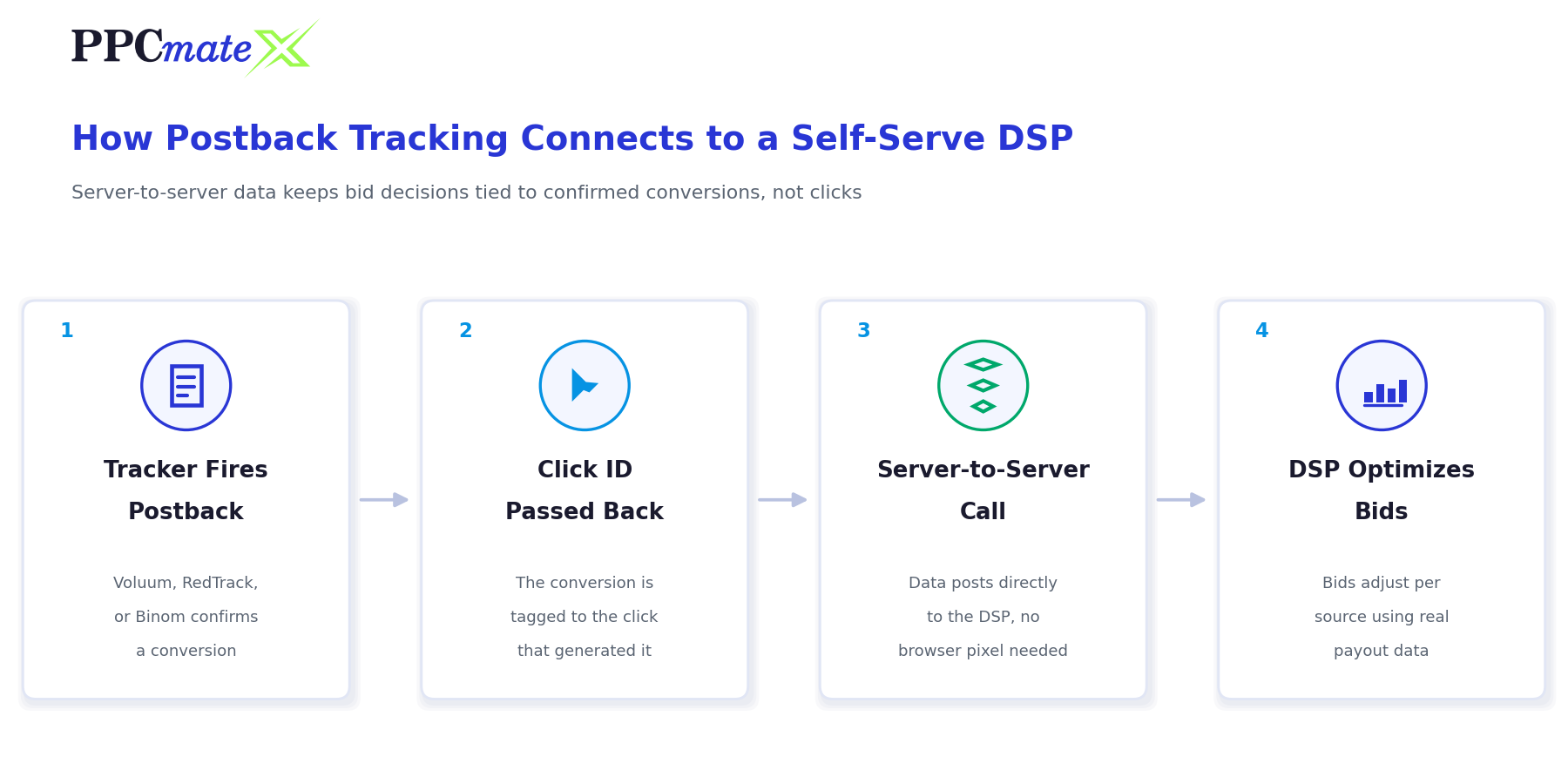
Postback (server-to-server) tracking is what turns a self-serve DSP from a media-buying tool into an optimization engine. Instead of relying on a pixel that can be blocked by browser privacy settings, the affiliate’s tracker (Voluum, RedTrack, Binom, or similar) fires a server-side call back to the DSP the moment a conversion is confirmed, tagged with the click ID that generated it.
The practical setup is the same across most trackers: generate a postback URL template from the DSP that includes a click ID macro, paste that URL into the tracker’s traffic-source settings, and confirm the tracker is passing that click ID forward to the DSP’s tracking link on every click. PPCmate’s conversion tracking integrations support this same server-to-server pattern, so bid and budget decisions are always based on confirmed conversions rather than clicks.
Which Traffic Format Fits Which Offer
Affiliates running self-serve campaigns typically split budget across more than one format, since different offer types convert on different formats:
| Format | Best-Fit Offer Types | Decision Speed | Typical Volume |
| Push | Sweepstakes, subscriptions, app installs | Fast, single decision | High |
| Pop / Pop-under | Dating, utilities, flash offers | Fast, low-commitment | Very high |
| Native | Finance, health, e-commerce | Slower, needs trust | Moderate |
| Display / Video | Branded offers, retargeting | Slower, multi-touch | Moderate |
Affiliates scaling a single offer often start on one format to establish a profitable baseline, then layer in a second format once source-level data shows which segments respond best, rather than splitting a small test budget across every format at once.
How Scaling Actually Works on Self-Serve
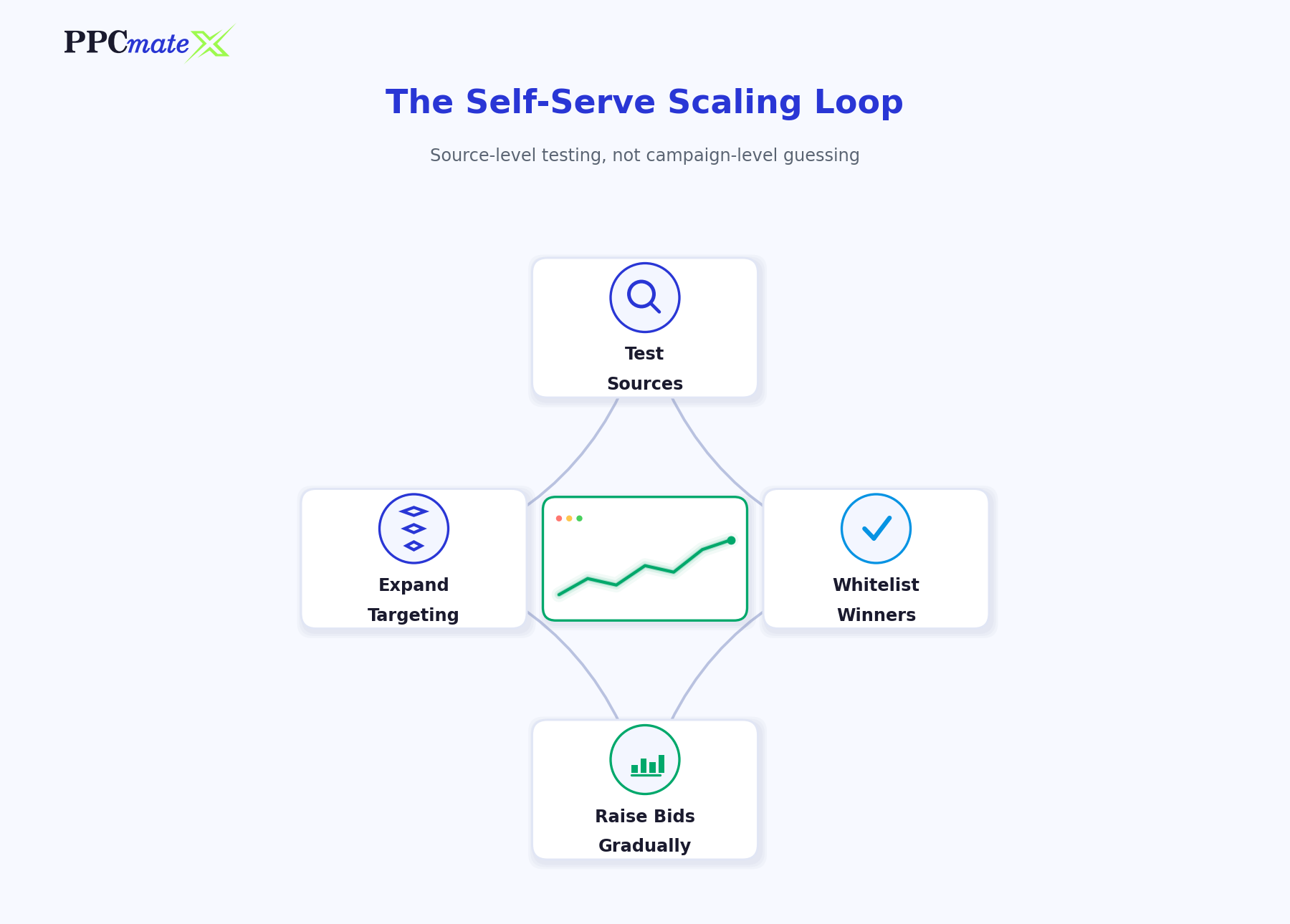
Scaling on a self-serve DSP is a source-level exercise, not a campaign-level one. The general pattern:
- Duplicate the winning campaign rather than editing the live one, so scaling tests don’t disturb a profitable baseline
- Raise bids in small increments on the sources already converting, watching for a drop in ROI as the bid moves up the auction curve
- Whitelist the top-converting sources into a dedicated campaign once volume justifies it, separating them from the broader testing pool
- Expand geo or device targeting only after the current targeting is fully saturated, rather than widening and testing everything simultaneously
Common Mistakes to Avoid
- Optimizing on clicks instead of postbacks — without server-to-server tracking, bid decisions are based on a signal that has no connection to actual payouts
- Scaling bids too fast — large bid jumps move a campaign into a different segment of the auction, which can flip a profitable source unprofitable overnight
- Ignoring frequency and fatigue on push and pop formats — the same users seeing the same creative repeatedly drags conversion rates down even when volume looks stable
- Testing too many variables at once — changing creative, targeting, and bid in the same test window makes it impossible to know which change moved the result
- Treating a managed-network offer page as a self-serve landing page — offers built for network traffic sometimes assume pre-qualified users; self-serve traffic needs a landing page that can convert cold
Scale Affiliate Campaigns With PPCmate
PPCmate gives affiliates direct, self-serve access to native, pop-under, push, display, and video inventory, source-level reporting, and server-to-server postback integration with major trackers, so scaling decisions can be made on real conversion data instead of network-filtered summaries. Visit Maximize Affiliate Earnings to see the full self-serve toolkit, or explore Media Buyer Solutions for a broader look at how PPCmate supports affiliates and media buyers at any budget level.
FAQs
What is a self-serve DSP in affiliate marketing?
A self-serve DSP is a demand-side platform where the affiliate directly manages targeting, bidding, budgets, and creative, buying traffic straight from the auction instead of routing it through a managed ad network account manager.
Is a self-serve DSP better than a managed ad network for affiliates?
It depends on the stage of the offer. Managed networks can be a reasonable way to test an offer with no tracking set up yet, but self-serve DSPs give the source-level visibility and bid control needed to scale a proven offer profitably.
Do I need my own tracker to use a self-serve DSP?
A dedicated tracker such as Voluum, RedTrack, or Binom is strongly recommended. It lets postback data flow directly into the DSP, which is what makes source-level bid optimization possible instead of optimizing on click volume alone.
What traffic format should I start with as an affiliate?
Match the format to the offer’s decision speed: push or pop for fast, single-decision offers like sweepstakes and subscriptions, and native for offers that need more trust-building, such as finance or health verticals.
How do I know when a source is ready to scale?
A source is ready to scale once it has produced enough conversions to be statistically meaningful, not just a low click count with one lucky conversion. Whitelist and raise bids gradually rather than jumping the bid all at once.
Why did my campaign stop converting after I raised bids?
Large bid increases move a campaign into a different segment of the auction, which can shift the mix of inventory it wins. Raising bids in small increments and watching ROI at each step avoids this kind of sudden drop-off.
Can I run multiple traffic formats in one self-serve campaign?
Most self-serve DSPs let a campaign target a single format for cleaner reporting, with separate campaigns run per format. This makes it easier to see which format is actually driving conversions for a given offer.
What’s the biggest reason self-serve campaigns fail to scale?
Optimizing on click data instead of confirmed postbacks is the most common cause. Without server-to-server tracking, the DSP is being told to chase a signal that doesn’t reflect actual payouts, which leads to scaling the wrong sources.