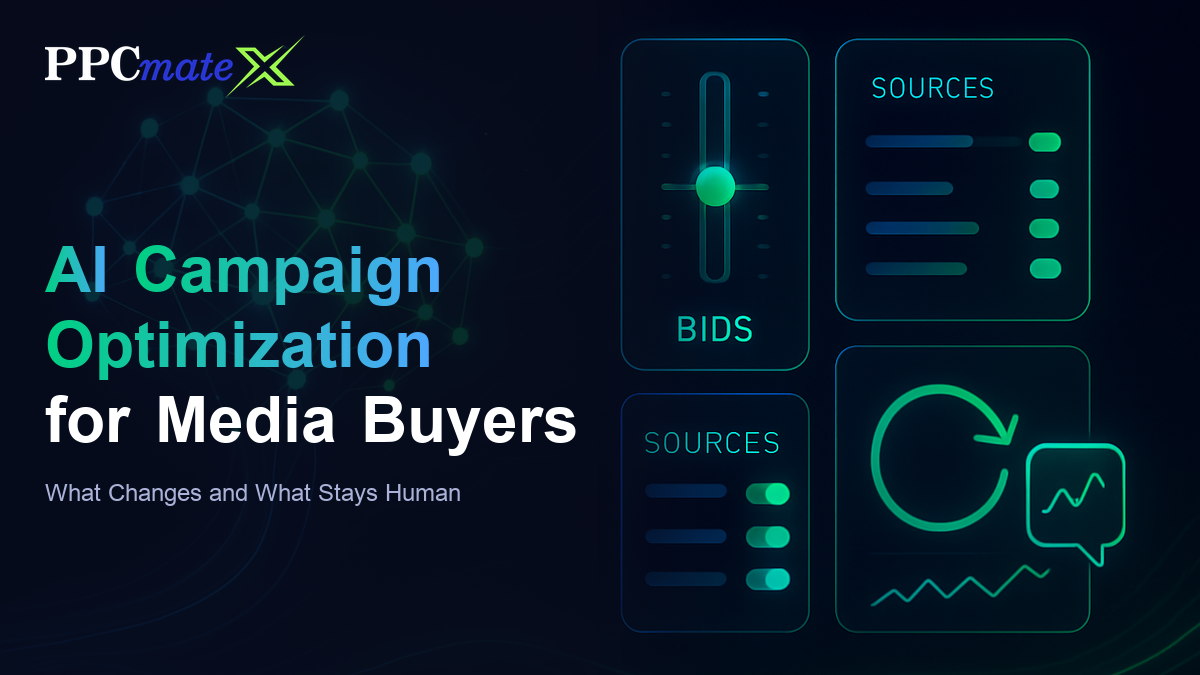
How AI Is Changing Campaign Optimization for Media Buyers
For most of the history of paid traffic, optimization has meant a media buyer with a spreadsheet: export the report, sort by cost, find the sources and creatives that lose money, adjust bids, repeat. AI does not replace that loop, but it changes how fast each turn happens, how much of the account gets looked at, and who does the reading. This guide explains what AI actually does in campaign optimization today, which decisions it handles well, which ones still need a human, and how to bring it into your workflow without handing over control you are not ready to give.
What “AI Optimization” Actually Means in Paid Media
“AI” is used loosely in ad tech, so it helps to separate three different things that often share the label:
- Rule-based automation. If-this-then-that logic you write yourself, such as “pause a source after it spends a set amount without a conversion.” It is predictable and transparent, but it only knows what you told it.
- Machine-learning bidding and prediction. Models that estimate how likely an impression or click is to convert and price bids accordingly. These learn from data rather than from rules, which makes them more adaptive but harder to inspect.
- AI assistants. Language-model tools that read your account data, explain it in plain language, answer questions and, if you allow it, make changes on request. This is the newest layer, and the one changing day-to-day work the most.
All three are useful, and most media buyers will end up using a mix. The important point is that none of them change what good optimization is. They change who performs each step and how often.
The Optimization Loop Has Not Changed. Its Speed Has.
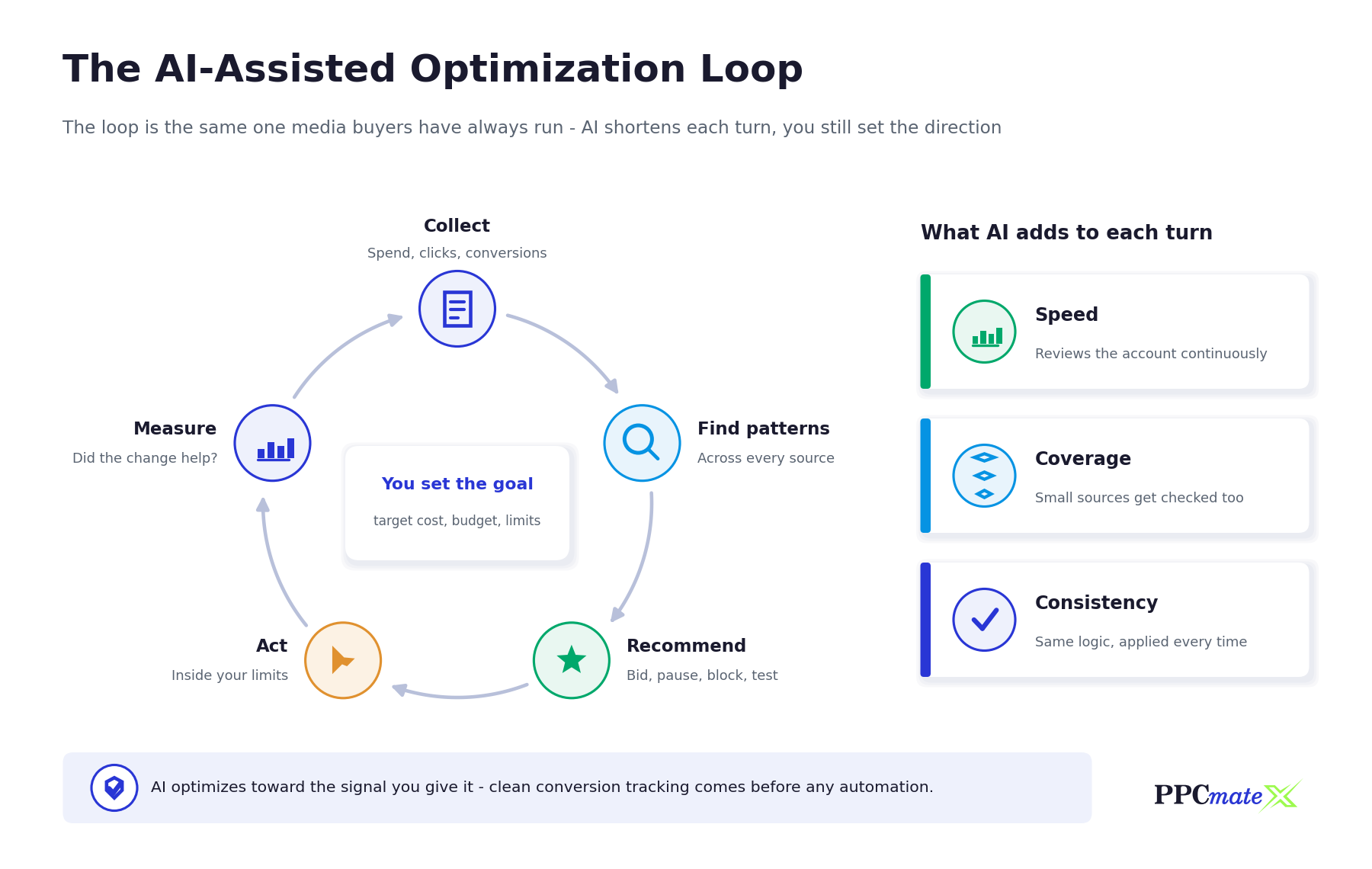
Every campaign optimization process is a loop: collect performance data, find the patterns in it, decide what to change, make the change, then measure whether it helped. A media buyer running that loop by hand can only complete so many turns a week, and in practice attention goes to the biggest spenders while the long tail of smaller sources, creatives and segments is reviewed rarely, if at all.
AI shortens each turn of the loop. It can re-read the whole account continuously, apply the same logic to a small source as to a large one, and surface a recommendation the moment the evidence supports it rather than at the next weekly review. What it cannot do is decide what the loop is for. The goal, the target cost and the limits still come from you.
Where AI already performs well
AI tends to do best on tasks that are repetitive, data-heavy and judged against a clear signal:
- Bid adjustments within a range. Nudging bids up on sources that convert below target cost and down on sources that do not, inside limits you set.
- Spotting weak sources early. Flagging placements that spend without results, or whose behaviour suddenly changes, before they consume a meaningful share of budget.
- Pacing and delivery alerts. Noticing when a campaign stops spending, overspends or runs out of balance, and explaining the likely cause.
- Summarising performance. Turning a large report into a short, readable explanation of what changed and why it matters.
Where human judgment still decides
AI is weaker where the right answer depends on context that is not in the data. It does not know that your offer’s payout changed yesterday, that a landing page is being redesigned, that a source is strategically important even while it is unprofitable, or that a placement is technically profitable but wrong for your brand. It also cannot tell whether your conversion tracking is correct; it simply optimizes toward whatever signal it receives.
What Changes for the Media Buyer
The practical shift is in where a media buyer’s time goes. Less of it goes to exporting, sorting and repeating the same checks. More of it goes to the decisions that need context: choosing offers, designing tests, setting guardrails and judging whether a recommendation makes sense.
| Task | Manual optimization | AI-assisted optimization |
| Reviewing sources | Periodic exports, top spenders first, long tail checked rarely | Whole list re-read continuously, weak sources flagged as evidence builds |
| Bid changes | Batched, often days after the data supports them | Proposed or applied sooner, within limits you set |
| Diagnosing problems | Clicking through settings, reports and billing to find the cause | Ask a question in plain language and get a checked answer |
| Reporting | Built by hand for each client or campaign | Drafted automatically, then reviewed and edited |
| Strategy and goals | Set by the media buyer | Still set by the media buyer |
| Main risk | Slow reactions and an unreviewed long tail | Fast, confident changes based on a wrong signal |
The last row matters most. Manual optimization fails slowly; automated optimization can fail quickly. That is why the inputs and the guardrails become more important, not less, once AI is involved.
Deciding What to Hand Over
A useful way to think about AI in campaign management is three lanes. Some work can be handed over almost entirely, some should be shared with a human approving each step, and some should stay with you.
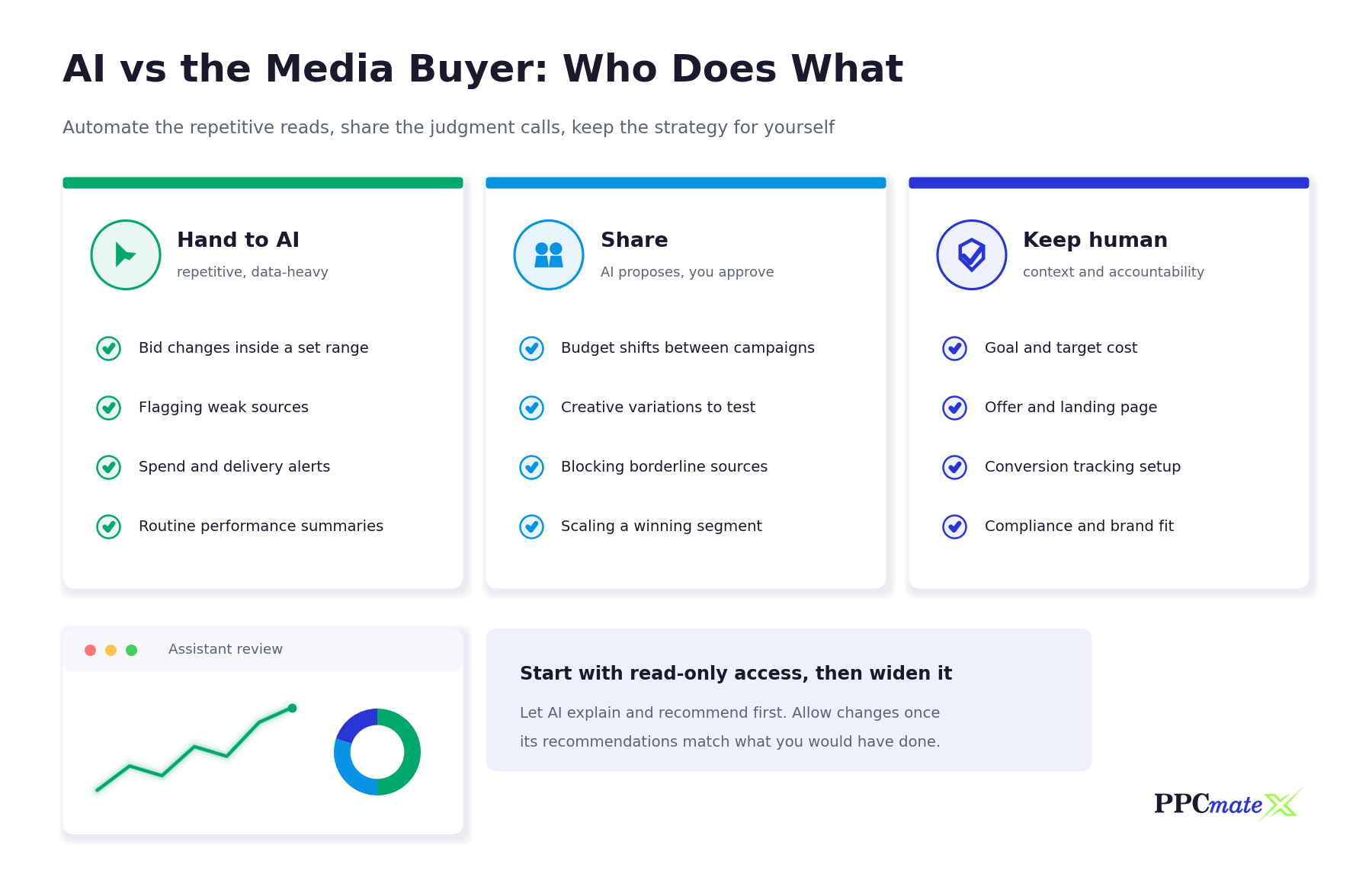
Hand to AI: repetitive, data-heavy reads
Routine checks, alerts, summaries and small bid moves inside a fixed range are good candidates. The cost of a single wrong call is small, and the benefit of doing them consistently is large.
Share: AI proposes, you approve
Moving budget between campaigns, blocking a borderline source, scaling a winning segment or launching new creative variations have bigger consequences. Let AI do the analysis and draft the change, and keep the final approval with a person.
Keep human: goals, offers and accountability
The target cost per conversion, the choice of offer and landing page, the conversion tracking setup, and brand and compliance decisions all depend on business context. These are also the decisions you will be held accountable for, so they should not be delegated.
How to Bring AI Into Your Optimization Workflow
The safest adoption path is gradual: start by letting AI read and explain, then let it recommend, and only then let it act, with limits at each stage.
- Fix your conversion signal first. AI optimizes toward whatever you measure. Before automating anything, confirm that conversions are firing correctly and reaching your ad platform, for example by checking your postback tracking setup.
- Write down your goal and limits. Define the target cost per conversion, daily budget ceilings, the maximum size of a single bid or budget change, and anything that must never be touched.
- Start read-only. Use AI to explain performance, answer questions and run health checks without permission to change anything. Compare its explanations with your own reading of the data.
- Move to recommendations. Let it propose bid changes, source blocks and budget shifts, and approve them one at a time. Track how often you would have made the same call.
- Allow limited actions. Once recommendations are consistently sensible, allow small, reversible changes within your limits, and keep a change history you can review and undo.
- Review on a schedule. Check what was changed and whether it helped, on a cadence that matches your conversion delay. Widen or narrow permissions based on results, not on how convenient automation feels.
Give AI clean inputs
Automation amplifies whatever it is fed. If a meaningful share of your traffic is invalid, an optimizer can learn to favour sources that generate cheap, fake engagement. Pair AI-driven decisions with traffic quality checks; our guide to using a traffic quality score explains how to read quality signals next to your conversion data.
Common Mistakes to Avoid
- Automating before tracking works. An optimizer pointed at a broken or partial conversion signal will confidently move budget in the wrong direction.
- Setting no limits. Without caps on bid and budget changes, a single bad data day can trigger large, expensive swings.
- Judging changes too early. If conversions arrive with a delay, evaluating a bid change after a few hours means acting on incomplete data, whether a human or a model is doing it.
- Treating recommendations as facts. An AI explanation can sound certain and still be wrong. Ask it to show the figures behind the recommendation and check them.
- Cutting sources on thin data. Automated pruning can remove sources that simply had not had enough volume yet. The same discipline described in how to read a source-level report applies to AI-driven cuts.
- Losing the audit trail. If you cannot see what was changed, when and why, you cannot learn from it or reverse it.
- Giving up on strategy. AI can make an existing campaign more efficient. It will not tell you that the offer, angle or traffic format is wrong for the audience.
Using AI With Your PPCmate Campaigns
PPCmate offers an AI Connector, an MCP server that connects AI assistants such as Claude and ChatGPT to your advertiser account. Once connected, you can ask about spend, clicks, conversions and cost per conversion in plain language, run a campaign health check, and see which placements are costing money. You choose View only or View and manage when you approve the connection, which maps directly onto the read-only-first approach above. With View and manage, the assistant can pause and resume campaigns, change budgets, bids and schedules, and block placements; budget and bid increases are limited per change, every change appears in your notifications, and changes can be undone for a period afterwards. It cannot add funds, make payments or delete anything.
Want to try AI-assisted optimization on your own account? Read how the PPCmate AI Connector works, connect it with View only access, and ask it to explain last week’s performance before you allow any changes.
FAQs
Will AI replace media buyers?
Not in the near term. AI takes over repetitive analysis and routine adjustments, but goals, offers, tracking, testing strategy and accountability still need a person. The role shifts toward setting direction and reviewing decisions.
What is AI campaign optimization?
It is the use of machine learning and AI assistants to analyse campaign data and adjust bids, budgets, sources and creatives toward a goal you set. It runs the same collect, analyse, act and measure loop as manual optimization, only faster and across more of the account.
What is the difference between rule-based automation and AI optimization?
Rule-based automation follows conditions you write, such as pausing a source after a set spend without conversions. AI optimization learns patterns from data or interprets your questions, so it can handle situations you did not write a rule for, but its reasoning needs more checking.
What data does AI need to optimize a campaign well?
Above all, a reliable conversion signal tied to the right campaign, source and creative. Spend, impression and click data alone lets AI optimize for cheap traffic, not for results.
Should I let an AI assistant change my campaigns directly?
Start with read-only access and move to changes only once its recommendations consistently match your own judgment. When you do allow changes, keep limits on their size and make sure every change is logged and reversible.
Can AI detect ad fraud on its own?
AI can help spot unusual patterns, but fraud protection works best as a dedicated layer that filters invalid traffic before you pay for it. An optimizer fed fraudulent data can mistake fake engagement for performance.
Does AI optimization work for small budgets?
AI assistants that read and explain data are useful at any budget. Fully automated bidding needs enough conversions to learn from, so with low volume, keep changes small and judge them over longer periods.
How do I know if AI changes are actually helping?
Compare cost per conversion and conversion volume before and after each change over a period long enough to cover your conversion delay. A change history that records what was changed and when makes this comparison possible.