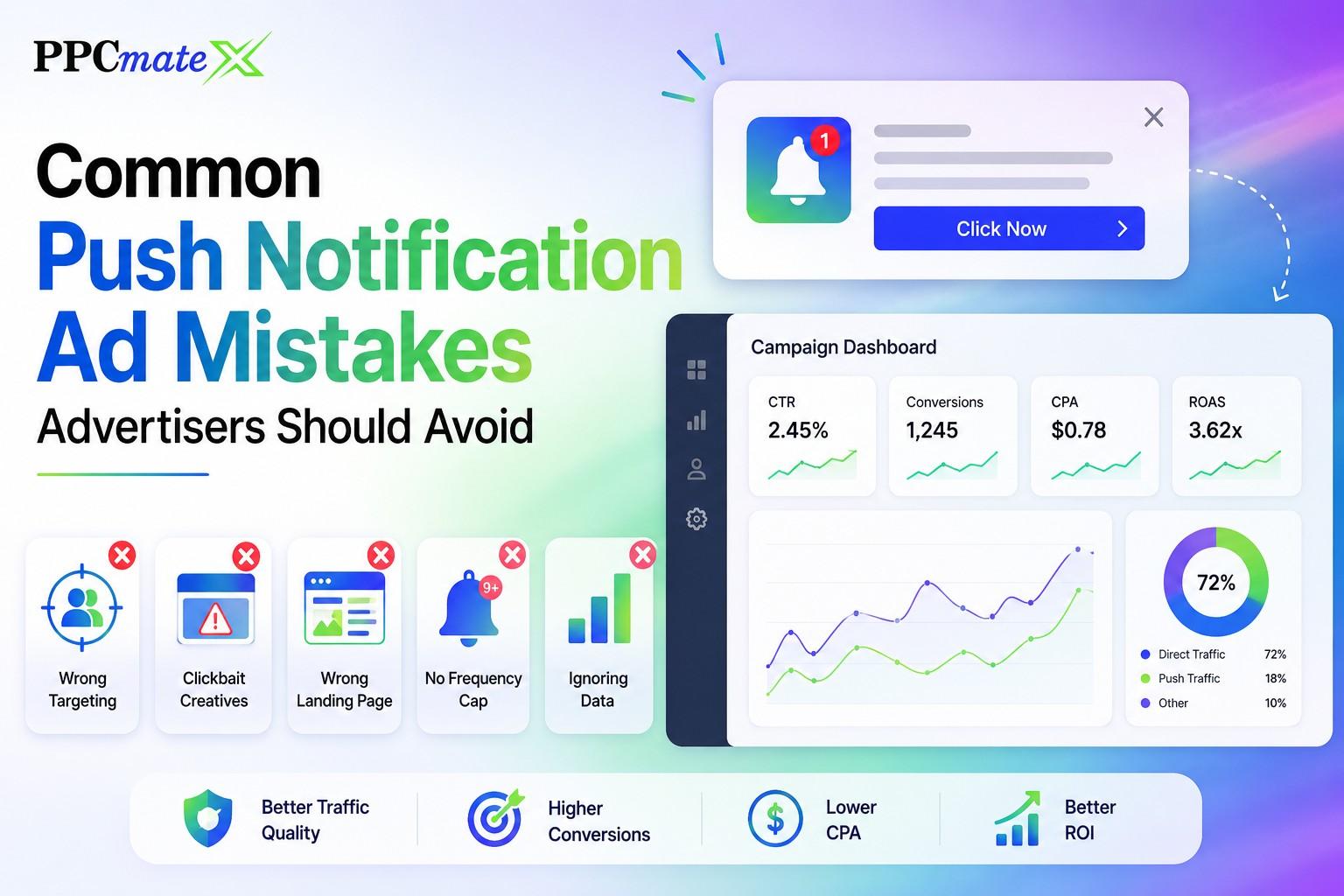
Push notification ads can drive fast clicks, broad reach, and strong direct-response results. But they can also waste budget when campaigns are too broad, poorly tracked, or built around weak creatives.
For advertisers, affiliates, agencies, and e-commerce teams, push ads work best when each campaign has a clear goal, tight targeting, clean tracking, and regular optimization.
This guide explains the most common push notification ad mistakes and how to avoid them before they hurt CTR, CPA, ROAS, and traffic quality.
Key Takeaways
- Push ads need clear targeting, not broad traffic buying.
- Creative quality matters because users decide fast.
- Landing pages must match the push message.
- Frequency caps help prevent user fatigue.
- Source-level data is needed to block weak traffic and scale strong traffic.
- Tracking must be active before launch, not added later.
What Are Push Notification Ads?
Push notification ads are short ad messages that appear like device or browser notifications. They usually include a headline, short text, icon, image, and call to action.
Advertisers use push ads for traffic, lead generation, affiliate offers, app campaigns, e-commerce promotions, and retargeting. A strong push traffic format can work well because the message is visible and easy to click.
But visibility alone is not enough. Push ads still need the right offer, audience, timing, and post-click experience.
Push Notification Ad Mistakes at a Glance
| Mistake | Why It Hurts | Better Approach |
| Broad targeting | Wastes spend on low-fit users | Start with focused geo, device, OS, and source filters |
| Weak creatives | Lowers CTR and trust | Test clear headlines, images, and CTAs |
| No tracking | Makes optimization impossible | Set conversion and source tracking before launch |
| Poor landing-page match | Increases bounce rate | Match the ad promise with the page |
| No frequency cap | Causes user fatigue | Limit repeated exposure |
| Ignoring source data | Keeps weak traffic active | Block poor sources and scale winners |
Mistake 1: Targeting Too Broad Too Early
Many advertisers launch push campaigns with wide geos, all devices, and loose source settings. This may collect data quickly, but it can also burn budget before the campaign finds quality traffic.
Push ads perform better when the audience matches the offer.
For example, a mobile app offer may need Android users in selected geos. A finance lead campaign may need desktop traffic, stronger landing-page trust, and tighter source controls.
What to Do Instead
Start with a focused test.
Use filters such as:
- Country or city
- Device type
- Operating system
- Language
- Connection type
- Source or publisher quality
- Website or app placement
- Whitelist or blacklist rules
A good push ad setup gives advertisers enough reach to test, but enough control to avoid random traffic.
Mistake 2: Using Clickbait Creatives
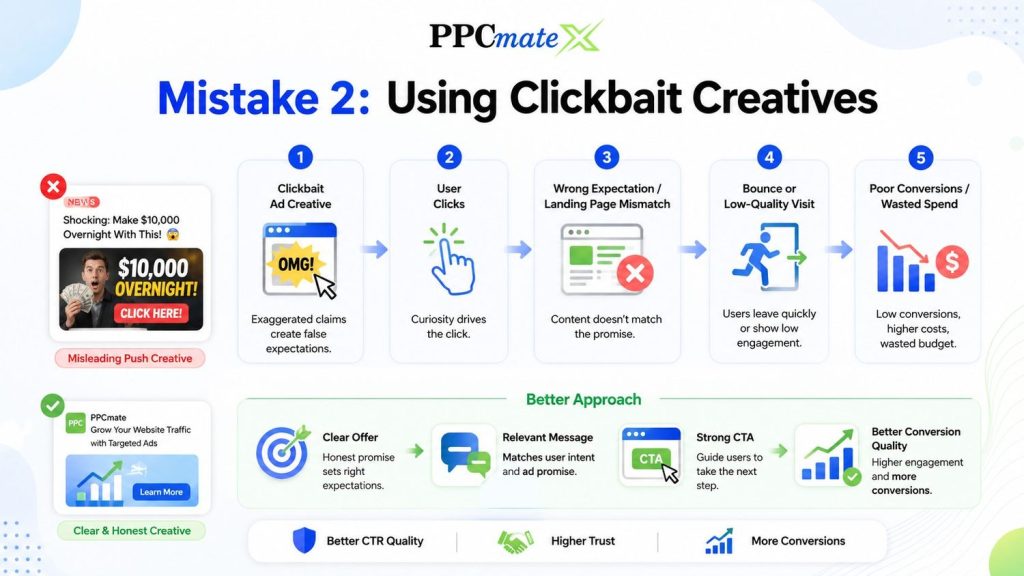
Clickbait headlines can raise CTR, but they often hurt conversion quality. If the push message overpromises, users click and leave quickly.
That can increase wasted CPC spend and make campaign data look better than it really is.
A high CTR is not always a good result. The better question is: did the click lead to a useful action?
Better Creative Rules
| Creative Element | Common Mistake | Better Version |
| Headline | Too vague or shocking | Clear benefit or offer |
| Image | Generic stock image | Relevant product or outcome image |
| CTA | No clear next step | Simple action phrase |
| Message | Too much text | One direct reason to click |
| Icon | Low-quality or unrelated | Clean, recognizable visual |
Good push creative should be direct, relevant, and easy to understand in a few seconds.
Mistake 3: Sending Traffic to the Wrong Landing Page
A push ad creates a promise. The landing page must complete that promise.
If the ad says “Get a travel discount,” the page should show the travel offer right away. If the page opens on a generic homepage, users may leave before taking action.
This hurts conversion rate, CPA, and traffic quality.
Strong notification ad campaigns connect message, audience, and landing page as one flow.
Landing Page Checklist
Before launching, check that the page:
- Loads fast on the target device
- Matches the push headline and image
- Shows the offer above the fold
- Has one clear CTA
- Works in the target geo and language
- Tracks clicks, leads, purchases, or installs
- Avoids too many pop-ups or distractions
Mistake 4: Ignoring Frequency Caps
Push ads can become annoying when the same user sees the same message too often.
This can lower engagement, increase unsubscribes, and reduce trust in the offer.
Frequency caps help control how often a user sees your ad within a set time. This protects user experience and helps advertisers avoid paying for repeated low-value impressions or clicks.
Mistake 5: Not Testing Enough Creatives
One creative rarely gives the full picture. Push ad performance can change by image, headline, device, geo, and time of day.
Advertisers should test multiple creative angles before deciding what works.
For example:
- Benefit angle
- Discount angle
- Urgency angle
- Problem-solution angle
- Product feature angle
Avoid testing too many things at once. Start with a few clear variations, then keep the winners and replace weak ads.
Mistake 6: Optimizing Only for CTR
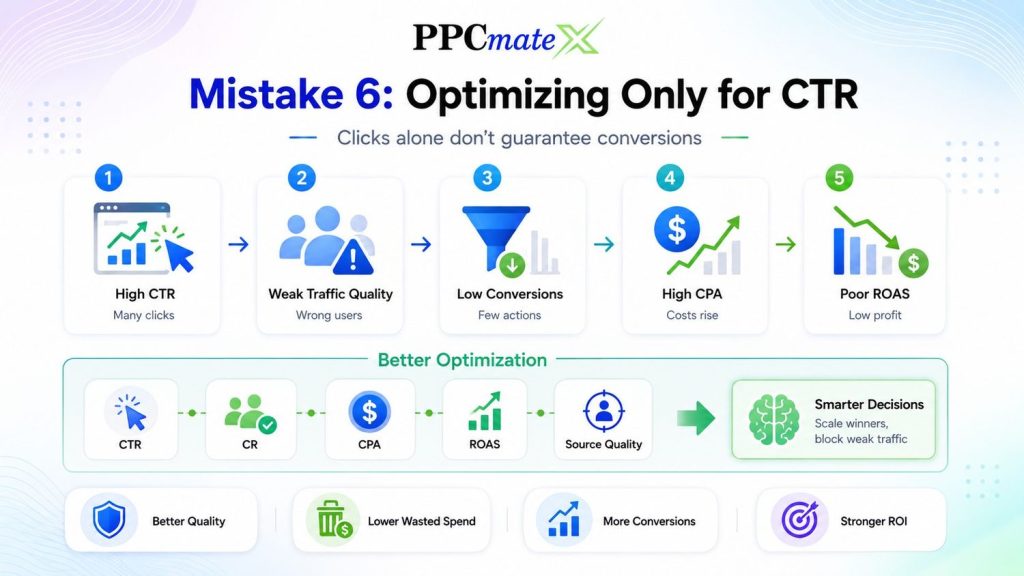
CTR shows whether users click. It does not show whether users convert.
A campaign with a high CTR and low conversion rate may be attracting the wrong users. A campaign with a lower CTR but better CPA may be more profitable.
| Metric | What It Shows | Why It Matters |
| CTR | Click interest | Helps judge creative appeal |
| CR | Conversion rate | Shows traffic and offer match |
| CPA | Cost per action | Measures efficiency |
| EPC | Earnings per click | Useful for affiliate buying |
| ROAS | Revenue from ad spend | Useful for e-commerce |
| Dwell time | Time after click | Helps spot weak or accidental clicks |
| Source ROI | Performance by source | Helps decide what to block or scale |
A DSP-style workflow can help advertisers compare traffic quality across sources. This is where real-time bidding controls can support smarter buying decisions.
Mistake 7: Leaving Weak Sources Active
Not every source will perform the same. Some sources may drive clicks but no leads. Others may convert well at a higher bid.
If advertisers only look at total campaign results, they miss the source-level story.
Source-level optimization helps answer:
- Which sources convert?
- Which sources have high bounce rates?
- Which placements waste spend?
- Which geos or devices scale?
- Which sources should be whitelisted?
A programmatic buying platform helps advertisers manage these decisions from one place instead of guessing from surface-level campaign data.
Mistake 8: Launching Without Fraud and Quality Controls
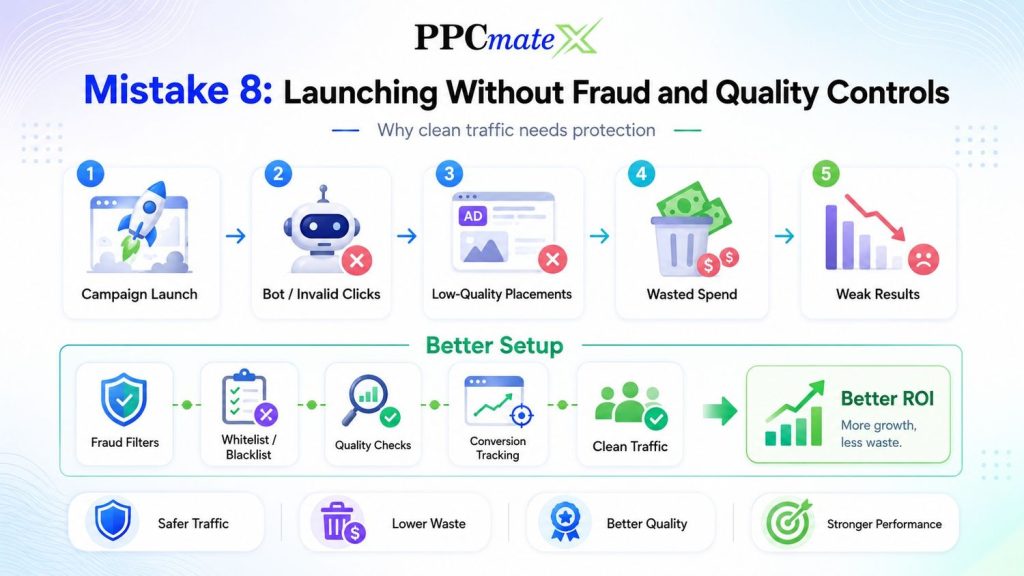
Push traffic can include low-quality clicks, bot activity, misleading placements, or poor post-click behavior. Advertisers should not assume every click has equal value.
Fraud protection, source controls, blacklists, whitelists, and conversion tracking all help reduce risk.
The goal is not just more clicks. The goal is cleaner traffic that supports the campaign outcome.
Mistake 9: Not Matching the Offer to the Push Format
Push ads are short and direct. They work best when the offer is easy to understand quickly.
Good fit:
- Lead generation
- App installs
- Coupons and deals
- Sweepstakes
- E-commerce offers
- Content recommendations
- Retargeting campaigns
Poor fit:
- Very complex B2B offers
- Long decision-cycle products
- Offers that need heavy explanation before interest
If the offer needs more education, advertisers can combine push with native ad placements or retarget users later with display or video.
Mistake 10: Scaling Before the Data Is Stable
Early results can be misleading. A campaign may look strong after a small number of clicks but fail when spend increases.
Before scaling, check:
- Enough clicks and conversions
- Stable CPA or ROAS
- Source-level performance
- Device and geo performance
- Creative fatigue
- Landing-page conversion rate
- Fraud or invalid traffic signals
Scaling should follow proof, not hope.
How PPCmate Helps Advertisers Avoid Push Ad Mistakes
PPCmate helps advertisers buy, manage, and optimize push notification traffic with practical campaign controls.
Advertisers can use PPCmate to:
- Launch push ad campaigns with controlled budgets
- Target by geo, device, OS, language, source, and supply partner
- Test creatives and offers across traffic segments
- Monitor clicks, spend, and conversion data
- Block weak sources and scale strong ones
- Use self-serve control or managed campaign support
PPCmate also supports multiple ad formats, so advertisers can compare push with display traffic or use video ad campaigns when the message needs more visual explanation.
Ready to Launch Push Ads With More Control?
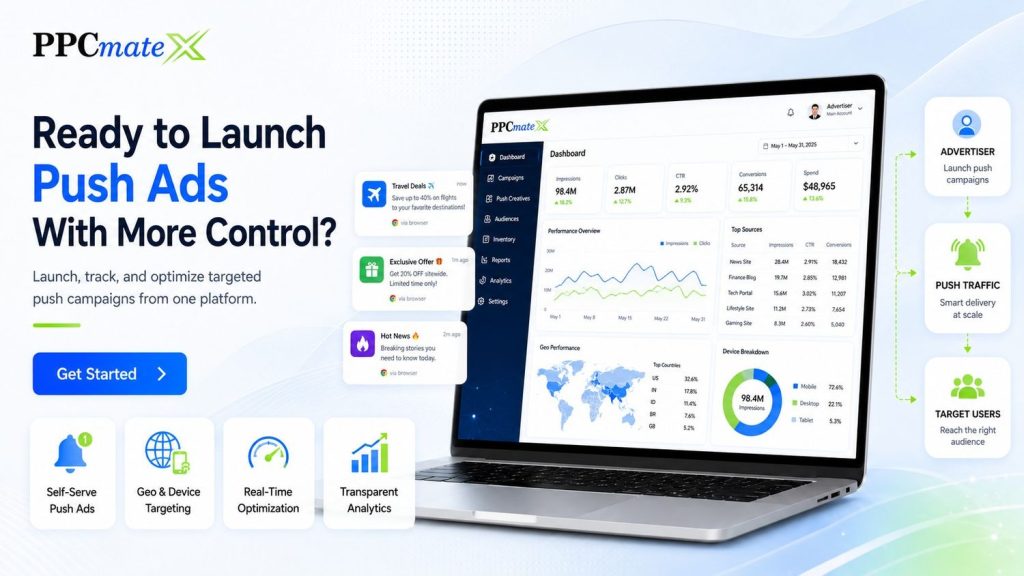
PPCmate gives advertisers a flexible platform for buying targeted push notification traffic across different geos, devices, sources, and campaign goals.
Whether you want hands-on self-serve control or managed campaign support, PPCmate helps you launch, track, and optimize push ad campaigns from one platform.
FAQs
What is the biggest mistake in push notification advertising?
The biggest mistake is buying broad traffic without clear targeting or tracking. This makes it hard to know which users, sources, and creatives are actually driving results.
How many push ad creatives should advertisers test?
Advertisers should start with a small set of clear creative variations. Testing 3 to 5 versions is often enough to learn which angle gets better clicks and conversions.
Are push notification ads good for affiliate marketing?
Yes, push ads can work well for affiliate marketing when the offer is simple, the geo is tested, and source-level tracking is active.
How can advertisers reduce wasted spend?
Advertisers can reduce wasted spend by using tighter targeting, frequency caps, conversion tracking, blacklists, whitelists, and regular source-level optimization.
Should advertisers use push ads alone?
Push ads can work alone for direct-response campaigns, but they can also support a wider funnel with native, display, video, and retargeting campaigns.