
Push ads can bring fast traffic, but poor bidding can waste budget quickly. A high bid may win more traffic, but not all clicks have the same value. A low bid may save money, but it can also limit volume and slow testing.
A strong push ads bidding strategy helps advertisers control CPC, manage daily spend, test traffic quality, and scale sources that convert. This guide explains how to use bids, budgets, caps, targeting, and performance data in a simple way.
Key Takeaways:
- CPC is the cost you pay for each push ad click.
- Higher bids can bring more traffic, but they should be tied to conversion value.
- Daily budgets, click caps, pacing, and frequency caps help control spend.
- Source-level reporting helps advertisers block weak traffic and scale strong traffic.
- The best bidding strategy depends on CPA, conversion rate, offer payout, and traffic quality.
What Is CPC Bidding in Push Ads?
CPC bidding means you pay when a user clicks your push ad. You are not paying only for the notification view. You are paying for the click that sends the user to your landing page or offer.
Push ads are often used for traffic, lead generation, affiliate offers, e-commerce promotions, app installs, and retargeting. For advertisers learning push ad buying, CPC gives a clear way to control visit cost.
The goal is not only to get cheap clicks. The goal is to buy clicks that can turn into leads, installs, sales, or other valuable actions.
What Affects Push Ads CPC and Campaign Spend?
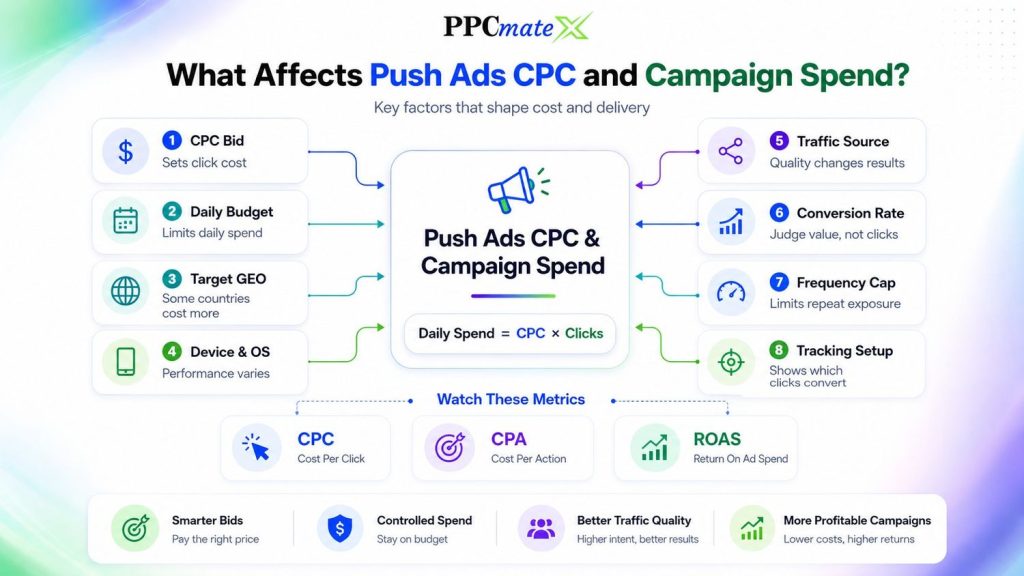
Push ad spend is controlled by more than your bid. Your CPC, targeting, traffic source, budget limit, and conversion rate all affect how much you pay and how fast your campaign spends.
A campaign with a low CPC can still waste money if the clicks do not convert. A campaign with a higher CPC can still be profitable if the traffic brings leads, installs, or sales.
The goal is to find the point where your bid brings enough traffic while keeping your CPA or ROAS under control.
| Factor | How It Affects Spend | What Advertisers Should Watch |
| CPC bid | Controls how much you pay for each click | Start with a controlled bid and adjust slowly |
| Daily budget | Limits how much the campaign can spend per day | Use smaller budgets during testing |
| Target GEO | Some countries cost more than others | Compare CPC and CPA by location |
| Device and OS | Mobile, desktop, Android, and iOS may perform differently | Split campaigns when performance varies |
| Traffic source | Some sources bring better users than others | Block weak sources and scale strong ones |
| Conversion rate | Shows how many clicks turn into actions | Judge CPC by CPA, not clicks alone |
| Frequency cap | Limits how often users see your ads | Reduce repeat clicks from the same users |
| Tracking setup | Shows which clicks lead to conversions | Use conversion tracking before scaling |
How Push Ads Bidding Affects Campaign Spend
Your campaign spend depends on more than one number. CPC is important, but it works with traffic volume, targeting size, delivery speed, and source quality.
A simple spend formula is:
Daily Spend = CPC x Number of Clicks
If your CPC is $0.02 and you buy 5,000 clicks, your spend is $100.
But the real question is: did those clicks produce conversions?
Advertisers using push notification traffic should judge CPC with CPA, not CPC alone. A $0.01 click can be expensive if it never converts. A $0.05 click can be profitable if it brings strong buyers.
CPC vs CPA vs CPM for Push Campaigns
| Pricing Model | What You Pay For | Best Use Case | Risk |
| CPC | Each click | Traffic, lead generation, affiliate offers | Clicks may not convert |
| CPA | Each action or conversion | Performance campaigns with tracking | Needs enough conversion data |
| CPM | Every 1,000 impressions | Awareness and reach | You pay before clicks happen |
CPC is often the easiest model for advertisers who want traffic control. CPA works better when conversion tracking is clean. CPM can work for awareness, but it needs strong creative and traffic monitoring.
For advertisers buying through a DSP, real-time auctions and bid controls can also affect how often ads win traffic. This is why understanding real-time bidding basics helps when planning push budgets.
How to Set a Starting CPC Bid
Start with a bid that gives enough traffic to test. Do not start too low if it blocks volume. Do not start too high if you do not know traffic quality yet.
A practical starting bid should consider:
- Target GEO
- Device type
- Offer payout
- Landing page quality
- Expected conversion rate
- Competition level
- Campaign budget
For example, an offer with a $20 payout can usually support a higher CPC than an offer with a $2 payout. But the final decision depends on conversion rate.
Simple CPC Limit Formula

Max CPC = Target CPA x Expected Conversion Rate
If your target CPA is $10 and your landing page converts 2% of clicks, your max CPC is:
$10 x 0.02 = $0.20
This does not mean you should bid $0.20 immediately. It means $0.20 is the rough upper limit before the campaign becomes risky.
Controls That Help Manage Push Ad Spend
| Spend Control | What It Does | When to Use It |
| Daily budget | Limits spend per day | Always |
| Total budget | Limits full campaign spend | Fixed tests or short promotions |
| Click cap | Limits click volume | Early traffic testing |
| Frequency cap | Limits repeated exposure | Retargeting or broad campaigns |
| Bid limit | Prevents overpaying per click | Competitive GEOs |
| Source blacklist | Blocks weak sources | After enough data |
| Source whitelist | Focuses on proven sources | Scaling profitable campaigns |
| Dayparting | Runs ads at selected hours | When conversions vary by time |
These controls help advertisers avoid buying too much traffic before they understand performance. PPCmate gives advertisers budget and format control across programmatic buying tools, which is useful when push ads are part of a larger traffic strategy.
How to Optimize CPC After Launch

Do not change bids too quickly. Push campaigns need enough data before decisions are useful. Early results may look random if there are not enough clicks or conversions.
Use this simple decision table:
| Campaign Signal | What It Means | Action |
| High spend, no conversions | Traffic may be weak or offer mismatch | Lower bid, pause sources, review landing page |
| Good CTR, poor conversions | Creative attracts clicks but wrong users | Adjust message or targeting |
| Low traffic volume | Bid may be too low or targeting too narrow | Raise bid slowly or broaden targeting |
| Good CPA from some sources | Strong source-level performance | Increase budget or whitelist sources |
| High CPC, strong ROAS | Expensive clicks are still profitable | Keep bid or scale carefully |
| Low CPC, high bounce rate | Cheap traffic may be low quality | Block weak sources |
A useful push strategy is to separate testing from scaling. During testing, buy enough data to compare creatives, devices, GEOs, and sources. During scaling, move budget toward proven segments.
Targeting Factors That Change CPC
Push ad CPC can change by market and traffic quality. Competitive GEOs, mobile users, premium sources, and high-value verticals may cost more.
The most important targeting filters include:
- GEO and city
- Device type
- Operating system
- Browser
- Language
- Connection type
- Source or publisher ID
- Website or app placement
- User freshness
- Retargeting audience
For mobile-heavy offers, device, OS, and connection filters matter because user behavior can change across networks. Advertisers comparing push ad formats should also test how copy and icons perform across devices.
Common Push Ads Bidding Mistakes
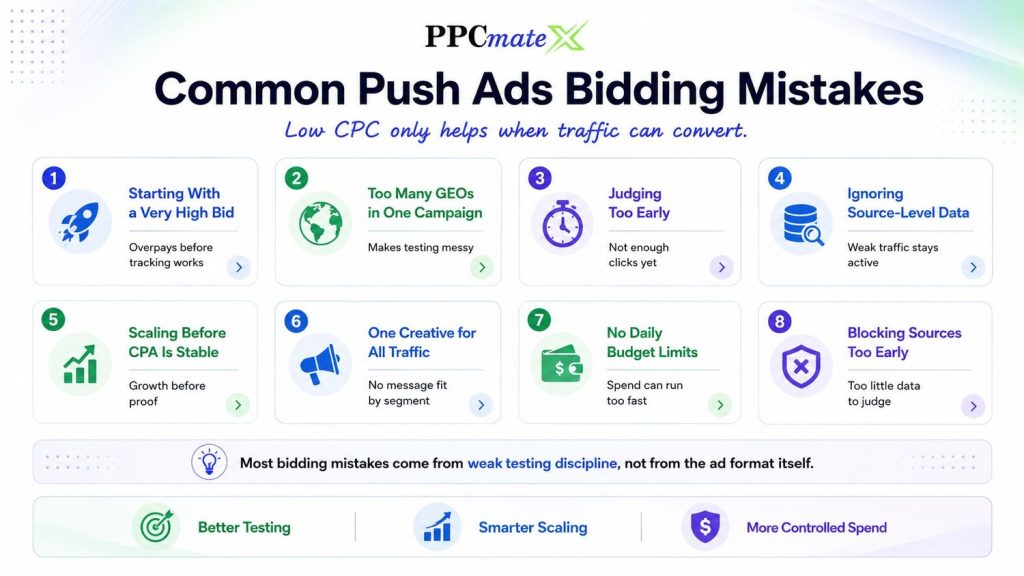
Many advertisers lose budget because they focus only on cheap clicks. Low CPC is useful only when the traffic can convert.
Avoid these mistakes:
- Starting with a very high bid before tracking works
- Running too many GEOs in one campaign
- Judging performance before enough clicks
- Ignoring source-level data
- Scaling before CPA is stable
- Using one creative for all traffic
- Not setting daily budget limits
- Blocking sources too early after very little data
Many push campaign mistakes come from weak testing discipline, not from the ad format itself.
How PPCmate Helps Advertisers Control Push Campaign Spend
PPCmate helps advertisers buy push traffic with practical controls for targeting, budgets, formats, and campaign management.
Advertisers can use PPCmate to:
- Set campaign budgets and bid limits
- Buy push traffic on a CPC basis
- Target users by GEO, device, OS, language, source, and supply partner
- Monitor clicks, CTR, conversions, and spend
- Compare traffic sources before scaling
- Run push ads alongside native ad traffic, display, and video campaigns
- Use self-serve control or managed campaign support
This gives advertisers more control over what they buy, what they block, and what they scale.
Ready to Launch Programmatic Ads With More Control?
PPCmate gives advertisers a flexible DSP for buying targeted traffic across multiple channels, formats, and pricing models.
Whether you want hands-on self-serve control or managed campaign support, Connect with PPCmate to help you launch, track, and optimize programmatic campaigns from one platform.
FAQs
What is a good CPC for push ads?
A good CPC depends on GEO, offer payout, conversion rate, and traffic quality. The best CPC is not always the lowest CPC. It is the CPC that helps you reach your target CPA or ROAS.
How do I reduce CPC in push ads?
You can reduce CPC by lowering bids, narrowing weak targeting, blocking poor sources, improving creatives, and testing different GEOs or devices. Do not lower bids so much that traffic volume disappears.
How much budget should I use for testing?
Use a budget that gives enough clicks to judge performance without risking too much spend. Small campaigns should start with controlled daily limits and increase only when conversion data supports it.
Should I use manual CPC or CPA optimization?
Manual CPC gives more direct control. CPA optimization can help when tracking is clean and the campaign has enough conversion data. New campaigns usually need testing before automation can work well.
Why is my push campaign spending too fast?
Fast spending can happen when bids are high, targeting is broad, pacing is aggressive, or click caps are missing. Add daily limits, source controls, and tighter targeting to slow waste.
Can push ads work for e-commerce?
Yes. Push ads can work for e-commerce when the offer is clear, the landing page loads fast, and tracking shows which sources bring buyers. Retargeting and time-sensitive offers often work well.