

Display advertising mistakes can quietly reduce campaign performance. A campaign may look active in reports, but still fail to bring quality clicks, leads, sales, or retargeting results.
This often happens when advertisers focus only on impressions or clicks instead of the full path from ad view to conversion. Weak targeting, poor creative, missing tracking, and broad traffic sources can all make display ads look less effective than they really are.
By understanding these mistakes early, advertisers can build better campaigns, reduce wasted spend, and optimize display traffic with more control.
Key Takeaways
Display campaigns work better when every part of the setup supports one clear goal. Advertisers should avoid judging performance from clicks alone.
Key points to remember:
- Match the campaign goal with the right audience, bid, and landing page.
- Use clear creatives that are easy to understand in small ad placements.
- Track conversions, not only impressions and clicks.
- Review performance by source, device, geo, OS, and time.
- Use frequency caps to avoid showing the same ad too often.
- Scale winning segments slowly after the data is stable.
What Are Display Advertising Mistakes?
Display advertising mistakes are campaign setup or optimization problems that reduce performance. These mistakes can lead to low CTR, poor conversion rates, weak ROAS, wasted impressions, or low-quality traffic.
Display ads rely on visual attention. They appear across websites, apps, and publisher placements while users browse content. That means the ad must be relevant, easy to understand, and connected to a clear next step.
Advertisers who need a wider format overview can use PPCmate’s Complete Display Ads guide to understand formats, targeting, bidding, and optimization before launching campaigns.
Why Display Ad Campaigns Waste Budget
Display campaigns usually waste budget when advertisers buy too much traffic without enough control. Broad reach can help awareness, but it can also bring irrelevant impressions if targeting and source quality are ignored.
Budget waste often happens when:
- The campaign goal is unclear.
- Targeting is too broad or too narrow.
- The same creative is used for every audience.
- Ads send users to a weak landing page.
- Tracking is missing or incomplete.
- Poor sources are not paused.
- Bids are increased before conversion data is stable.
A better setup starts with a clear goal, controlled traffic, strong tracking, and regular source-level review.
Common Display Advertising Mistakes Advertisers Should Avoid
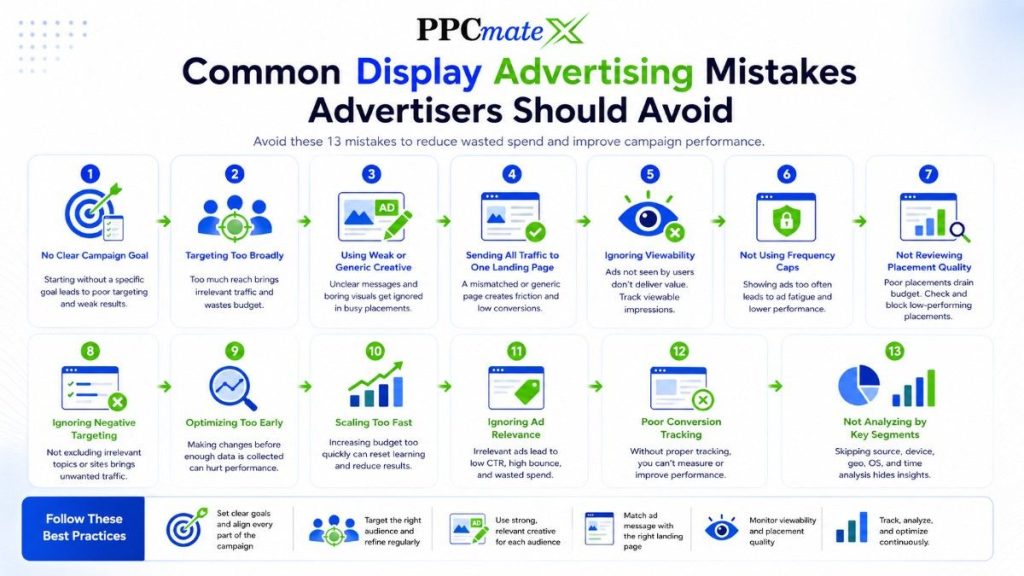
1. Starting Without a Clear Campaign Goal
A display campaign should not begin with only “get more traffic.” Traffic is not always the same as value. A campaign for awareness needs different settings than a campaign for leads, installs, sales, or retargeting.
Choose one main goal before launch. This helps guide the bid model, audience, creative message, landing page, and performance metrics.
Common campaign goals include:
- Brand awareness
- Website visits
- Product sales
- Lead generation
- App installs
- Retargeting
- Offer testing
When advertisers understand how display ads work, it becomes easier to connect the campaign setup with the real business goal.
2. Targeting Too Broadly at Launch
Broad targeting can bring scale, but it can also spend money on users who are unlikely to act. New campaigns need enough reach to collect data, but not so much that the budget disappears before patterns appear.
Start with basic targeting that matches the offer. Then refine the campaign after enough data is collected.
Useful targeting areas include:
- Country or region
- Device type
- Operating system
- Browser
- Language
- Website or app source
- Supply partner
- Time of day
- Retargeting audience
The goal is not to block all traffic early. The goal is to give the campaign enough control to learn.
3. Using Weak or Generic Creative
Display ads compete for attention in busy pages and apps. A generic banner with unclear copy is easy to ignore.
Strong display creative should show the offer quickly. The user should understand what is being promoted, why it matters, and what to do next.
A better creative usually includes:
- One clear message
- A simple benefit
- Strong visual contrast
- Brand name or logo
- Short CTA
- Mobile-friendly design
- Correct size for each placement
For image-heavy campaigns, choosing the right visuals matters. Choosing high-performing ad images can help advertisers avoid unclear, crowded, or low-quality creatives.
4. Sending All Traffic to One Landing Page
A display ad and landing page should feel connected. If the ad promises a discount, the landing page should show that discount clearly. If the ad promotes a product, the page should lead with that product.
Sending all traffic to a homepage can hurt conversions because users have to search for the offer. This adds friction after the click.
A strong landing page should:
- Match the ad message
- Load quickly
- Work well on mobile
- Show one clear offer
- Use a simple form or checkout path
- Repeat the CTA from the ad
- Remove distractions that do not support the goal
The landing page should continue the promise made in the ad.
5. Ignoring Viewability
Not every served impression is a useful impression. An ad can be counted as served even if the user barely had a chance to see it.
Viewability helps advertisers understand whether ads appear in visible placements. This matters because display campaigns can look active in reports while still producing weak attention.
Advertisers should review:
- Viewable impressions
- Placement quality
- Above-the-fold and below-the-fold performance
- CTR by source
- Conversion rate by source
- Time on site after click
Viewability should not be the only success metric, but it helps explain why some placements spend budget without producing results.
6. Treating Display Ads Like Search Ads
Display and search ads do not work the same way. Search ads reach users who are actively looking for something. Display ads reach users while they browse websites, apps, or content.
This means display ads often need stronger visual appeal, clearer value, and better audience matching. A user may not be ready to buy right away, especially in prospecting campaigns.
Advertisers comparing display and search ads should measure each format based on its role in the funnel, not only last-click sales.
7. Not Separating Mobile and Desktop Traffic
Mobile and desktop users behave differently. Screen size, click behavior, landing page layout, and conversion intent can all change by device.
Running all devices in one campaign can hide performance problems. Mobile may bring more clicks, while desktop may bring stronger lead quality. Or the opposite may happen depending on the offer.
Separate device data helps advertisers adjust:
- Bids
- Creatives
- Landing pages
- Frequency caps
- Time schedules
- Source lists
This makes optimization cleaner and easier to understand.
8. Using the Wrong Bidding Strategy
A bid should match the campaign goal. If the goal is awareness, CPM may make sense. If the goal is traffic, CPC may be useful. If the goal is conversions, CPA or ROAS should guide optimization.
The mistake is choosing a bid model without knowing what success looks like. Cheap impressions are not useful if users never convert. Cheap clicks are not useful if they come from weak placements.
A clear display bidding strategy helps advertisers control spend while testing traffic quality.
9. Running Without Conversion Tracking
Clicks only show that someone visited the page. They do not show whether the campaign created value.
Advertisers should track actions that match the goal. Without tracking, it is hard to know which sources, devices, geos, or creatives deserve more budget.
Important actions to track include:
- Leads
- Purchases
- Signups
- App installs
- Add-to-cart events
- Trial starts
- Revenue
- Returning users
Strong tracking helps advertisers optimize from real campaign value instead of surface-level engagement.
10. Ignoring Source-Level Performance
Campaign averages can hide weak traffic. One source may bring many cheap clicks but no sales. Another source may cost more but produce better leads.
Advertisers should review performance at the source level before scaling. This helps separate good placements from poor ones.
Review source data by:
- Spend
- CTR
- CPC or CPM
- Conversion rate
- CPA
- ROAS
- Bounce rate
- Lead quality
Weak sources can be added to a blacklist. Strong sources can be added to a whitelist for more controlled scaling.
11. Showing Ads Too Often
Frequency matters in display advertising. If users see the same ad too many times, they may ignore it or feel annoyed by the brand.
Frequency caps help control how often one user sees an ad within a set time. This protects budget and supports a better user experience.
High frequency can be useful in retargeting, but it should still be controlled. A user who has already converted should also be removed from the active audience when possible.
12. Making Ads Too Disruptive
Display ads should catch attention without hurting the browsing experience. Ads that flash, block content, or feel misleading may damage trust.
A better display ad is visible, relevant, and easy to understand. It does not need to interrupt the user aggressively to work.
Advertisers can improve performance by making ads less disruptive with better design, timing, targeting, and frequency control. PPCmate’s guide on less disruptive ads supports this user-first approach.
13. Testing Too Many Things at Once
Testing is important, but messy testing creates unclear results. If an advertiser changes the headline, image, audience, bid, and landing page at the same time, it becomes hard to know what caused the change.
Test one main variable at a time when possible. This helps make campaign decisions based on cleaner data.
Good testing areas include:
- Headline
- Image
- CTA
- Audience
- Landing page
- Bid
- Device segment
- Traffic source
A simple testing plan is easier to manage and more useful for scaling.
Display Advertising Mistakes by Campaign Stage
| Campaign Stage | Common Mistake | Better Approach |
| Planning | No clear goal | Choose one main outcome |
| Targeting | Too broad too early | Start controlled, then expand |
| Creative | Generic banner | Use one clear message |
| Landing page | Weak message match | Continue the ad promise |
| Bidding | Chasing cheap traffic | Match bids to campaign value |
| Tracking | Measuring clicks only | Track conversions and revenue |
| Optimization | Using campaign averages | Review source-level data |
| Scaling | Raising spend too fast | Scale winning segments slowly |
What to Track in Display Campaigns
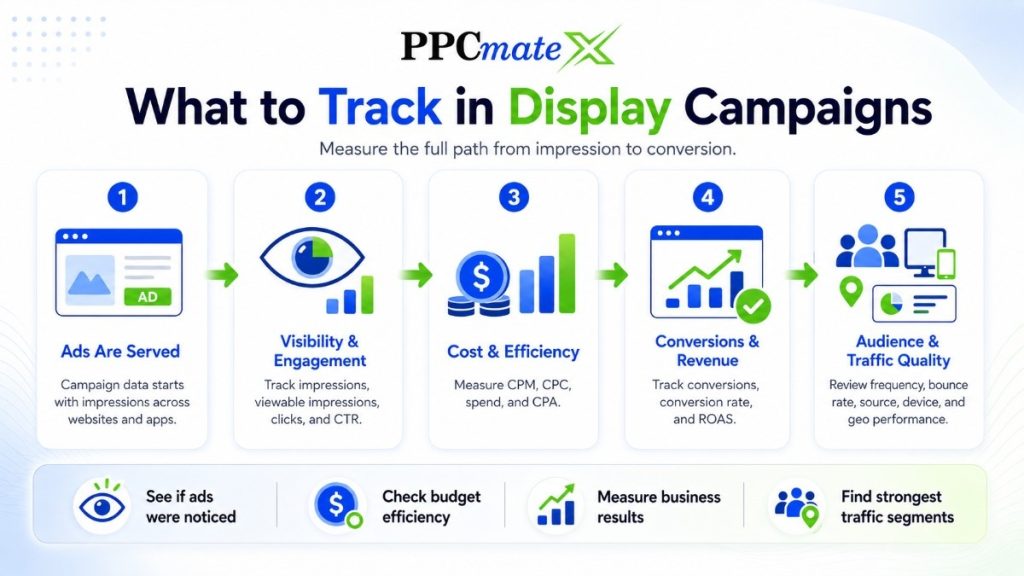
Display campaigns should be measured across the full path from impression to conversion. This gives advertisers a better view of traffic quality.
Useful metrics include several categories rather than a long list of isolated numbers.
Visibility and engagement metrics
These metrics show whether users are seeing and interacting with your ads:
- Impressions
- Viewable impressions
- Clicks
- CTR (click-through rate)
Cost and efficiency metrics
These help measure how efficiently the campaign uses budget:
- CPM
- CPC
- Spend
- CPA (cost per acquisition)
Conversion and revenue metrics
These reveal whether the campaign is generating business results:
- Conversions
- Conversion rate
- ROAS (return on ad spend)
Audience and traffic quality metrics
These help identify where performance is strongest or weakest:
- Frequency
- Bounce rate
- Source performance
- Device performance
- Geo performance
A clear metric setup helps advertisers understand the real value of display advertising, not just the number of ads served.
How to Avoid Display Advertising Mistakes
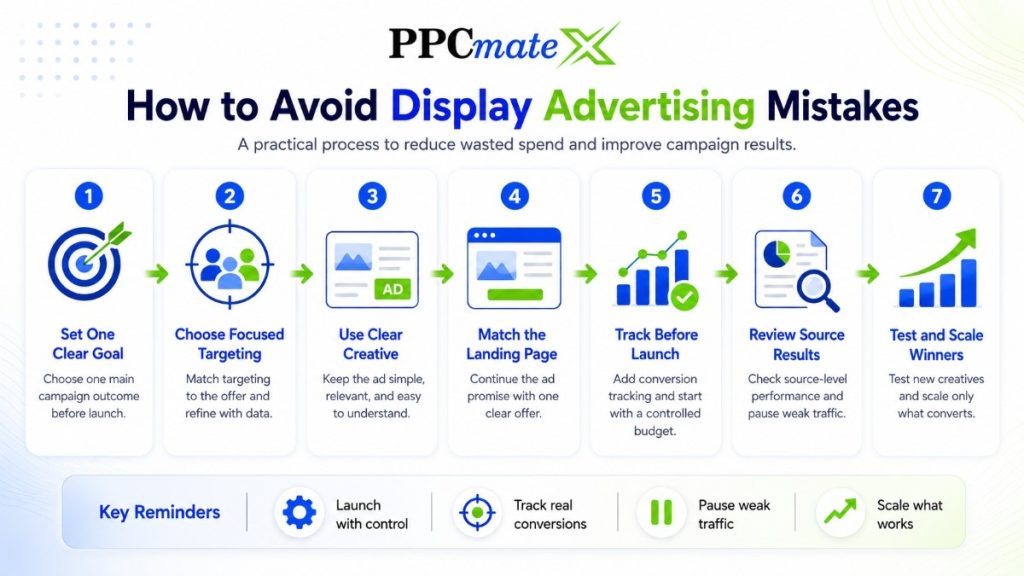
Advertisers can avoid most problems with a simple setup and review process. The goal is to launch with enough control, collect data, and improve based on results.
A practical process includes:
- Set one campaign goal.
- Choose targeting that matches the offer.
- Use clear, simple creative.
- Match the landing page to the ad.
- Add conversion tracking before launch.
- Start with a controlled budget.
- Review source-level results.
- Pause weak traffic.
- Test new creatives.
- Scale only what converts.
This process keeps the campaign focused and reduces wasted spend.
How PPCmate Helps Advertisers Improve Display Campaigns
PPCmate helps advertisers launch, manage, and optimize display ad campaigns from one platform.
Advertisers can use PPCmate to:
- Buy display traffic across websites, apps, and sources
- Control bids and budgets
- Target by geo, device, OS, browser, language, and source
- Test banner and HTML5 creatives
- Track conversions with pixel or postback data
- Review campaign performance
- Use frequency capping and dayparting
- Apply whitelists and blacklists
- Compare display with other programmatic formats
PPCmate also supports broader programmatic campaign buying for advertisers who want more control across multiple traffic types.
Ready to Launch Programmatic Ads With More Control?
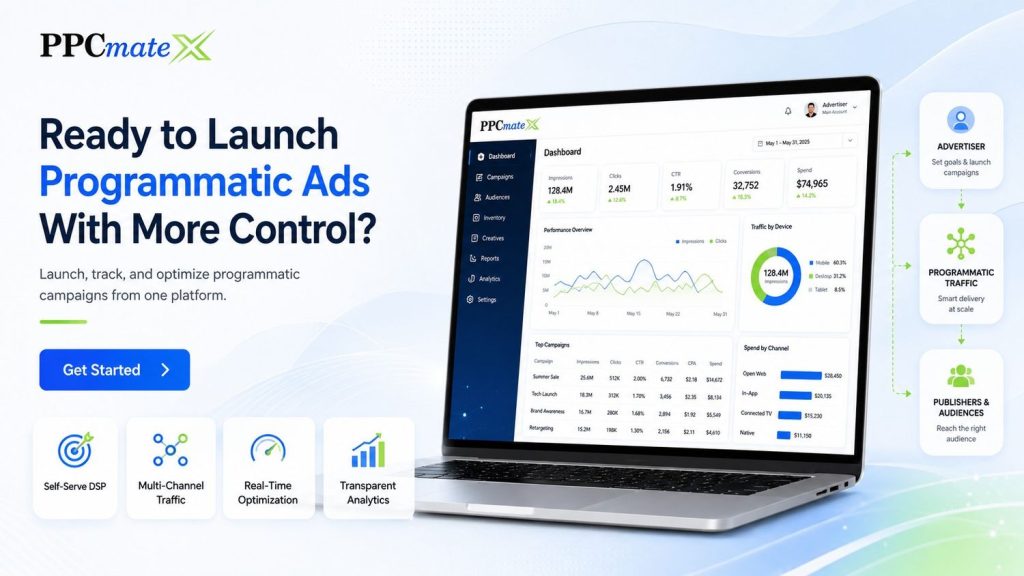
PPCmate gives advertisers a flexible DSP for buying targeted traffic across multiple channels, formats, and pricing models.
Whether you want hands-on self-serve control or managed campaign support, PPCmate helps you launch, track, and optimize programmatic campaigns from one platform.
FAQs
What is the biggest display advertising mistake?
The biggest mistake is launching without clear tracking. Without conversion tracking, advertisers cannot see which sources, creatives, devices, or audiences create real value.
Why do display ads get clicks but no conversions?
This often happens when targeting is too broad, the creative attracts the wrong users, or the landing page does not match the ad message.
Should advertisers use the same creative for every audience?
No. Prospecting, retargeting, mobile, desktop, and cart recovery audiences often need different messages.
How often should display ads be optimized?
Advertisers should review data regularly, but they should avoid making major changes too early. Wait until the campaign has enough clicks, spend, and conversion data to make a fair decision.
Are display ads better for awareness or conversions?
Display ads can support both. Awareness campaigns should focus on reach, viewability, and frequency. Conversion campaigns should focus on CPA, ROAS, source quality, and landing page performance.
How can advertisers reduce wasted display ad spend?
They should track conversions, review source-level results, pause weak placements, improve creatives, control frequency, and scale only the segments that produce results.