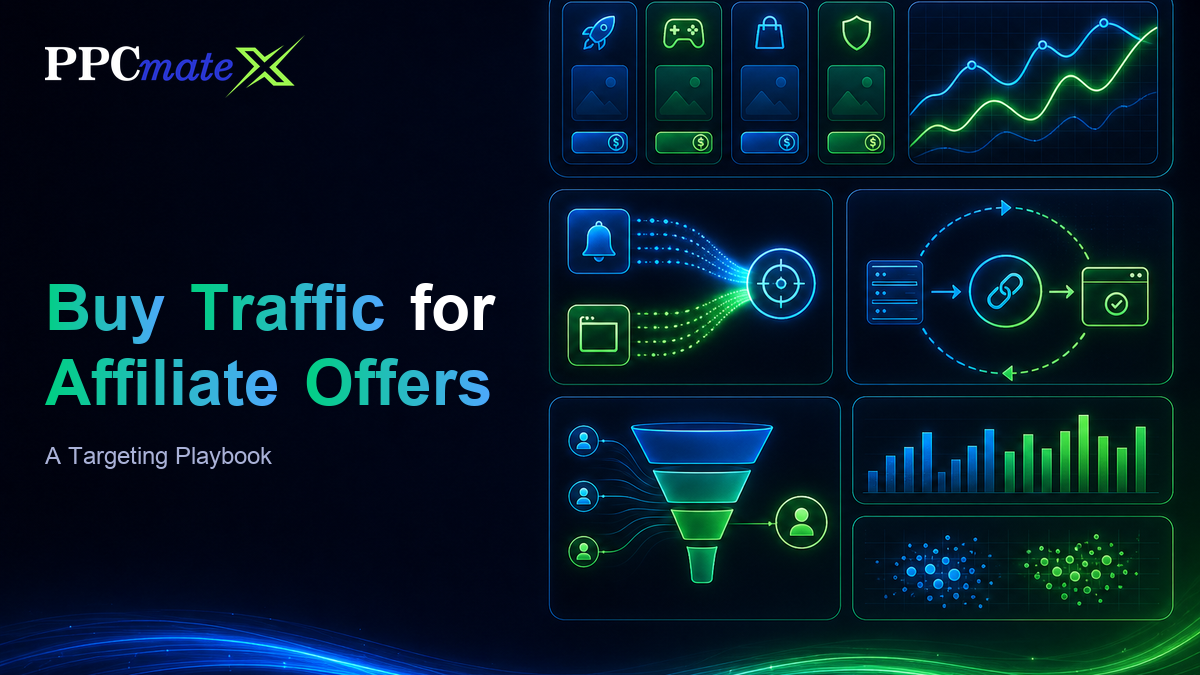
To buy traffic for affiliate offers, pick a traffic source whose audience and ad format match the offer, start with a small test budget on narrow targeting, track every click to a conversion with a postback, and scale only the placements that return a profit. Formats like pop-under and push are popular with affiliates because they are cheap to test and fast to buy, while native and display suit offers that need more pre-selling.
This guide walks through how affiliate traffic sources differ, how to plan a first test, and the mistakes that burn most budgets before an offer ever gets a fair chance.
What “Targeted Traffic” Means For Affiliates
Targeted traffic is not just visitors from the right country. For an affiliate, it means visitors whose device, connection, operating system, time of day and context make them likely to complete the action the advertiser pays for. A mobile subscription offer, a desktop software trial and a sweepstakes lead form each need a different audience, even inside the same country.
Before you spend anything, write down the offer’s real conversion requirements:
- Allowed geos and devices: many offers only pay for specific countries, carriers or operating systems.
- Allowed traffic types: some advertisers forbid pop or push traffic or certain kinds of placements. Breaking these rules usually means unpaid conversions.
- Conversion event: a single-field email submit converts very differently from a credit card trial.
- Payout and approval rate: your break-even cost per click depends on both.
The Main Affiliate Traffic Sources Compared
Most paid affiliate traffic comes from a handful of formats. Each has a different cost profile and suits different offers.
Pop-Under Traffic
A pop-under opens the advertiser’s page in a new window behind the one the visitor is browsing. It is a full-page view with no click required, which makes it one of the cheapest ways to get a landing page in front of people. Pop-under ads work well for simple-flow offers such as sweepstakes, utilities, VPNs, gaming and short lead forms, and for quickly testing whether a landing page converts at all. The trade-off is lower intent, so your landing page has to grab attention immediately.
Push Notification Traffic
Push ads look like system notifications with a title, a short text, an icon and sometimes a large image. Users opted in to receive notifications from a site, and a click opens your page. Push notification ads are a strong fit for mobile offers, finance and insurance leads, e-commerce deals and content-driven funnels. Because the user actively clicks, intent is higher than with pops, but creative fatigue sets in fast, so plan to refresh images and copy often.
Native Ads
Native ads appear as recommended-content widgets on publisher sites. They suit offers that need a pre-sell step, such as an advertorial or quiz, before the offer page. Click costs are usually higher than push, but visitors arrive in a reading mindset.
Display, Video And Search Or Social
Banners, video and HTML5 creatives build reach and work for brand-safe offers. Search and social platforms like Google, Microsoft, Meta and TikTok bring high intent, but they have strict policies, and many affiliate offers are not allowed there at all. Always read the platform policy before planning a campaign.
How To Plan Your First Test Campaign
A disciplined test tells you more for less money than a large, loosely targeted launch. A practical sequence:
- Set up tracking first. Use a tracker or your network’s postback so each conversion is tied back to the click, placement and creative. Without this, you cannot optimize anything.
- Pick one geo and one device type. Mixing countries and devices in one campaign hides what actually works.
- Calculate a test budget. A common rule of thumb is to spend at least two to three times the offer payout per placement or segment before judging it, so a few conversions have the chance to appear.
- Start near the suggested bid. Bidding far below the market often means you only win leftover inventory, which skews your test results.
- Run two or three creatives or landers. Testing one variant at a time is slow; testing ten splits the budget too thin.
- Review data daily. Look at cost per conversion by placement, not just by campaign.
Optimizing: Placements, Bids And Creatives
Once data comes in, optimization is mostly about cutting waste and moving budget to what works.
- Block losing placements. When a source or zone spends well past your threshold with no conversions, block it.
- Whitelist winners. Move proven placements into a separate campaign where you can bid higher and control their budget.
- Adjust by time and device. Many offers convert noticeably better at certain hours or on certain operating systems.
- Refresh creatives. Push and native creatives in particular lose click-through rate as audiences see them repeatedly.
- Watch landing page speed. Slow pages lose many mobile visitors before the page even renders.
Protecting Your Budget From Bot Traffic
Low-quality and bot traffic is one of the biggest hidden costs in affiliate media buying. Warning signs include very high click-through rates with zero engagement, traffic concentrated in data-center IP ranges, and conversions the advertiser later rejects. Ask any traffic source how it filters invalid traffic and whether you are billed for it.
On PPCmate, every request is filtered for bots before bidding, and refused traffic is not billed. That does not replace your own tracking, but it means fraud checks happen before your money is spent rather than after.
Choosing A Platform To Buy From
When comparing self-serve platforms, look at:
- Minimum deposit and pricing: lower entry points make testing new offers less risky. PPCmate starts at a $25 minimum deposit with no subscription, with CPM from $0.10 and CPC from $0.001.
- Format coverage: moving from pop to push to native without opening new accounts saves time. PPCmate offers pop-under, push, native, display, video and HTML5 traffic from one prepaid balance.
- Targeting depth: country, device, OS, browser, connection type and placement-level control.
- Reporting: placement-level stats and conversion tracking support.
- Refund policy: PPCmate offers a 7-day money-back guarantee.
PPCmate also runs Google, Microsoft, Meta, TikTok, Reddit, LinkedIn, YouTube and ChatGPT ads on its own house accounts, so you do not need your own ad accounts. Those platforms’ ad policies still apply, so check that your offer is allowed before choosing them.
Common Mistakes To Avoid
- Judging too early. Pausing after a handful of clicks rarely tells you anything.
- Ignoring offer rules. Sending a forbidden traffic type can void your commissions.
- Scaling too fast. Doubling budget overnight often pulls in weaker placements; increase in steps.
- Direct linking every offer. Some offers need a pre-lander to explain the value; test both.
- Skipping compliance. Misleading creatives get campaigns rejected and accounts flagged.
Matching Offer Verticals To Traffic Types
A quick way to shortlist sources is to think about how much explanation the offer needs and how the visitor will act on it.
- Sweepstakes and simple lead forms: low friction, so broad, cheap formats such as pop-under and push usually get the first test.
- Mobile apps and utilities: push and pop-under on mobile, with tight OS and device targeting, because many app offers only pay for specific platforms.
- Finance, insurance and health leads: these often need trust-building, so native with an advertorial or push with clear, compliant copy tends to fit better. Check advertiser and platform rules carefully, as these verticals are tightly regulated.
- E-commerce and coupons: push and native work well for deals; display and video help with retargeting and reach.
- Software and B2B trials: desktop display, native and search or professional networks such as LinkedIn generally fit better than pop traffic.
These are starting points, not rules. The only reliable answer comes from a tracked test.
Reading Your Numbers Correctly
Three numbers decide whether a campaign lives or dies: cost per conversion, conversion rate on the landing page, and approval rate from the advertiser. Track them per placement and per creative. A campaign can look unprofitable overall while two or three placements inside it are clearly profitable, and the fix is to isolate those rather than pause everything.
Compare CPM and CPC pricing on the same offer too. Pop-under is usually bought per thousand impressions, while push and native are often bought per click. Work out your effective cost per conversion for each, because a cheaper unit price does not always mean a cheaper result.
Finally, write down what you changed and when. Bids, creatives, landers and blocked placements all interact, and a simple change log makes it much easier to see which decision actually moved the numbers.
Start Testing Your Offer
Buying traffic for affiliate offers comes down to matching the format to the offer, tracking everything and letting data decide where the budget goes. If you want to test pop, push and other formats from one balance, you can get started with PPCmate with a $25 deposit.
Frequently Asked Questions
What is the best traffic source for affiliate offers?
There is no single best source. Pop-under suits simple, broad offers and fast landing page tests, push suits mobile and lead offers, and native suits offers that need a pre-sell. Match the format to the offer's audience and rules.
How much budget do I need to test an affiliate offer?
A common rule of thumb is two to three times the offer payout per segment you test. On PPCmate the minimum deposit is $25, so you can run small tests without a subscription.
Is pop-under traffic good for affiliate marketing?
Yes, for the right offers. Pop-under traffic is cheap and gives full-page views, which makes it useful for sweepstakes, utilities, gaming and short forms, but intent is lower than with click-based formats.
How do I track conversions from paid traffic?
Use a tracker or your affiliate network's postback URL so each conversion is linked to the click ID, placement and creative. This lets you block losing placements and scale winners.
Can I run affiliate offers on Google or Meta through PPCmate?
PPCmate runs Google, Microsoft, Meta, TikTok, Reddit, LinkedIn, YouTube and ChatGPT ads on its own house accounts, but each platform's ad policies still apply, and many affiliate verticals are not allowed there.
How do I avoid paying for bot traffic?
Choose sources that filter invalid traffic and do not bill for it, and watch your own data for signs like high CTR with no engagement. PPCmate filters every request for bots before bidding, and refused traffic is not billed.
Should I use a pre-lander or a direct link?
Test both. Direct linking works for simple offers, while a pre-lander helps when the visitor needs context or persuasion before seeing the offer.