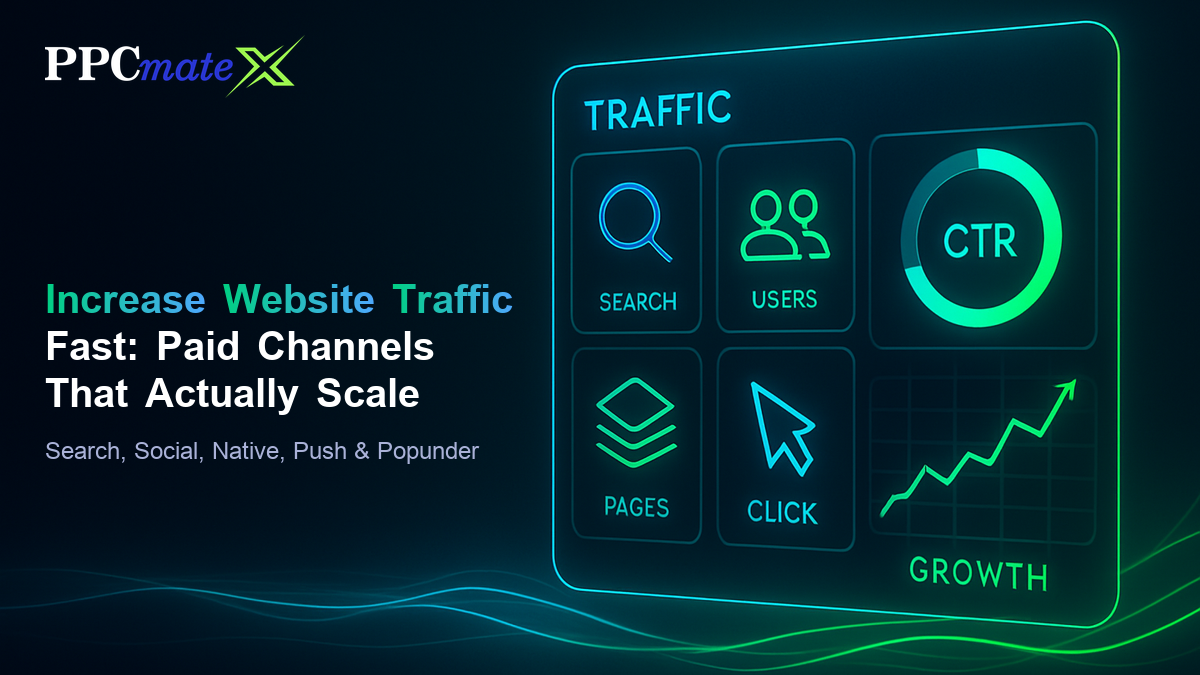
Organic growth is slow by design — it takes months of content and links to move the needle. If you need more visitors now, paid traffic is the lever that actually scales on a timeline you control. The hard part isn’t finding a paid channel; it’s picking the right one for your budget, your offer, and how fast you need results.
Why Paid Channels Are the Fastest Way to Grow Traffic
Organic search rewards patience: new content typically needs weeks to get indexed, crawled, and ranked, and competitive keywords can take much longer. Paid traffic flips that timeline — a campaign can start sending visitors to your site within hours of launch, and you control volume directly by adjusting bids and budget rather than waiting on an algorithm. That control is exactly why paid channels are the standard answer when a business needs traffic fast: for a product launch, a seasonal push, testing a new offer, or simply filling a pipeline that organic alone can’t fill quickly enough.
The tradeoff is that paid traffic has to be bought correctly. Different channels are priced differently (CPC, CPM, or a mix), reach different types of intent, and scale at different speeds. Picking the wrong one for your situation wastes budget before you learn anything useful.
The Paid Channels That Can Scale Your Website Traffic
Search Ads (Intent-Based Clicks)
Search ads place your link in front of people actively typing in a query related to your product or service. Because the visitor already has intent, click quality is usually high — but so is competition: pricing runs on a real-time auction, so cost-per-click rises in crowded, high-value keyword categories, and results depend on ad relevance as much as bid size. Search is a strong fit when you want visitors who are already looking for what you sell, but it’s rarely the cheapest or fastest way to move a large volume of raw traffic.
Social Ads (Interest & Audience Targeting)
Social platforms sell attention based on interests, demographics, and behavior rather than a typed query, billed on a CPM or CPC basis depending on the objective you choose. This makes social ads good for reaching people who don’t yet know they want your product, but it also means more creative testing is usually needed before a campaign finds its winning angle, which slows down how quickly a brand-new account can scale traffic.
Native Ads (Content-Style Placements)
Native ads are styled to match the look and feel of the publisher’s own content — a recommended-articles widget, an in-feed card — rather than standing out as an obvious banner. Billing is typically CPC, and because the ad blends into the page rather than interrupting it, native traffic tends to tolerate broader targeting and higher volume without the same click-fatigue that harsher formats can trigger.
Push Notification Ads (Low-Cost, High-Volume Clicks)
Push ads land directly on a user’s device or browser as an opt-in notification, competing with almost nothing else on the screen for attention. Push is billed on CPC and optimized around CTR and CPA rather than raw impressions, which typically makes it one of the lowest-cost-per-click formats available — a major reason it’s a go-to channel when the goal is volume of clicks per dollar rather than brand storytelling.
Popunder Traffic (Fastest Way to Scale Raw Visits)
Popunder traffic opens a full page behind the user’s active browser window, to be seen the next time they close or minimize it. Billed on CPM, popunder inventory is typically the cheapest way to buy large volumes of website visits, which is why it’s the format most associated with fast, budget-friendly traffic scaling — well suited to testing a new landing page, geo, or offer before committing bigger spend to a higher-intent channel.
Paid Traffic Channels Compared
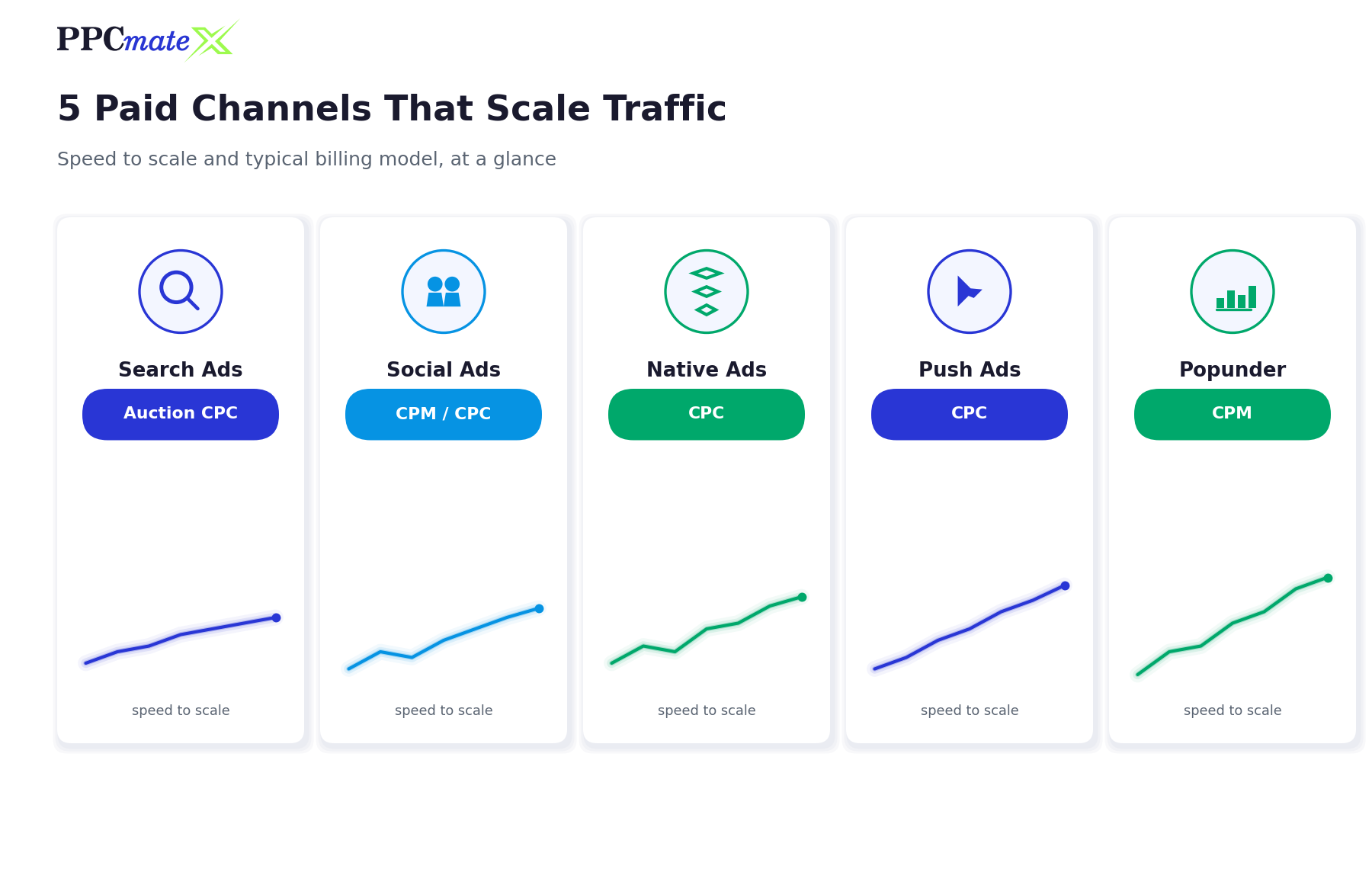
| Channel | Billing Model | Speed to Scale | Best For |
| Search Ads | Auction CPC | Moderate — limited by search volume | Capturing existing intent |
| Social Ads | CPM / CPC | Moderate — needs creative testing first | Brand discovery, interest targeting |
| Native Ads | CPC | Fast — blends into content feeds | Content-style offers, advertorials |
| Push Ads | CPC | Fast — low cost per click | High volume of clicks per dollar |
| Popunder | CPM | Fastest — cheapest volume of raw visits | Testing offers, geos, landing pages |
Which Channel Should You Choose?
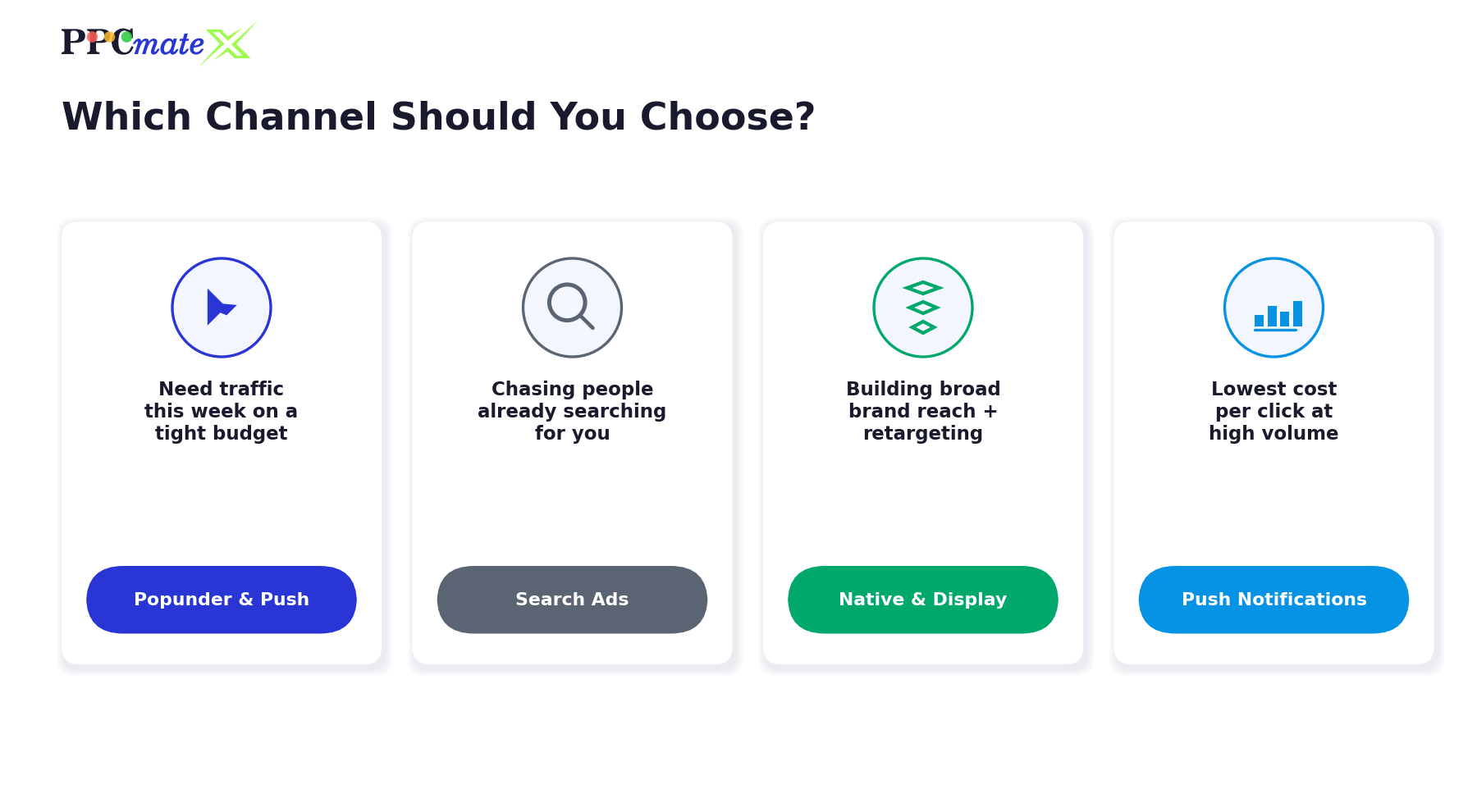
- Choose popunder if you need the largest volume of visits for the lowest cost per visit, or you’re testing a new offer/geo before scaling further.
- Choose push ads if you want a very low cost-per-click and a steady, predictable flow of clicks without heavy creative production.
- Choose native ads if your landing page or offer reads like an article or story and benefits from blending into a content feed.
- Choose social ads if you’re building brand awareness or targeting very specific interests/demographics and can invest time in creative testing.
- Choose search ads if capturing people who are already actively searching for your exact product or service matters more than raw volume.
- Choose a combination if your goal is both fast volume and building a retargeting pool — popunder or push for immediate scale, paired with native or display to keep the brand in front of return visitors.
How to Launch a Paid Traffic Campaign That Scales
- Define the goal before the channel. Raw visits, leads, or sales each point to a different format and a different way of measuring success.
- Start with a small test budget. Run a limited spend across 2-3 geos or audience segments before committing your full budget to one setup.
- Set up conversion tracking first. Use S2S postback tracking (a
{TRACKING_ID}macro passed from click to conversion) so you know which sources actually convert, not just which ones generate clicks. - Layer in targeting. Narrow by geo, device, OS, and connection type once you have early data, rather than targeting broadly forever.
- Set frequency and budget caps. Prevent a single source from burning budget on repeat impressions to the same users.
- Review performance in real time and reallocate. Shift budget toward the sources and creatives producing your cheapest qualified visits, and cut the rest.
Common Mistakes to Avoid
- Picking a channel based on what worked for someone else’s business rather than your own offer and budget.
- Launching with no conversion tracking, so you can’t tell which traffic source is actually worth scaling.
- Spending the full budget on one untested source before running a smaller test across a few options.
- Ignoring frequency capping, which lets a shrinking pool of the same users see (and ignore) the same ad repeatedly.
- Treating “more traffic” as the finish line instead of “more traffic that converts” — volume without a tracked outcome is not progress.
Ready to Scale Your Website Traffic?
PPCmate is a self-serve platform built around popunder and push traffic — the two fastest, lowest-cost-per-visit channels covered above — alongside native, display, and video, with granular geo/device/OS targeting and real-time reporting so you can see what’s working and adjust immediately. Start with a small test budget and scale what performs.
FAQs
What’s the fastest paid channel to increase website traffic?
Popunder traffic is typically the fastest to scale to high volume because it’s billed on CPM and doesn’t require the creative testing cycle that social or native ads usually need before they perform.
How much does it cost to buy website traffic?
Cost depends entirely on the channel, geo, and targeting you choose — CPM formats like popunder are generally the cheapest per visit, while auction-based search ads in competitive categories can cost significantly more per click. Set a test budget first to see real costs in your specific niche.
Is popunder traffic good for increasing website visits fast?
Yes — popunder is one of the highest-volume, lowest-cost-per-visit formats available, which makes it a common choice specifically when the goal is fast, budget-friendly traffic scaling rather than narrow high-intent targeting.
What’s the difference between CPC and CPM when buying traffic?
CPC (cost-per-click) charges only when someone clicks your ad, while CPM (cost-per-thousand-impressions) charges based on how many times the ad is shown regardless of clicks. CPM can move more raw traffic per dollar; CPC ties spend directly to actual visits.
Can I combine multiple paid channels at once?
Yes, and it’s a common strategy — for example, using popunder or push for immediate volume while running native or display in parallel to build a retargeting pool of return visitors.
How quickly will I see more visitors after launching a campaign?
With CPM or CPC-based paid formats, traffic typically starts flowing within hours of a campaign going live, unlike organic strategies which can take weeks or months to produce a measurable increase.
Does buying paid traffic help or hurt my SEO?
Paid traffic itself doesn’t directly boost organic rankings, and it isn’t a substitute for SEO work — but it can indirectly support content and product testing (finding what converts) while your organic strategy builds up separately.
What budget do I need to start buying traffic?
This varies by platform and payment method, but self-serve platforms are generally built to let advertisers start with a modest test budget rather than requiring a large upfront commitment — check the specific platform’s minimum deposit before committing.