
Additionally, you need your ad to accomplish certain things. You want to grab attention, communicate your message clearly and get qualified prospects to click — all while staying within character count limits and other restrictions.
So, how do you write a great text ad? Here are 15 tips for getting it done right.
1. Get the story directly from the client
When we onboard clients, we ask them to complete a new client questionnaire so we can get to know their company better. I always request that they fill out the questionnaire personally and avoid copying and pasting from their company website. There’s simply no substitute for getting the story directly from the client!
Often, a client’s own words give the most accurate and complete description of their products and services. When we write ads, we’ll review their words carefully and often lift phrases and terms for ad messaging.
2. Get into the mind of the target audience
Before you start writing, you want to understand things from the target audience’s perspective. What problems are they experiencing? What are their pain points? How does this product or service solve their problems? What questions might they have about your product?
The answers to these questions will help direct your ad messaging.
3. Make it about your audience, not you
Following on the above point, make your ad copy about your audience, not you. In other words, you want to use (or imply) the word “you” more than “us” or “ours.”
For example, look at these two headlines:
- “XYZ Helicopter Tours – Fly Over the Las Vegas Strip”
- “XYZ Helicopter Tours – We Fly Over the Las Vegas Strip”
The difference is subtle, but ultimately the first one is better than the second because you’re making the searcher the subject (rather than yourself).
4. Include product/service benefits
What makes your product or service awesome? What unique benefits do you bring?
Put these benefits in your ad messaging when relevant to your target audience.
5. Describe how you’re better than the competition
If your ad displays next to competitor ads, how will it compare? It’s never a bad idea to research competitor ads to find out.
You don’t want competitor ads to unduly influence what you write, of course. But knowing how they compare might make clear which product features and benefits to highlight.
6. Think holistically
You must consider the big picture when writing ad copy. That’s why we typically create a messaging roadmap for clients that includes the ad copy and all relevant extensions. This helps you avoid the problem of inadvertently repeating messaging when one or more ad extensions show up.
Some repetition is fine, of course, if it helps you make your point. But if “Get 10% off!” shows up in four different places, it’s not only wasted space, it’s also distracting.
7. Include a call to action
Somewhere in your ad copy, you need to tell visitors what to do, such as “Buy now,” “View now,” “Shop now,” “Learn more” or “Request a quote.”
Make sure your call to action is strong and clear. Use an action verb and include any (legitimate) time constraints, e.g., “Shop today! Sale ends Monday.”
8. Use keywords
Of course, you also need to use keywords in your ad, typically in your first or second headline.
9. Mirror the potential search phrase
Following on the previous point, the closer you can match your ad copy to the users’ search phrase, the better.
So, for example, if people are searching for “office lunch catering Atlanta,” then try putting “office lunch catering in Atlanta” in your ad copy instead of “catering for office lunches in Atlanta.”
10. State your price point (or not)
You’ll need to decide whether or not to include pricing in your ad. If you’ve done your research, and you know that your product or service is price-competitive, then you can include it. (But monitor carefully, in case your competitors drop their prices or have a sale.)
You may also decide to include your price if you have a high-quality, more expensive product and want to discourage bargain-hunting shoppers from clicking on your ad.
11. Include qualifying elements, if applicable
You can also include elements in your ad to qualify prospects. We referenced this in the above point when we discussed using price as a way to discourage price-sensitive shoppers.
But you can also qualify prospects in other ways. For example:
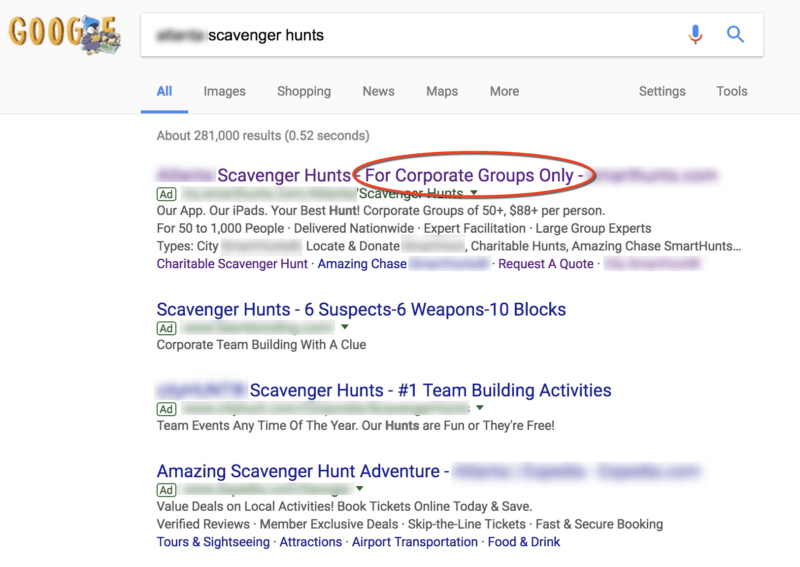
As you can see, the top ad has “for corporate groups only” in the headline.
This makes clear that this particular company doesn’t run scavenger hunts for non-corporate events.
In contrast, the fourth-position ad doesn’t have this kind of qualifier. So if you’re looking for a scavenger hunt for a school group, you might click on this ad. But I happen to know that this company only runs scavenger hunts for corporate clients. So they might get ad clicks from groups they don’t serve.
And the company in second position? Well, I’m not sure what “6 Suspects-6 Weapons-10 Blocks” means. But it sounds a little scary!
12. Craft your headlines carefully
When it comes to paid search ad copy, headlines are king. Your description line, display URL and ad extensions only exist to complement the headlines. So write them carefully and thoughtfully.
13. Copy if you want
Unlike in high school, it’s okay to copy here! If your clients have existing taglines or other marketing copy that looks good, then by all means, use it in your ad.
14. Have someone else proofread
If you’re the person who conceived and wrote an ad, you shouldn’t be the one proofing it. In fact, the more eyes you can get on an ad before it goes live, the better.
At Group Twenty Seven, we’ve built proofing into our processes. A PPC associate will craft the ad. The team lead will review it. Then, we’ll review the ad with our client for approval.
With this process, we have three opportunities to catch errors.
15. Test, and then test again
Even if you think you’ve arrived at the perfect ad, it’s always wise to create another two or three, and then test to see how they perform.
As described in the AdWords help file:
Create three to four ads for each ad group, and use different messages for each to see which does the best. AdWords rotates ads automatically to show the best-performing ads more often.
What are your tips for creating awesome ad copy?
Even the most stellar PPC program can’t survive bad text ads. You have to get them right.
But by following the 15 tips outlined above, you’re much more likely to write text ads that grab attention, communicate your message clearly and get qualified prospects to click.
__
by Pauline Jakober
Source: searchengineland.com